Why the US GEO Market Is Accelerating in 2026
The US GEO market hit $365 million in 2026 and is projected to reach $9.09 billion by 2035 — a 42.9% compound annual growth rate driven by enterprises and SMBs racing to capture AI search visibility (Dimension Market Research, 2026). ChatGPT now holds 60.2% of the US AI chatbot market and drives 71.04% of all AI referral traffic to US websites (First Page Sage, April 2026; SE Ranking, 2025).
Key Takeaways
- ChatGPT converts US visitors at 15.9% — 9x Google organic's 1.76% (Seer Interactive, 2025).
- Pages optimised for fanout queries earn 161% more AI citations (Ekamoira Research, Jan 2026).
- 68% of AI-cited pages don't appear in Google's traditional top 10 — your SEO rank doesn't determine your GEO rank (Ekamoira, 2026).
- US GEO market grows at 42.9% CAGR, reaching $9.09 billion by 2035 (Dimension Market Research, 2026).
- Only 11% of domains are cited by both ChatGPT and Perplexity — you need to optimise for both (Digital Bloom, 2025).
ChatGPT referral traffic converts at 15.9% versus Perplexity at 10.5% and Google organic at 1.76% (Seer Interactive, June 2025). These aren't marginal differences. AI-referred users arrive pre-qualified by a trusted intermediary — further along in their research and more ready to act. The right GEO tool gives you the visibility data to capture that conversion premium systematically.
What Are Fanout Queries — and Why They Change GEO Strategy
Pages covering the full range of fanout sub-queries are 161% more likely to earn AI citations — with a Spearman correlation of 0.77 between fanout coverage and AI Overview citation frequency (Ekamoira Research, analysis of 173,902 URLs, January 2026). This is the most underappreciated concept in GEO today. Traditional SEO optimises for one query. AI search optimises for dozens.
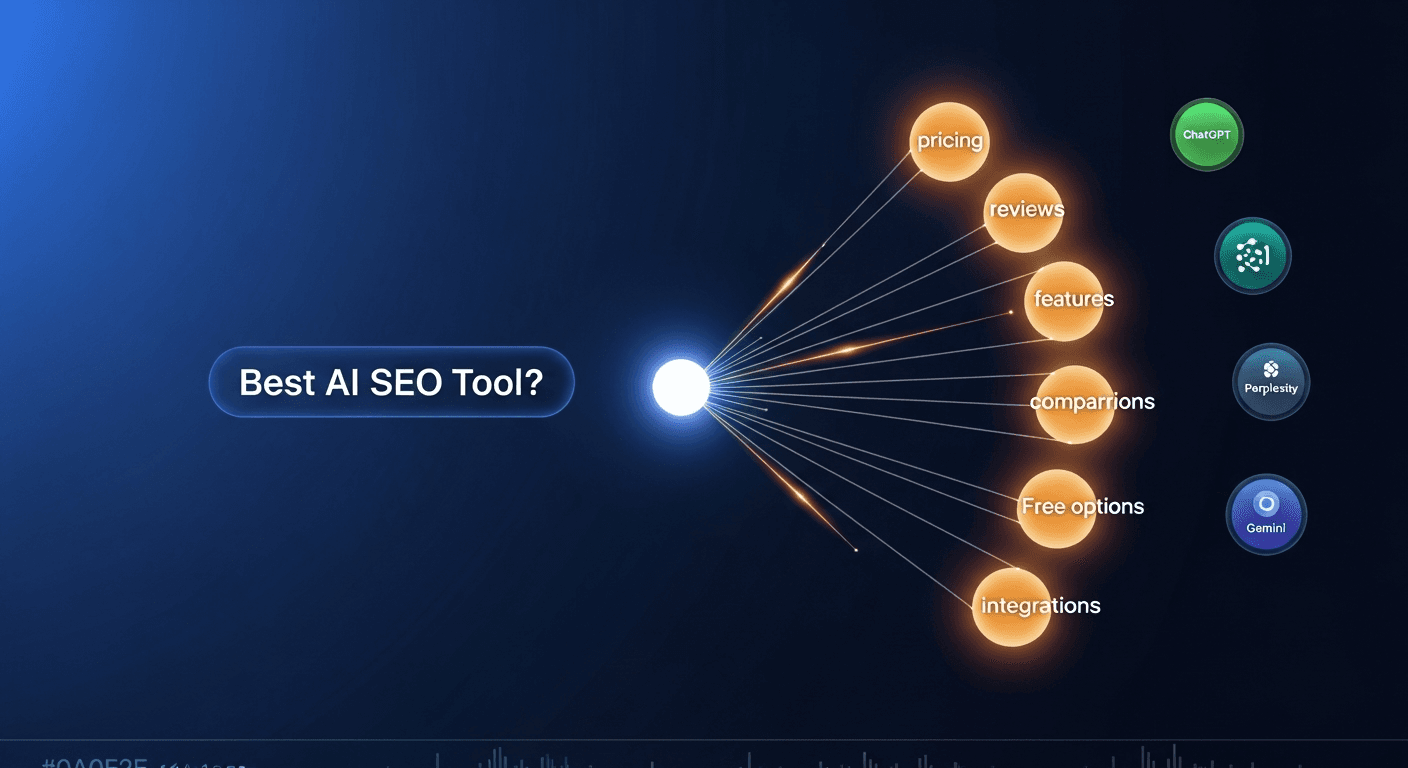
Query fanout is the process by which AI search engines decompose a single user question into multiple sub-queries to retrieve comprehensive source material. When someone asks 'What's the best project management tool for remote teams?', Google's AI Mode may split that into up to 11 simultaneous sub-queries — covering pricing, features, reviews, comparisons, free options, and integrations (documented by Google, via Superlines, September 2025). Each sub-query retrieves different pages. The AI synthesises the best sources into one answer.
The problem for US brands
ChatGPT triggers a web search on only 31% of queries and averages just 2 sub-queries when it does (Nectiv, analysis of 8,500+ prompts, 2025). The sub-queries that do fire are dynamic — only 27% remain consistent across repeated searches (Surfer SEO, December 2025). Brands optimising purely for traditional SEO miss approximately 88% of AI citation opportunities because their content doesn't cover the full sub-topic range AI systems probe (Ekamoira, 2026).
Fanout optimisation changes how you build content. Instead of targeting one keyword per page, you need content that addresses the primary query and the 5-10 most likely sub-queries an AI will generate around that topic. Comprehensive content isn't a stylistic choice — it's the architecture AI citation requires. The right GEO tool helps you identify exactly which sub-queries you're missing.
Best GEO and AI SEO Tools for US SMBs in 2026
Yozigo — Best for Dedicated AI Visibility Monitoring. Purpose-built for Generative Engine Optimization, Yozigo tracks brand citation frequency across ChatGPT, Perplexity, Google Gemini, and Claude in real time. Its Share of Model metric — the percentage of relevant AI queries where your brand is cited — is the GEO equivalent of keyword ranking. The Citation Dominance dashboard shows which competitor is capturing your citation slots and why. Ideal for US SMBs wanting dedicated GEO intelligence without enterprise-level overhead.
SE Ranking — Best All-in-One Value. At $44/month base with an AI Visibility Tracker add-on from $99/month, SE Ranking covers traditional SEO plus citation tracking across AI Overviews, Google AI Mode, ChatGPT, Perplexity, and Gemini. Its 'No Cited' competitor gap feature surfaces which queries competitors are getting cited for that you're not — a fast starting point for fanout gap analysis.
Search Atlas — Best for US SMBs Scaling Into GEO. Winner of 'Best AI Search Software Solution' at the Global Search Awards 2025, Search Atlas's QUEST LLM Visibility Tracker monitors citations across ChatGPT, Gemini, AI Mode, Perplexity, Copilot, and Grok — the broadest multi-LLM coverage at the SMB price point. Its OTTO AI autopilot handles routine GEO tasks. At $99-$199/month, it brings enterprise-grade AI coverage at accessible pricing.
Moz Pro — Best Budget Entry Point. At $49-$99/month, Moz Pro's AI Overviews by Keyword (open beta) and Brand Authority Score offer the lowest-cost entry into GEO monitoring. It doesn't yet provide direct ChatGPT or Perplexity citation tracking, but for bootstrapped US teams starting with Google AI Overview coverage, it's a sensible first step.
SpyFu — Best for Competitor Intelligence. SpyFu GPT tracks brand visibility across 250 million LLM questions. Its RivalFlow AI identifies content gaps your competitors exploit — particularly useful for fanout query gap analysis. At $39-$119/month, it's the budget-friendliest option for US SMBs prioritising competitor-driven content strategy.
Best Enterprise GEO Platforms for US Teams
Enterprise GEO requirements differ fundamentally from SMB needs. US enterprise teams need multi-user workflows, custom AI model querying at scale, API integrations with existing martech stacks, and executive dashboards tracking AI visibility across thousands of keywords. Three platforms lead the enterprise field.
BrightEdge AI Catalyst — Best for Enterprise GEO Intelligence. BrightEdge continuously analyses AI-generated responses across ChatGPT, Perplexity, Gemini, and Copilot to identify which brands and content types are being cited. Its Share of Voice in AI metric benchmarks your visibility against competitors at scale. Typically $30,000+/year. Best for: large US enterprises with dedicated SEO teams and content operations at scale.
Conductor — Best for Integrated Content Marketing Workflows. Conductor produced the definitive 2026 AEO/GEO Benchmarks Report, analysing 13,770 domains and 21.9 million searches. Its citation tracking covers ChatGPT, Perplexity, AI Overviews, and Claude, with strong CMS integration and editorial workflow automation. Enterprise pricing on request. Best for: large content marketing teams needing GEO built into their editorial process.
Ahrefs Enterprise — Best for Authority-First GEO. Ahrefs Brand Radar tracks AI brand mentions across ChatGPT, Gemini, Perplexity, and Copilot using 300 million search-backed prompts. Research by The Digital Bloom established that brand search volume — not backlinks — is the single strongest predictor of LLM citations (correlation 0.334). Ahrefs remains the definitive tool for building the domain authority driving that metric. Enterprise plan $14,990/year.
Semrush One AI Toolkit — Best for Teams in the Semrush Ecosystem. Semrush's AI Visibility Toolkit tracks brand across ChatGPT, Perplexity, Gemini, and AI Overviews with custom prompts. ContentShake AI assists GEO content creation. For teams already using Semrush for traditional SEO, the AI add-on ($99/domain/month standalone) eliminates switching costs. Enterprise plans from $549/month.
How to Optimize for Fanout Queries Using These Tools

Only 11% of domains are cited by both ChatGPT and Perplexity — the two platforms use fundamentally different source selection algorithms (The Digital Bloom, analysis of 680 million+ citations, 2025). Fanout optimisation isn't just about covering sub-topics; it's about building content structured for each platform's distinct citation criteria.
Step 1 — Map your fanout landscape
Use your GEO tool's competitor citation analysis — SE Ranking's 'No Cited' gap feature or Search Atlas's QUEST tracker — to identify which sub-queries around your primary topic are generating competitor citations you're not capturing. These gaps are your fanout content priorities.
Step 2 — Build sub-query coverage pages
For each identified gap, create a dedicated page or add a comprehensive section to an existing pillar. Content reaching a cosine similarity score above 0.88 with the target sub-query achieves a 7.3x citation rate advantage (Ekamoira, January 2026). Your GEO tool's content scoring should reflect this threshold.
Step 3 — Format for multi-platform citation. Listicles and comparison content represent 32.5% of all AI citations — the single highest-performing format (Surfer SEO, December 2025). Including specific statistics boosts AI visibility by up to 25%. For each fanout sub-query page: lead with a stat-backed answer, include at least one comparison element, and structure sub-sections to answer the most likely follow-on questions.
Step 4 — Monitor citation distribution
Track which pages are cited across which platforms for which queries. Sites appearing on 4+ platforms are 2.8x more likely to appear in ChatGPT responses (Digital Bloom, 2025). Systematic multi-platform monitoring reveals where your fanout coverage still has gaps — and where your next content investment should go.
How to Build Your US GEO Stack in 2026
The right GEO stack for a US brand depends on three variables: team size and technical maturity, budget, and whether you want a purpose-built GEO platform or an all-in-one SEO suite with GEO features.
For US SMBs under 50 employees
Start with SE Ranking Essential ($44/month) for traditional SEO plus AI Overview monitoring, and add Yozigo for dedicated LLM citation tracking. Total stack: under $200/month. Avoid enterprise analytics capabilities you won't use for at least 12 months.
For US mid-market teams (50-500 employees): Search Atlas Growth ($199/month) handles multi-LLM citation tracking and content optimisation in one platform. Pair with Ahrefs Standard ($249/month) for authoritative backlink intelligence. Under $500/month total, covering both authority-building and content-optimisation dimensions of GEO.
For US enterprise teams
BrightEdge or Conductor for AI citation intelligence, integrated with your existing SEO stack. Budget $30,000-$100,000/year for enterprise GEO tooling. Non-negotiable feature: citation-level data — which specific pages are cited, by which AI engine, for which queries. Tools providing only aggregate 'AI mentions' won't deliver the operational intelligence enterprise teams need.
Whatever your tier, the most critical evaluation question is the same: can the tool show you which sub-queries around your target topics are generating competitor citations you're missing? Without that fanout gap visibility, you're building GEO strategy without a map.