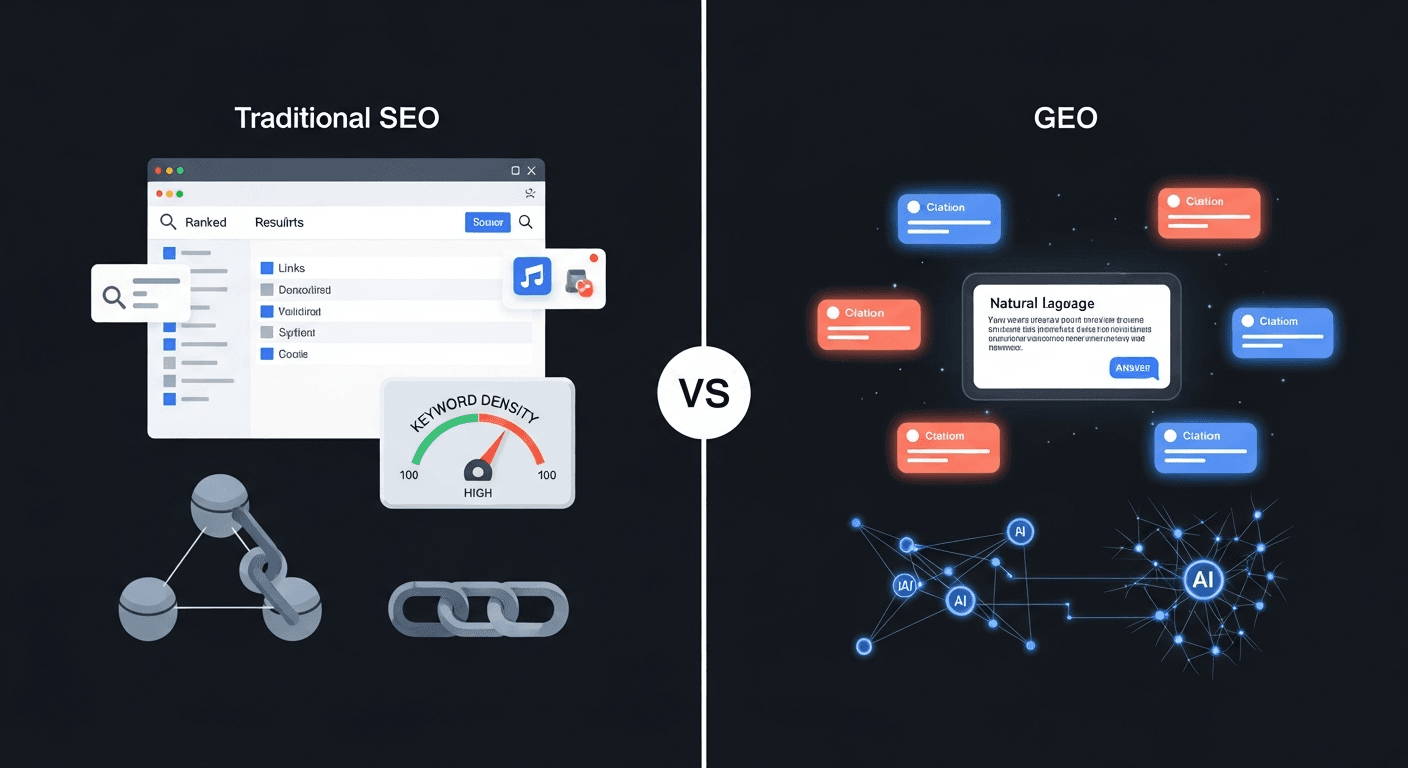
The Search Landscape Has Changed
For two decades, SEO meant one thing: rank on Google's first page. Then AI search traffic started growing 165 times faster than traditional organic (Ahrefs / Graphite, 2025–2026). ChatGPT reached 900 million weekly active users by January 2026. Users aren't clicking ten blue links anymore — they're asking AI models a question and getting a single synthesized answer.
Key Takeaways
- AI search traffic grows 165x faster than traditional organic (Ahrefs/Graphite, 2026).
- ChatGPT drives 87.4% of all AI referral traffic to websites (Semrush, March 2026).
- ChatGPT visitors convert at 15.9% — 9x higher than Google organic's 1.76% (Seer Interactive, 2025).
- GEO techniques boost AI citation visibility by up to 40% (Princeton University, ACM KDD 2024).
- 44% of AI prompts currently return zero brand mentions (BrightEdge, 2025).
If your brand isn't cited in that AI answer, it simply doesn't exist for that user. That's the gap GEO is designed to close.
Core Difference: Links vs. Citations
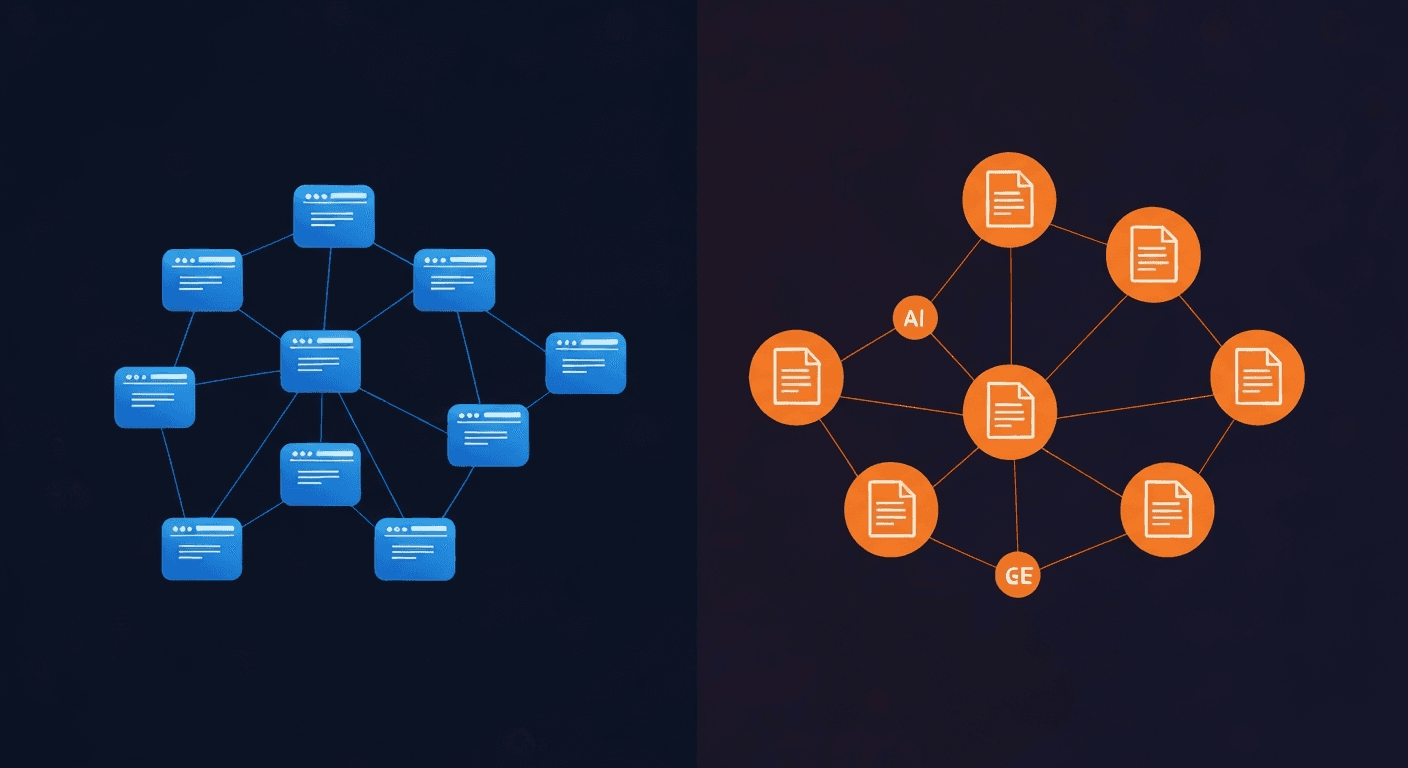
Google's algorithm uses incoming links as a proxy for authority. The more high-quality sites that link to yours, the higher you rank. AI models work differently. They select content based on how definitively it answers a query, the perceived authority of the source domain, how recently the content was updated, and how clearly key information is structured for extraction.
Generative Engine Optimization (GEO) is the practice of structuring content so AI models select it as a citation source. A Princeton University study published at ACM KDD 2024 found GEO techniques boost AI citation visibility by up to 40% — this is a measurable, optimizable discipline, not guesswork.
ChatGPT cites only 15% of the pages it retrieves during search — 85% of sources accessed never appear in the final response (AirOps, 2026). That selectivity means how your content is formatted and where your key answer appears matters enormously. A well-structured page with a clear answer in the first 150 words gets cited far more often than a keyword-dense page with the answer buried in section 4.
How Google SEO and GEO Signals Compare
Traditional SEO and GEO share foundational signals. Domain authority, content quality, and technical site health matter in both. But the optimization emphasis diverges significantly.
For Google
keyword placement in titles and headers, backlink profile, page speed, and Core Web Vitals drive rankings. For AI models: where the key answer appears on the page is paramount — 44.2% of ChatGPT citations originate from the first 30% of a webpage (ALM Corp analysis of 1.2 million ChatGPT responses, February 2026). Content depth also signals quality: articles over 2,900 words average 5.1 AI citations, versus 3.2 for articles under 800 words (SE Ranking, 2025).
The biggest practical difference is formatting philosophy. GEO rewards answer-first content — clear, factual, extractable answers placed early. Traditional SEO rewarded keyword-dense headers and deep content hierarchies. Writing answer-first content doesn't hurt Google rankings. It significantly improves AI citation frequency. These goals are more aligned than most marketers assume.
Does Traditional SEO Still Matter?
Yes. Google processes roughly 8.5 billion searches per day — far more than AI chat platforms combined. Traditional SEO remains essential for near-term traffic volume. The more accurate framing isn't 'SEO vs. GEO' — it's 'SEO plus GEO.'
High domain authority, built through good SEO practices, is the strongest single predictor of AI citation frequency. SE Ranking's analysis of 216,524 pages found sites with 32,000+ referring domains averaged 5.6 ChatGPT citations per page, versus 1.6 for sites with under 2,500 referring domains (SE Ranking, 2025). Link building still feeds directly into GEO performance.
What's shifting is the mix. AI search traffic grew 165x faster than organic in 2025–2026 (Ahrefs / Graphite). Brands investing only in traditional SEO are optimizing for a shrinking share of the discovery market. The smart play is to strengthen both simultaneously — and most GEO improvements reinforce SEO performance rather than conflict with it.
How to Pivot to GEO Without Starting Over
Most GEO improvements work on existing content. You don't need a full content overhaul — you need strategic edits to your highest-traffic pages.
Start with answer-first formatting. Rewrite the first 150 words of your key pages to state the main finding, include a sourced statistic, and answer the reader's question directly. That's where 44.2% of AI citations originate (ALM Corp, February 2026). Then add citation capsules — 40-60 word self-contained passages that state a claim, include data with a named source, and read as a complete thought. Place two to three per page.
Update freshness signals. Content reviewed within three months earns 67% more ChatGPT citations than stale pages (SE Ranking, 2025). Add a 'last updated' date, refresh statistics older than 12 months, and republish. Monitor your AI presence across ChatGPT, Gemini, Claude, and Perplexity — tracking both citation rate and mention rate — so you can measure GEO performance alongside your existing SEO dashboards.
Measuring GEO Success vs. SEO Rankings
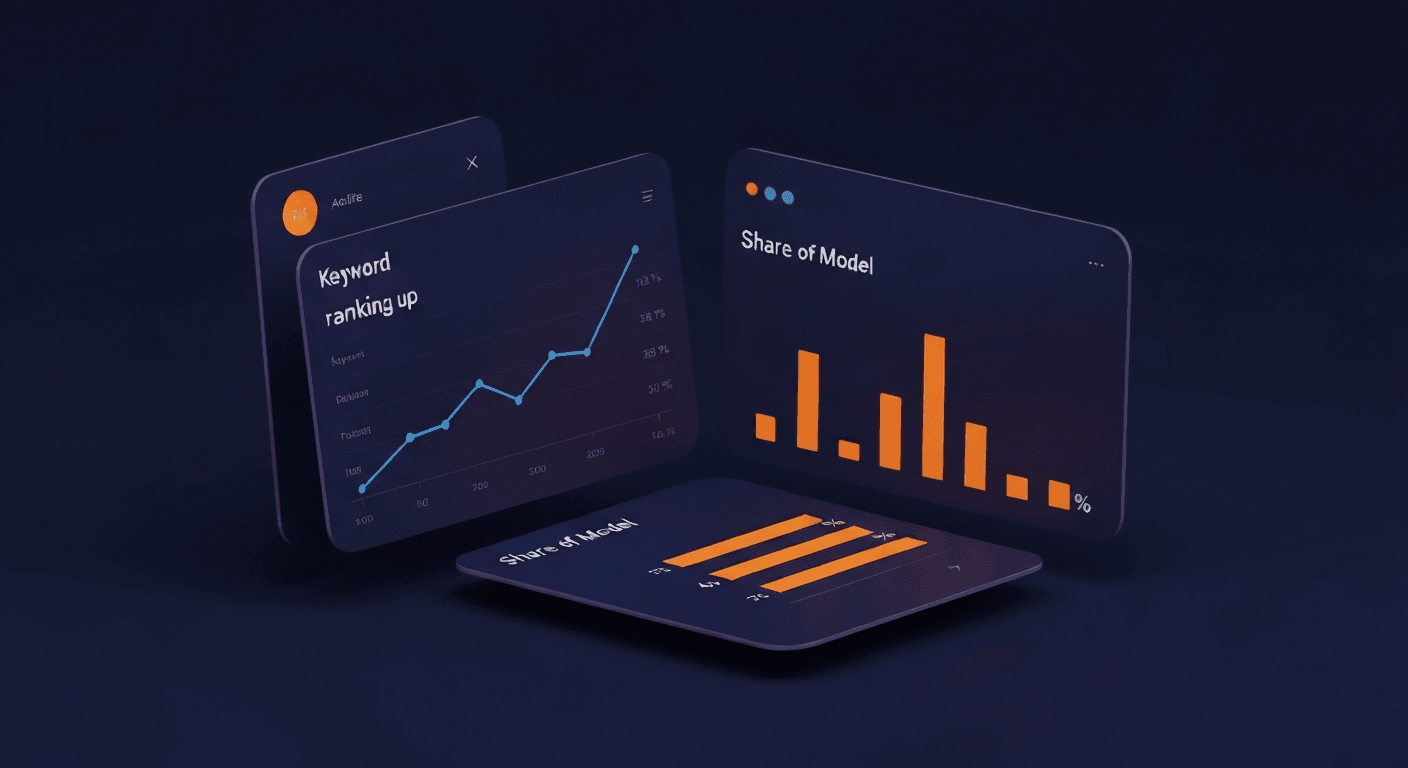
Traditional SEO measures keyword ranking positions and organic traffic. GEO uses a different primary metric: Share of Model (SoM) — the percentage of relevant AI queries where your brand is cited or mentioned. ChatGPT drives 87.4% of all AI referral traffic (Semrush, March 2026), making Share of Model the essential leading indicator for AI-era brand performance.
Key metrics to track
citation rate (percentage of AI responses that cite your URL), mention rate (percentage that name your brand without a link), Share of Model by topic cluster, and trend direction over 30 and 90-day windows.
BrightEdge data shows 44% of prompts return zero brand mentions — even in categories with many active competitors. If you're not tracking Share of Model, you have no visibility into whether GEO is working. Run 10 to 20 relevant queries weekly in ChatGPT Search mode, log when your brand appears, and compare against competitors. That baseline is where GEO improvement starts.
Frequently Asked Questions
GEO and SEO Work Best Together
The shift from traditional SEO to GEO isn't an either/or decision. It's an expansion. The fundamentals — strong domain authority, comprehensive content, technical site health — underpin both disciplines.
What GEO adds is a formatting layer and a measurement shift. Answer-first content, citation capsules, brand footprint ownership, and content freshness are the specific levers that move AI citation frequency. None of these require abandoning what's already working in SEO.
The brands that act now have a real first-mover advantage. AI models learn from the sources they cite most — and the sources cited most often today become the default authorities tomorrow. Start with your top 10 pages, apply answer-first formatting, and measure your Share of Model. That's how a GEO strategy compounds over time.