Why ChatGPT Brand Visibility Matters in 2026
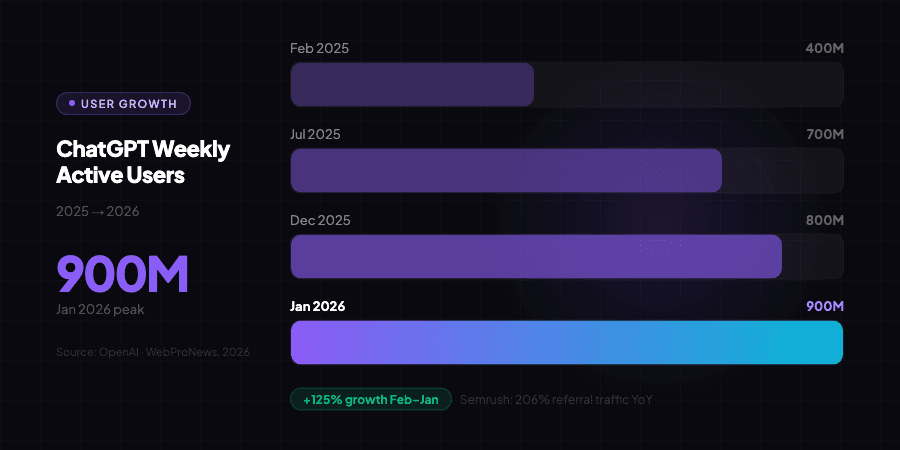
ChatGPT reached 900 million weekly active users in January 2026 — up from 400 million just eleven months earlier — making it one of the fastest-growing platforms in internet history (Sam Altman via WebProNews, Jan 2026). For brands, this isn’t just a headline: ChatGPT now drives 87.4% of all AI referral traffic to websites, with outbound clicks growing 206% year-over-year (Semrush clickstream analysis of 200 million users, March 2026).
Key Takeaways
- ChatGPT cites only 15% of the pages it retrieves — 85% never appear in the response (AirOps, 2026).
- 44.2% of citations come from the first 30% of a page’s content (ALM Corp analysis of 1.2 million ChatGPT responses, Feb 2026).
- Sites with 32,000+ referring domains get 3.5x more citations than low-authority sites (SE Ranking, 2025).
- 86% of all AI citations come from brand-managed sources (Yext, analysis of 6.8 million citations, 2025).
- ChatGPT traffic converts at 15.9% — roughly 9x higher than Google organic’s 1.76% (Seer Interactive, June 2025).
The conversion case is compelling. While ChatGPT sends far less traffic than Google, one case study found ChatGPT visitors converted at 15.9% compared to just 1.76% for Google organic — roughly 9x higher (Seer Interactive, June 2025). These are users who already trust the AI’s recommendation when they arrive on your site.
There’s a gap most brands overlook, however. ChatGPT mentions brands 3.2x more often than it cites them as sources, averaging 2.4 mentions per prompt but only 0.74 citations (BrightEdge, 2025). Meanwhile, 44% of prompts return zero brand mentions at all. Closing this gap — from invisible to mentioned, from mentioned to cited — is exactly what GEO optimization is about.
How ChatGPT Decides Which Brands to Cite
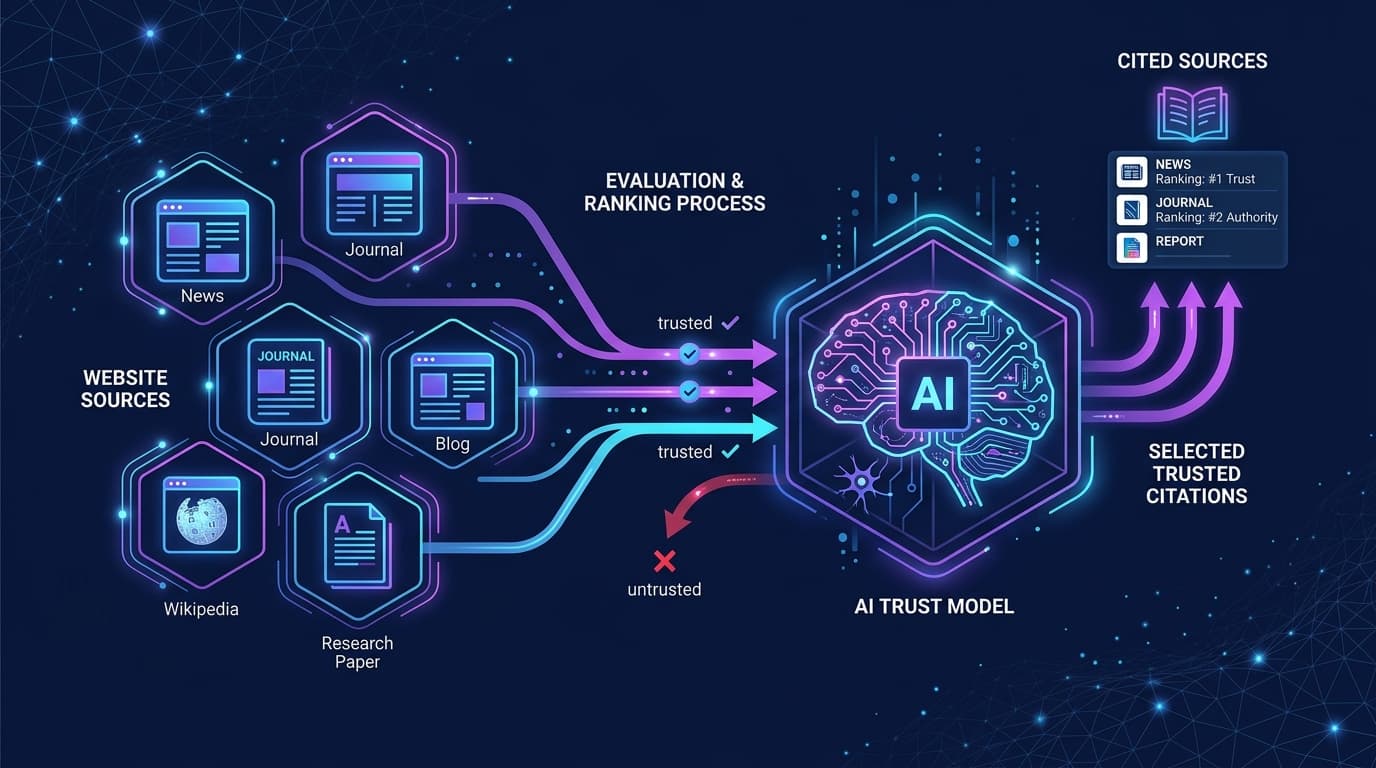
ChatGPT cites only 15% of the pages it retrieves during a search — 85% of sources accessed are never referenced in the final response (AirOps, 2026). Selection is governed by four factors: domain authority, content positioning, content recency, and the breadth of your brand’s digital footprint.
Generative Engine Optimization (GEO) is the practice of structuring your content so AI models select it as a citation source. Unlike traditional SEO — which targets Google’s ranking algorithm — GEO targets the retrieval and selection criteria of large language models. A peer-reviewed Princeton University study published at ACM KDD 2024 found that GEO techniques can boost content visibility in generative engine responses by up to 40%.
ChatGPT’s search component uses Bing’s index to retrieve candidate pages based on semantic relevance, then selects citations based on how definitively a page answers the query, the perceived authority of the source domain, how recently the content was updated, and how clearly the information is structured for extraction. Optimizing all four of these vectors is the core GEO playbook.
Step 1: Build the Domain Authority ChatGPT Favors
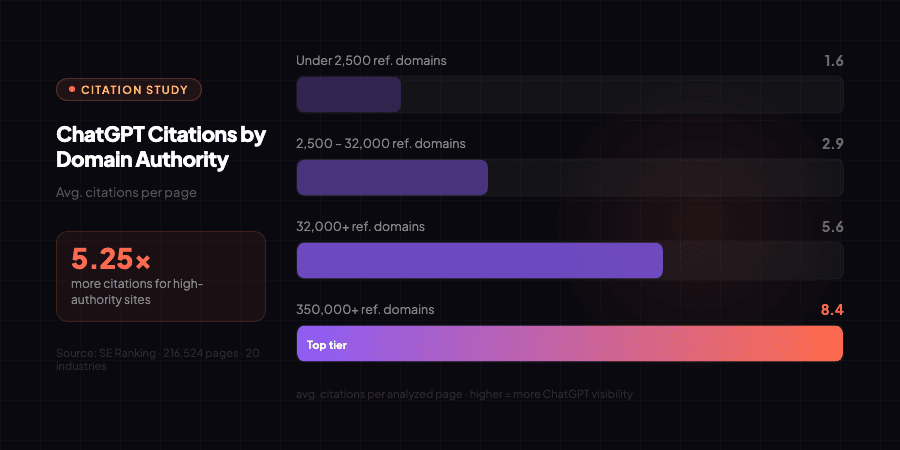
Domain authority is the strongest single predictor of ChatGPT citations. An SE Ranking analysis of 216,524 pages across 20 industries found that sites with more than 32,000 referring domains averaged 5.6 ChatGPT citations per page — versus just 1.6 citations for sites with under 2,500 referring domains. Sites with 350,000 or more referring domains averaged 8.4 citations per page (SE Ranking, 2025).
Building GEO authority differs from traditional link building. The priority is co-citation: being mentioned alongside recognized industry leaders in the same articles, studies, or expert roundups. When authoritative publications reference your brand in the same sentence as established names, AI models learn to associate you with credibility in that domain.
Practical tactics for building GEO authority: publish original research with unique data points that journalists and bloggers cite back to you; contribute expert quotes to industry publications; earn features on Wikipedia, Wikidata, and trusted vertical directories. Each mention in an authoritative source trains AI models to treat your brand as a legitimate reference — not just a website.
According to SE Ranking’s analysis of 216,524 pages across 20 industries, sites with over 32,000 referring domains receive an average of 5.6 ChatGPT citations per page — 3.5 times more than low-authority sites at 1.6 citations. Domain authority, measured by referring domain count, is the most consistent predictor of AI citation frequency (SE Ranking, 2025).
Step 2: Structure Your Content for Maximum Citations

Where your answer appears on the page matters as much as the answer itself. An analysis of 1.2 million ChatGPT responses and 18,012 verified citations found that 44.2% of all ChatGPT citations originate from the first 30% of a webpage — the introduction and early body sections (ALM Corp / Kevin Indig, February 2026, statistical significance P = 0.0).
The implication is direct
every page targeting AI citation should open with a clear, factual, self-contained answer. This is the answer-first format. Don’t bury your conclusion in the final section — state it in the first 150 words. Include a specific statistic, name your source, and make the key finding extractable without reading the rest of the page.
Content depth also signals quality to AI models. SE Ranking’s same study found that articles over 2,900 words averaged 5.1 ChatGPT citations versus only 3.2 for articles under 800 words. Long-form, comprehensive coverage — not keyword stuffing — is what AI models interpret as authoritative treatment of a topic.
Structural elements that increase citation probability include FAQ sections marked up with FAQ schema, numbered step-by-step guides, definition blocks answering ‘What is X?’, and data tables. ChatGPT’s retrieval system extracts structured answers; the clearer your content hierarchy, the easier it is to extract and cite.
Write citation capsules throughout your content: 40- to 60-word self-contained passages that state a claim, provide supporting data, and name a source — all in one extractable block. AI models prefer to cite passages they can quote without needing the surrounding context. Distribute two to three of these per page for maximum AI citation readiness.
Step 3: Own Your Brand’s Digital Footprint
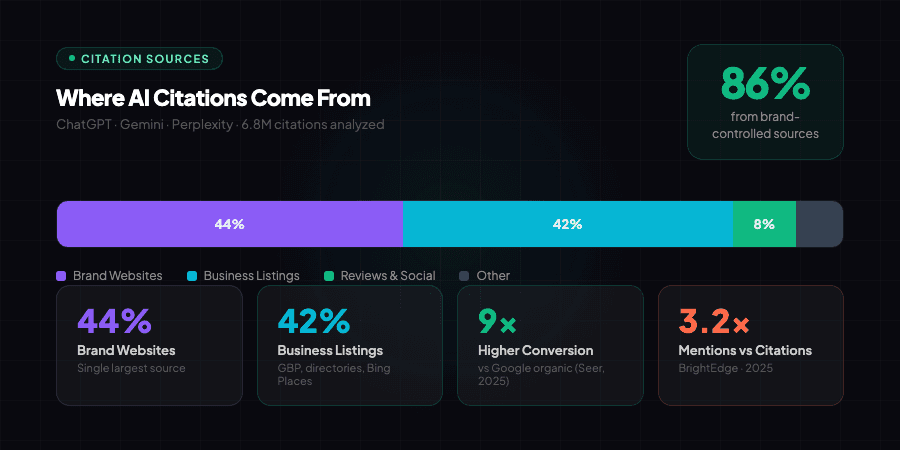
86% of all AI citations across ChatGPT, Gemini, and Perplexity come from sources brands already control — 44% from brand websites and 42% from business listings (Yext, analysis of 6.8 million citations across 1.6 million queries per platform, July–August 2025). The most impactful GEO investment is optimizing what you already own.
Business listings account for 42% of all citations in the Yext study despite being less content-rich than full websites. Ensure your Google Business Profile, Bing Places, Apple Maps, LinkedIn company page, and relevant industry directories (G2, Capterra, Clutch, Trustpilot) are fully populated, accurate, and consistent in brand description and category taxonomy.
Add an llms.txt file to your website — a plain-text document at yourdomain.com/llms.txt that tells AI crawlers exactly what your brand does, your key products or services, and the canonical facts you want cited. This format, modeled on robots.txt, is becoming a standard signal for LLM crawlers. State your unique value proposition in two to three clear, declarative sentences.
For established brands, a Wikidata entity and a Wikipedia article are among the highest-authority GEO signals available. AI models are heavily trained on and frequently cite Wikipedia. If your brand qualifies under Wikipedia’s notability guidelines, pursuing an entry is one of the highest-leverage GEO actions. At minimum, create a verified Wikidata entity with accurate structured properties for your organization.
Step 4: Keep Your Content Fresh and Comprehensive
Content recency is the second-strongest predictor of ChatGPT citations after domain authority. SE Ranking’s data shows content updated within the past three months averages 6.0 ChatGPT citations per page, compared to 3.6 for outdated pages — a 67% citation premium for fresh content (SE Ranking, 2025).
You don’t need to rewrite pages from scratch to capture the freshness signal. Adding a ‘last updated’ date, replacing outdated statistics with newer data, adding a section covering recent developments, and republishing with today’s date are all recognized freshness signals. For AI citations, what matters most is that the content reflects the current state of your industry.
Build a content freshness calendar
audit your top 20 pages by organic traffic each quarter. Pages covering time-sensitive topics — pricing, regulations, benchmarks, industry best practices — should be reviewed and updated every three months. Set a recurring reminder: stale content loses ChatGPT citations faster than it loses Google rankings.
How to Track Your ChatGPT Brand Visibility
You can’t optimize what you don’t measure. The primary metric for ChatGPT brand visibility is Share of Model (SoM) — the percentage of relevant AI queries where your brand is cited or mentioned. ChatGPT now drives 87.4% of all AI referral traffic (Semrush, March 2026), making Share of Model tracking the essential leading indicator for AI-era brand performance.
Tools for tracking
Yozigo provides automated Share of Model tracking across ChatGPT, Claude, Gemini, and Perplexity — submitting brand-relevant queries on a schedule and measuring citation frequency over time. For manual tracking, run 10 to 20 relevant queries weekly in ChatGPT Search mode and log when your brand appears as a mention or a cited source.
Key metrics to monitor
citation rate (percentage of responses that cite your URL), mention rate (percentage of responses that name your brand without a link), Share of Model by topic cluster, and trend direction over 30 and 90-day windows. The BrightEdge benchmark shows 44% of prompts return zero brand mentions — if you’re consistently below this in your category, significant GEO opportunity exists.
Frequently Asked Questions
Start Optimizing for ChatGPT Visibility Today
ChatGPT has grown from zero to 900 million weekly users in under three years, and AI search traffic is now growing 165 times faster than organic search (Ahrefs / Graphite, 2025–2026). The brands appearing consistently in ChatGPT responses don’t get there by accident.
The four-step framework
build domain authority through digital PR and co-citation; structure every page with answer-first formatting and citation capsules; own your brand’s digital footprint across websites, listings, and Wikidata; and refresh your top content every three months. Execute these steps consistently and you’ll be optimizing for exactly where your next customer is already searching.
Yozigo tracks your Share of Model across ChatGPT, Gemini, Claude, and Perplexity — giving you the data to measure your GEO progress and prioritize what to optimize next.