
The Search Revolution: Why Traditional SEO Is Falling Short
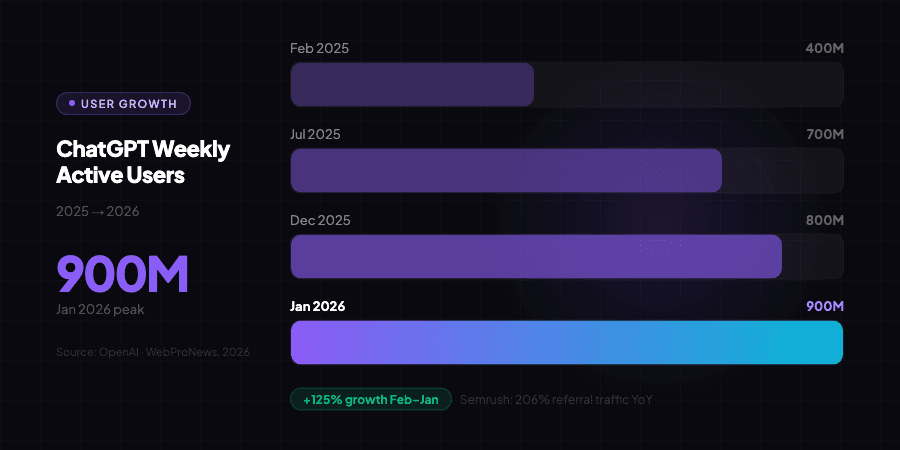
Google AI Overviews now appear in 47% of all searches, and ChatGPT reached 900 million weekly active users in January 2026 (OpenAI, Jan 2026). Traditional SEO — the practice of optimising for ten blue links — cannot prepare your business for a world where AI engines synthesise answers directly and cite only the sources they trust most.
For small and medium businesses, this shift is particularly sharp. Unlike large enterprises with dedicated content teams, SMBs have limited budgets and depend on search traffic to grow. When AI Overviews absorb the top of the results page without sending a single click, the stakes have never been higher.
The good news
research from Princeton University found that Generative Engine Optimization (GEO) techniques can increase a brand's AI search visibility by up to 40% (ACM KDD 2024). This guide explains exactly what GEO is, why it matters for your business, and the seven ranking factors you need to act on right now.
What Is Generative Engine Optimization (GEO)?
Generative Engine Optimization (GEO) is the practice of structuring your content, brand signals, and digital presence so that AI systems — ChatGPT, Perplexity, Google Gemini, and Claude — select you as a trusted citation source when answering user queries. Where traditional SEO targets algorithms that rank pages, GEO targets the language models that synthesise answers.
The discipline emerged from a landmark Princeton, Georgia Tech, and IIT Delhi study published at ACM KDD 2024. Researchers tested nine GEO techniques across 10,000 search queries and found visibility increases of up to 40%. The techniques that worked best: citing authoritative statistics, adding expert quotes, and structuring answers in a clear, declarative style that AI can extract and quote directly.
GEO is closely related to — but distinct from — Answer Engine Optimization (AEO), which focuses on featured snippets and voice search. While AEO targets Google's knowledge panels and People Also Ask boxes, GEO specifically targets large language model responses across all AI-powered platforms. Together, they form the new backbone of modern search strategy.
Think of GEO as teaching AI systems that your brand is the authoritative answer-giver for your topic area. Every piece of content you publish should answer a specific question, cite real data, and be written in language a language model can extract, understand, and quote verbatim.
How GEO Reshapes Search Visibility for Small and Medium Businesses
The opportunity for SMBs is real — and often overlooked. While large enterprises battle for high-volume keywords, AI engines cite the best answer to a question regardless of company size. A well-structured article from a Bangalore-based SaaS startup can outperform a Fortune 500 company's content if it more directly answers the user's query with specific, cited data.
ChatGPT now drives 87.4% of all AI referral traffic to websites, and that traffic converts at 15.9% — roughly nine times the 1.76% conversion rate of Google organic traffic (Seer Interactive, June 2025). For resource-constrained SMBs, fewer visitors from AI search can generate more business than a larger volume of traditional search traffic.
Research by ALM Corp analysed 1.2 million ChatGPT responses and found that 44.2% of citations come from the first 30% of a page's content. If your key insight is buried below the fold, AI engines won't find it. SMBs that front-load their expertise — answering the question in the opening paragraphs — dramatically improve their citation rate.
There's also a domain authority dimension. Sites with 32,000 or more referring domains receive 3.5 times more AI citations than low-authority sites (SE Ranking, 2025). For SMBs building from scratch, consistent digital PR and link acquisition are as important to GEO as they are to traditional SEO.
7 GEO Ranking Factors Every Business Must Know in 2026
Answer-First Structure
AI engines extract passages, not full pages. Every section should open with a clear, direct answer in the first 50 words. This inverted pyramid structure aligns with how AI systems parse and prioritise content — and it's the single highest-impact change most brands can make today.
Cited Statistics and Data
Content that references specific, sourced statistics is significantly more likely to be cited. The Princeton study found adding statistics citations increased GEO visibility by up to 40%. Every major claim should cite an external source — ideally a tier-1 research body, government report, or peer-reviewed study.
Domain Authority and Backlinks
AI models have absorbed quality signals similar to PageRank from their training data. Sites with strong backlink profiles are cited more often. Building topical authority — a comprehensive cluster of interlinked content on your specialisation — amplifies this effect significantly.
Entity Mentions and Knowledge Graph Presence
AI systems recognise named entities. If your brand, founders, and products are mentioned across multiple credible third-party sources — news sites, review platforms, directories — AI engines are more likely to surface you as a known entity, not just a page.
Content Freshness and Date Signals
AI engines with real-time web access (Perplexity, ChatGPT Browse) favour recently published and recently updated content. Adding a clear publication date and refreshing top pages quarterly signals currency to AI retrieval systems.
E-E-A-T Signals
Experience, Expertise, Authoritativeness, and Trust signals — the framework Google uses in its Search Quality Rater Guidelines — are equally relevant to GEO. AI systems absorb these signals from author bios, credentials, third-party mentions, and the depth of insight in your content.
Structured Answers (FAQs and How-Tos)
Content formatted as explicit question-and-answer pairs maps directly to the query formats AI systems handle. FAQ sections and step-by-step how-to guides, marked up with FAQPage JSON-LD schema, create a direct bridge between user queries and your content that AI engines can reliably extract.
GEO vs Traditional SEO: What Changes and What Stays the Same

The core objective of both SEO and GEO is identical: be the most visible, trustworthy answer when a potential customer is searching. The difference is who — or what — you're trying to convince. Traditional SEO optimises for algorithmic ranking signals (backlinks, keywords, page speed). GEO optimises for the language model's confidence that your content is the best answer.
What stays the same
technical website health, domain authority, and quality content remain essential. AI systems penalise slow, poorly structured sites just as Google does. Keyword research still informs what questions to answer — you're just now writing for a synthesiser, not a ranker.
What changes
keyword density is irrelevant to AI citation. Semantic completeness — covering a topic thoroughly enough that a language model can answer follow-up questions from your content alone — is what earns citations. Long-form, structured content outperforms keyword-stuffed short posts every time.
The biggest shift for SMBs
in traditional SEO, ranking #1 guarantees visibility. In AI search, a brand can rank on page three of Google but still be cited in 70% of AI responses on a topic, because the language model values answer quality over page rank. This democratises visibility for smaller brands with deep topical expertise.
How to Get Started With GEO: A Practical Checklist for SMBs
Step 1 — Audit for answer-first structure
Review your top 10 pages and check whether each H2 section opens with a clear, direct statement that answers its question. Rewrite opening sentences to lead with the answer before building context. This is the highest-ROI edit you can make.
Step 2 — Add cited statistics to every major claim: Replace vague statements ('studies show') with specific citations ('a 2025 BrightEdge survey of 1,600 marketers found…'). This single change can significantly increase your AI citation rate across ChatGPT, Perplexity, and Gemini.
Step 3 — Build a FAQ section on every key page: Create 5–10 question-and-answer pairs targeting the most common questions your customers ask. Mark up the section with FAQPage JSON-LD schema. This creates a direct bridge between user queries and your content that AI engines can reliably extract.
Step 4 — Monitor your AI search presence
Set up a system to query ChatGPT, Perplexity, and Gemini with your top 10 customer questions. Track whether your brand appears, and if so, whether it's cited as a source. Tools like Yozigo automate this tracking at scale, giving you a real-time dashboard of your AI visibility across all major platforms.
Step 5 — Strengthen your entity footprint
Ensure your brand is listed and consistent across Google Business Profile, LinkedIn, Crunchbase, G2, Capterra, and relevant industry directories. AI systems learn about entities from these structured data sources, and consistent citations across credible platforms reinforce your authority.