Why Isn’t My Brand Showing Up in AI Answers?
TL;DR
Your brand is missing from AI answers because ChatGPT, Gemini, Claude, and Google AI Overviews cite only sources they can retrieve, verify, and quote — and most brands never structure content to be quotable. Fix entity clarity, front-load answers, cite data, and track results with the ACTIVATE framework below.
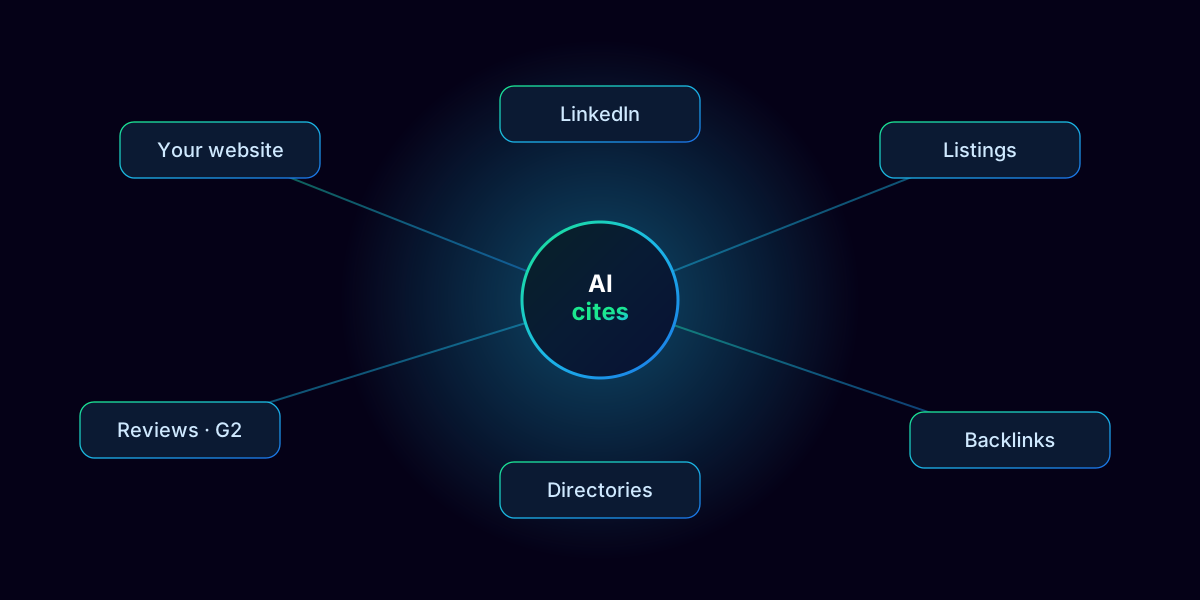
The numbers show how wide the gap is. BrightEdge found 44% of AI prompts return zero brand mentions, and AirOps reports that only about 15% of the pages an AI retrieves are actually cited — the other 85% are read and discarded. Meanwhile 86% of AI citations trace back to brand-owned sources like your own website and listings (Yext, 6.8M citations, 2025), which means the highest-leverage fixes are entirely within your control.
Key Takeaways
- You cannot 'train' ChatGPT by chatting with it — models cite content already published on the open web, not your prompts.
- 86% of AI citations come from brand-owned sources like your website and business listings (Yext, 2025).
- GEO techniques — cited statistics, expert quotes, answer-first structure — lift AI visibility by up to 40% (Princeton, ACM KDD 2024).
- Use the ACTIVATE framework to audit, structure, and track your way into AI answers.
- Measure progress with the Brand Mention Score, then run a weekly maintenance loop.
Getting mentioned is an engineering problem, not a mystery. This guide gives you the ACTIVATE framework to audit your AI readiness, structure content AI can quote, and track your brand across every assistant. New to the discipline? Start with our primer on what GEO is and the 7 ranking factors, then return here to operationalise it.
How Do AI Assistants Choose Which Brands to Cite?
AI assistants choose citations through retrieval-augmented generation (RAG): the model rewrites your question into several related sub-queries — a process Google calls query fan-out — pulls candidate passages from a search index, then synthesises an answer and attributes the passages it trusted most. Your content competes not as a whole page but as individual passages, which is why a self-contained answer near the top beats a long introduction.
This carries three consequences most marketers miss. First, you cannot game a single prompt: answers are personalised and vary per user and session, so real visibility comes from a broad, consistent footprint. Second, the model favours passages it can lift verbatim, so a 50–70 word direct answer outperforms three paragraphs of build-up. Third, because the model fans out into many related questions, you win by covering the whole question cluster around a topic.
OpenAI has been explicit that its search features surface content with clear, in-line, named attribution and links — so the source must be crawlable, structured, and unambiguous. To capture the fan-out you first have to know which questions the AI asks on your behalf: see our guide to finding the right AI prompts to track.
What Makes AI Skip a Brand?
| Reason AI skips you | Signal the model reads | The fix |
|---|---|---|
| Buried answer | Key claim sits below the fold; 44.2% of citations come from the top 30% of a page (ALM Corp, 2026) | Front-load a 50–70 word answer block under every H2 |
| No entity clarity | Inconsistent name, description, or broken schema across web sources | Standardise brand data + valid Organization/Article JSON-LD |
| Thin external validation | Few referring domains; sites with 32k+ earn ~3.5x more citations (SE Ranking, 2025) | Digital PR, reviews, and consistent third-party mentions |
| Stale content | No recent update; fresh pages earn markedly more citations | Refresh key pages quarterly with a visible date |
AI skips a brand for four recurring reasons: buried answers, unclear entity identity, thin external validation, and stale content. Each one removes a signal the model needs before it will quote you. The table below maps every reason to the signal AI reads and the concrete fix — a checklist you can run against any page today.
The single biggest offender is a buried answer. ALM Corp analysed 1.2 million ChatGPT responses and found 44.2% of citations come from the first 30% of a page (ALM Corp, Feb 2026). If your key claim sits below marketing fluff, the model never reaches it — no matter how good the rest of the page is. Burying the answer is one of eight writing mistakes that block AI citation, each with a measured fix from the Princeton GEO study.
What Is the ACTIVATE Framework for AI Citations?
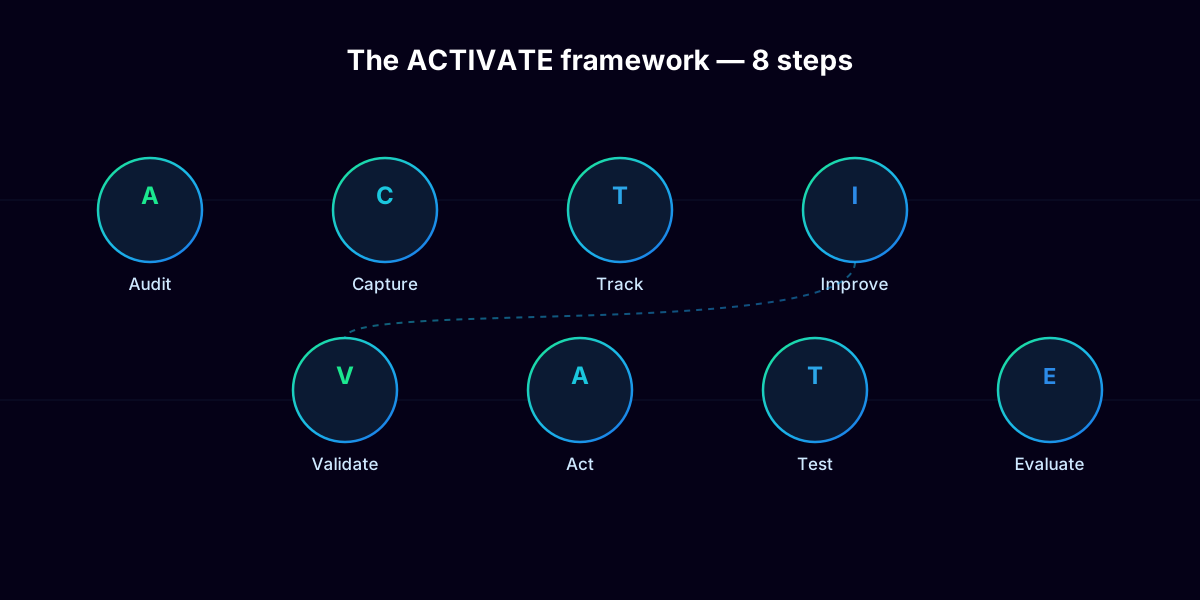
The ACTIVATE framework is an eight-step process to earn AI citations: Audit, Capture, Track, Improve, Validate, Act, Test, and Evaluate. It turns the abstract goal of 'get mentioned by AI' into a repeatable operating loop, mapping each step to a concrete deliverable you can complete this week.
Audit AI Readiness
Confirm pages are crawlable by GPTBot, ClaudeBot, and PerplexityBot, render server-side, and carry valid Organization and Article JSON-LD. Fix broken schema and inconsistent brand data first.
Capture Prompt Opportunities
Gather the real questions buyers ask from Google Search Console, People Also Ask, forums, and competitor FAQs. This becomes your target-prompt list.
Track AI Responses
Query ChatGPT, Gemini, Claude, and Perplexity with those prompts on a schedule and log where you and competitors appear. Sampling repeatedly averages out AI variability.
Improve Content
Add a 50–70 word answer block at the top of each target section, use descriptive claim-style H2s, and back every claim with a cited statistic.
Validate Against Competitors
Where rivals get cited and you do not, map what they have that you lack — data, entities, depth, or third-party mentions — and close the gap.
Act on High-Impact Prompts
Prioritise the handful of prompts with the most business value and the widest citation gap, rather than spreading effort thin.
Test Iteratively
A/B test answer-block phrasing and headline structure, then re-sample AI responses to see which version gets pulled more often.
Evaluate and Repeat
Score progress with the Brand Mention Score, review monthly, and feed new prompts back into step 2.
How Do You Measure AI Citation Readiness?
| Factor | Weight | What it measures |
|---|---|---|
| Entity Authority | 25% | Consistency of your brand identity across site, LinkedIn, Crunchbase, G2, and directories |
| Prompt Coverage | 20% | How many high-value buyer prompts your content actually answers |
| Evidence Quality | 20% | Density of original data, cited statistics, and expert quotes |
| Content Structure | 15% | Answer-first blocks, claim-style headings, and FAQ markup |
| External Validation | 10% | Backlinks, reviews, and third-party mentions |
| Freshness | 10% | How recently key pages were published or updated |
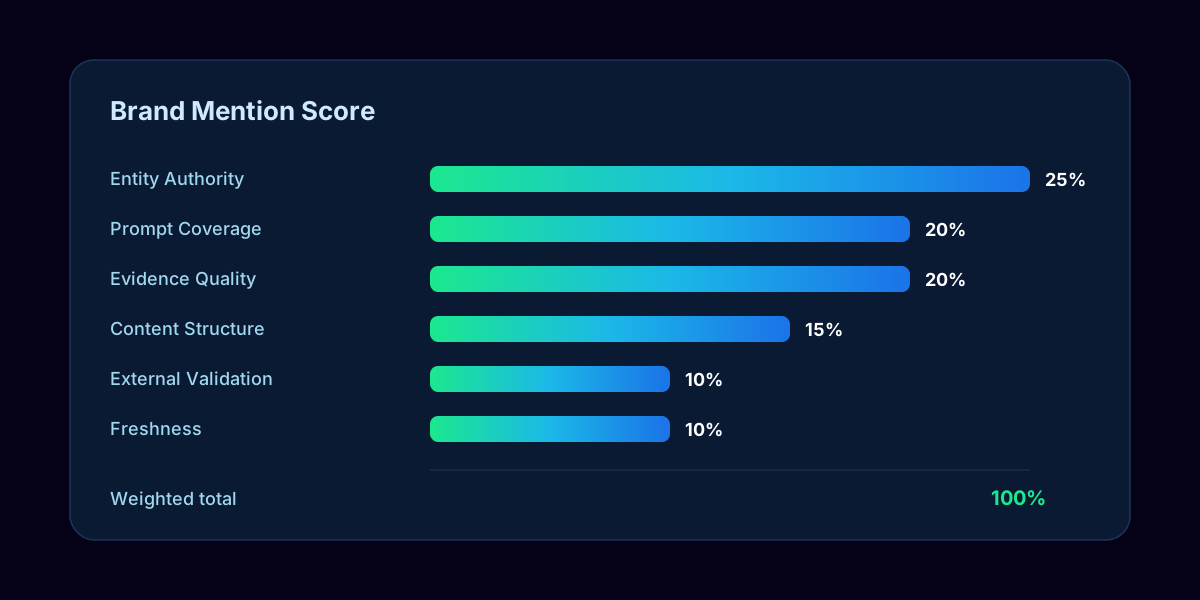
You measure AI citation readiness with a weighted Brand Mention Score across six factors: Entity Authority, Prompt Coverage, Evidence Quality, Content Structure, External Validation, and Freshness. Score each 0–100, apply the weight, and sum. Under 50 means effectively invisible; 50–75 means occasional mentions; above 75 is where brands become a default recommendation.
The weighting reflects what actually moves citations. Entity authority and evidence quality carry the most weight because AI must first identify you confidently, then find quotable proof. The Princeton study confirmed that adding cited statistics and expert quotes was among the highest-impact techniques (ACM KDD 2024).
What Should Your Weekly AI Visibility Workflow Look Like?
Your weekly AI visibility workflow should take one focused hour and cover four moves: review new question queries, sample your target prompts, fix one high-opportunity page, and check entity consistency. AI visibility rewards steady cadence far more than occasional overhauls — small, compounding improvements are what move a brand from occasional mention to default citation.
Review new question queries
Pull the latest question-style queries from Google Search Console and add fresh ones to your prompt list — our GSC and Bing playbook shows the exact filters.
Sample your target prompts
Run your top prompts through ChatGPT, Gemini, and Claude and record brand and competitor mentions.
Fix one high-opportunity page
Add or sharpen an answer block, insert a cited statistic, or refresh a stale example on the page with the biggest citation gap.
Check entity consistency
Verify brand data is identical across your site and top directories and that no schema errors crept in. Ready to automate this loop? See how Yozigo runs it for you.