Why Does My Content Never Get Cited by AI Search?
TL;DR
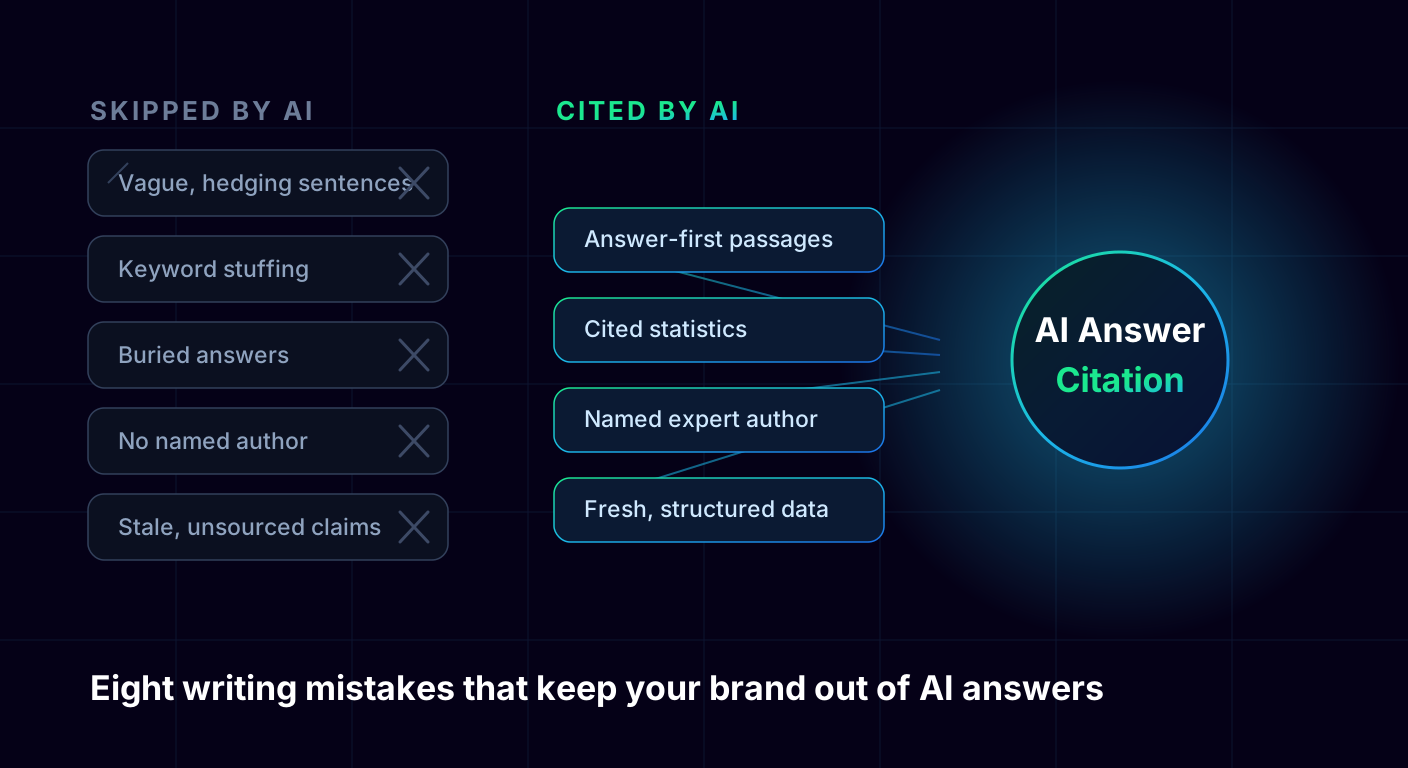
Content fails to get cited in AI search when it hedges instead of stating facts, stuffs keywords, buries the answer, skips sources, and carries no named author. The Princeton-led GEO study measured each of these — keyword stuffing scored below baseline, while citing sources lifted visibility by roughly 28%.
Most guides tell you what to do. This one starts from the other end, because the mistakes are better measured than the fixes. Researchers from Princeton, Georgia Tech, the Allen Institute for AI, and IIT Delhi formalised Generative Engine Optimization (GEO) in a 2024 paper presented at ACM KDD, built a benchmark called GEO-bench, and tested nine content strategies across roughly 10,000 queries. Some strategies lifted visibility inside AI answers by up to 40%. One — the single most reflexive habit in traditional SEO — measured *below* the unmodified baseline. If you have searched why ChatGPT never cites your content, the answer is usually not that you wrote too little. It is that you wrote in a shape no model can lift a sentence out of.
Key Takeaways
- Keyword stuffing is a measured mistake, not just an outdated habit — it scored roughly 10% below baseline on Perplexity.ai validation runs (Princeton, ACM KDD 2024).
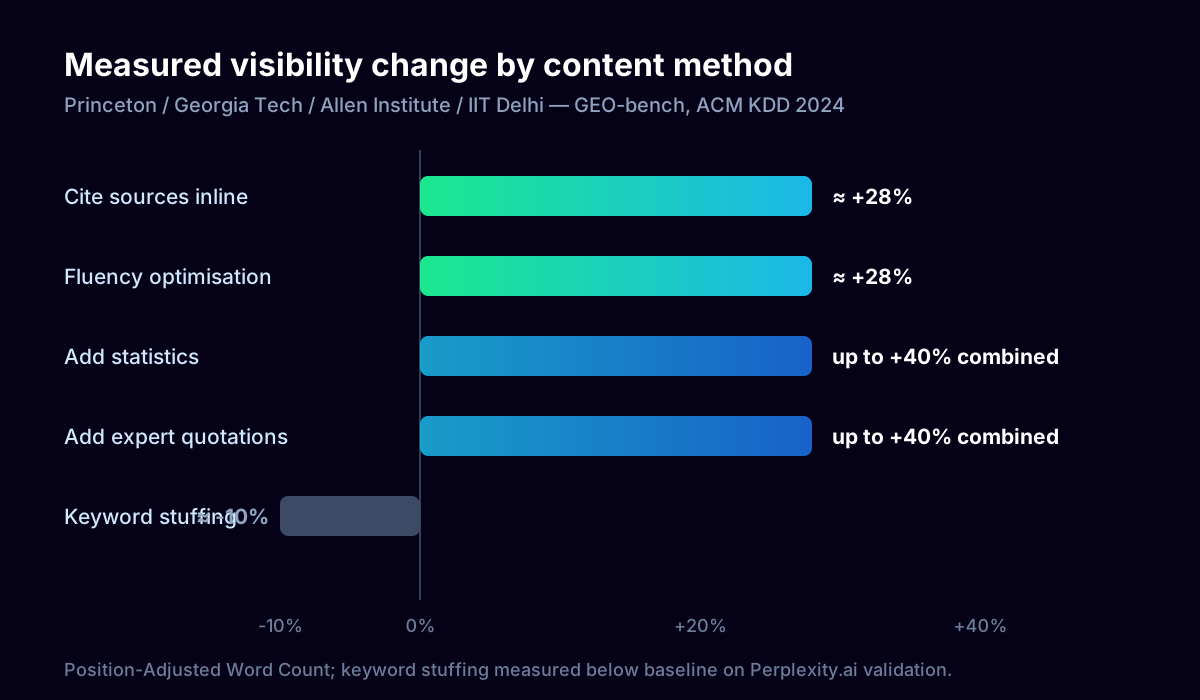
- Citing sources inline and improving fluency each produced around 28% gains on the study's Position-Adjusted Word Count metric.
- Only 17% of Google AI Overview citations come from pages ranking in the organic top 10, so ranking well does not guarantee being cited (BrightEdge).
- Anonymous content is rarely cited — a named, credentialed author supplies the E-E-A-T signal models weigh.
- Freshness is decisive: 76.4% of top-cited pages were updated within the previous 30 days (Ahrefs).
- Only about 11% of domains cited by ChatGPT are also cited by Perplexity, so one-platform optimisation leaves visibility on the table.
New to the discipline? Start with our primer on what GEO is and the 7 ranking factors, then come back here to audit what your drafts are doing wrong.
Why Do These Mistakes Cost More in 2026 Than They Did in 2024?
These mistakes cost more in 2026 because the click that used to forgive them is disappearing. Seer Interactive analysed 3,119 informational queries across 42 organisations — 25.1 million organic impressions between June 2024 and September 2025 — and found organic click-through rate falls from 1.76% to 0.61% when a Google AI Overview appears on the page. That is a 61% decline in organic CTR, with paid CTR down 68%. Even on queries with no AI Overview at all, organic CTR fell 41%, which suggests the behaviour shift is broader than any single feature.
The second shift is that ranking and citation have come apart. BrightEdge's Generative Parser research found only 17% of AI Overview citations come from pages that also rank in Google's organic top 10 — meaning roughly 83% are drawn from outside it. Ahrefs, using a different methodology, puts the top-10 overlap nearer 37%. The two numbers disagree on magnitude and agree on direction: the link between top-10 rankings and AI citation has weakened sharply. A page can rank first and still be invisible inside the answer sitting above it.
There is an upside worth naming. Seer's same dataset found brands cited inside an AI Overview earn 35% more organic clicks and 91% more paid clicks. The citation is now the traffic — which is exactly why the writing mistakes below have stopped being cosmetic.
What Are the 8 Writing Mistakes That Block AI Citation?
The eight mistakes below block AI citation for one shared reason: each removes something the model needs before it will quote you — an extractable sentence, a verifiable number, an identifiable author, or a parseable structure. They are ordered by how much measured evidence supports them, strongest first.
Writing vague, hedging sentences
AI models extract sentences that answer a question cleanly. A line like "there are many things to consider when choosing a laptop" gives a model nothing to quote — there is no claim, no number, and no way to verify it. The GEO study found that adding specific, sourced statistics was among the highest-impact changes tested; hedged language is the mirror image, offering nothing to lift out.
Keyword stuffing
This is the most directly measured mistake on the list. The KDD 2024 researchers tested keyword stuffing against an unmodified control and found it scored roughly 8% below baseline on Position-Adjusted Word Count, and about 10% below baseline in the Perplexity.ai validation run. Repetition that once signalled relevance to a ranking algorithm now reads as low-quality text to a language model.
Burying the answer
The highest-cited content leads with a direct, one-sentence answer under every heading rather than three paragraphs of preamble. Models compete passages against each other, not whole pages. If yours needs to be read to the middle before it says anything, a competitor's cleaner opening wins the slot.
Publishing without a named, credentialed author
Anonymous, byline-free content is one of the most consistently flagged weaknesses in current GEO research. This ties directly to E-E-A-T — Experience, Expertise, Authoritativeness, Trustworthiness. Unattributed claims are treated with more caution, by models and readers alike. A named author with visible credentials and real first-hand experience is the cheapest trust signal available.
Skipping sources and statistics
In the GEO-bench experiments, citing sources inline produced roughly 28% gains on Position-Adjusted Word Count, and the paper reports that combining citations, quotations, and statistics can lift source visibility by over 40%. Content that asserts without backing is easy for a model to skip in favour of a source that shows its work.
Letting content go stale
Ahrefs' analysis of roughly 17 million AI citations found 76.4% of top-cited pages had been updated within the previous 30 days. Publishing once and never revisiting dates, figures, or examples quietly removes you from eligibility — fastest in categories that move, like software, pricing, and health.
Treating "AI search" as one platform
Perplexity runs a live web search and cites sources on essentially every answer. ChatGPT now routes many factual queries to search too, but still answers from training data when it judges retrieval unnecessary — a materially different selection path. Domain-level analysis from The Digital Bloom found only about 11% of domains cited by ChatGPT are also cited by Perplexity. Optimising for one behaviour leaves the other unclaimed — our guide to tracking your brand across Perplexity, ChatGPT and Gemini breaks down how each engine selects sources.
No structure for machines to parse
Long, unbroken paragraphs are hard for crawlers to segment and hard for models to extract from. Cited competitors consistently use descriptive headings, ordered lists, and comparison tables with real table headers, and implement FAQPage and Article schema so the content parses unambiguously. Structure is not decoration — it is what makes a passage addressable, and our step-by-step guide to ranking in ChatGPT walks through the page-level layout that gets pulled.
Which Fixes Actually Increase AI Visibility?
| Mistake | Measured impact | The fix |
|---|---|---|
| Keyword stuffing | ≈10% below baseline on Perplexity.ai validation (Princeton, KDD 2024) | Write in natural, fluent language; fluency optimisation gained ≈28% |
| Vague claims, no numbers | Nothing extractable for the model to quote | Add a specific, sourced statistic with a date |
| No inline sourcing | Claims read as unverified | Cite sources inline — ≈28% gain on Position-Adjusted Word Count |
| No expert quotes | Weaker trust signal | Add attributed quotations; citations + quotes + stats lift visibility over 40% |
| Answer buried mid-page | A cleaner competing passage wins the citation slot | Lead each section with a 40–60 word direct answer |
| Anonymous authorship | Lower E-E-A-T trust | Name a credentialed author with visible experience |
| Stale content | 76.4% of top-cited pages updated within 30 days (Ahrefs) | Refresh dates, figures, and examples on a fixed schedule |
| One-platform focus | ≈11% domain overlap between ChatGPT and Perplexity (Digital Bloom) | Write for live-retrieval and training-data behaviours both |
The fixes that increase AI visibility are the ones the GEO-bench experiments measured directly: cite sources inline, add statistics and expert quotations, improve fluency, and lead every section with a direct answer. The table below pairs each mistake with what was measured and the specific change to make. Where a figure comes from the original GEO paper, it reflects the study's Position-Adjusted Word Count metric — the paper's measure of how prominently a source appears inside a generated answer.
Worth noting what does not appear in that list: none of these fixes replaces technical SEO, they sit on top of it. If the split between the two disciplines is still fuzzy, our breakdown of GEO vs traditional SEO sets out which signals each one owns, and the complete guide to AI search optimization covers the foundation these writing fixes are built on.
What Does a Citable Sentence Actually Look Like?
A citable sentence is one a model can lift verbatim and still have it be true, specific, and attributable. The difference is rarely about writing quality in the literary sense — it is about whether the sentence survives extraction. Compare two versions of the same claim.
Before (will not get cited)
"When it comes to laptops, there's a lot to think about, and budget options can vary quite a bit depending on what you need."
After (citation-ready)
"Budget laptops under $500 typically ship with 8GB of RAM, a 256GB SSD, and 8–10 hours of rated battery life, based on 2026 retail listings from major manufacturers."
The second version gives a model a bounded claim, three verifiable specifics, a price qualifier, and a time anchor. Pulled out of the page and dropped into an answer, it still stands up. The first version dissolves. Run this test on your own drafts: take any sentence out of context, and ask whether it would embarrass you or inform a reader. If the honest answer is neither — it would simply say nothing — that sentence is invisible to AI search.
Why Is Your Own Website Not Enough on Its Own?
Your own website is not enough because AI systems build answers through multi-source consensus. Before treating a fact, product, or brand claim as citable, models weigh whether it is echoed consistently across independent reviews, forums, and third-party publications. AirOps found brands are 6.5x more likely to be cited through third-party sources than through their own domain — which reframes the entire content budget question.
A claim that exists only on the domain making it is treated with more caution than one corroborated elsewhere. This is the mistake that catches sophisticated teams: they fix structure, add statistics, name an author, and still stay invisible, because every supporting signal points back to a single origin. The counter-move is earned presence — genuine reviews on the platforms your buyers check, substantive answers in the communities where the question gets asked, and press or analyst coverage that repeats your positioning in someone else's voice.
This does not replace owned content; it validates it. The practical sequence is to make your own pages quotable first, then work on having the same claims restated somewhere you do not control. Our guide to getting your brand mentioned across ChatGPT, Gemini and Claude covers the audit-and-earn loop in full.
How Do You Check Whether AI Actually Cites You?
You check by sampling
run your target questions through each assistant on a schedule and log where you and your competitors appear. AI answers vary by user, session, and phrasing, so a single check proves nothing — repeated sampling across the same prompt set is what turns anecdote into a trend line. Start by building the prompt list itself, using the method in our guide to finding the right AI prompts to track.
Two proxies are available before you automate anything. Rising impressions on question-style queries in Google Search Console indicate your content is being surfaced for the conversational phrasing AI answers are built from; our Search Console and Bing playbook covers the exact filters to apply. And direct referral traffic from assistant domains, though small, confirms citations are converting into visits. If you are weighing whether to fund a dedicated tracker at all, see AI visibility tools vs traditional SEO tools.
If you are choosing a tool for this, compare the category first: our roundup of AI brand monitoring tools for generative AI covers what monitoring alone can and cannot tell you, and the seven GEO platforms enterprises shortlist compares coverage, pricing, and reporting depth side by side.
Yozigo automates this loop
it tracks brand citations across ChatGPT, Perplexity, Gemini, Claude, Grok, Copilot, Google AI Overviews and Bing AI grounding, and connects to Google Search Console and Bing Webmaster Tools so your prompt list is built from queries people actually search rather than guesses. See how it works.