AI Visibility Tools vs Traditional SEO Tools: Should You Switch in 2026?
68% of US Google searches ended without a click in early 2026, and 51% of B2B software buyers now start research in an AI chatbot rather than Google. Here is what rank trackers and AI visibility trackers each measure — and why the answer is add, not switch.
Is It Worth Switching From Traditional SEO Tools to AI Visibility Tracking?
TL;DR: No — you should not switch. Traditional SEO tools and AI visibility trackers measure two different things, and neither substitutes for the other. Rank trackers tell you where a page sits on a results page. AI visibility trackers tell you whether ChatGPT, Perplexity, Gemini or AI Overviews cite your brand at all. Run both layers.
A client asked me this exact question last month, and it is the right question to be asking. Their Google rankings had barely moved in a year. Their organic traffic had fallen by roughly a fifth. Nothing in their SEO dashboard explained the gap, because the dashboard was not built to see it: people were getting the answer inside an AI response and never arriving. Rank held. Demand moved. The tooling only measured one of those.
Key takeaways
- Zero-click hit 68.01% of US Google searches between January and April 2026, up from 60.45% in 2024 (SparkToro / Similarweb).
- 51% of B2B software buyers now begin research with an AI chatbot more often than with Google — up from 29% in April 2025 (G2, 1,076 buyers, March 2026).
- 69% of those buyers chose a different vendor than they had planned, and 33% bought from a vendor they were not previously familiar with (G2).
- AI-referred visitors convert at roughly 4.4x standard organic despite being about 1.08% of total visits (Semrush, 2026).
- Only about 11% of domains cited by ChatGPT are also cited by Perplexity (The Digital Bloom), so a single-platform check is not coverage.
- The AI modules inside Semrush and Ahrefs are real but partial — see the section on what bolt-on tracking misses.
If you are new to the underlying discipline, start with our primer on what GEO is and its ranking factors or the concept-level breakdown in GEO vs traditional SEO. This guide is narrower: it is about the tools, and which line items belong in next year's budget.
What Do Traditional SEO Tools Actually Measure?
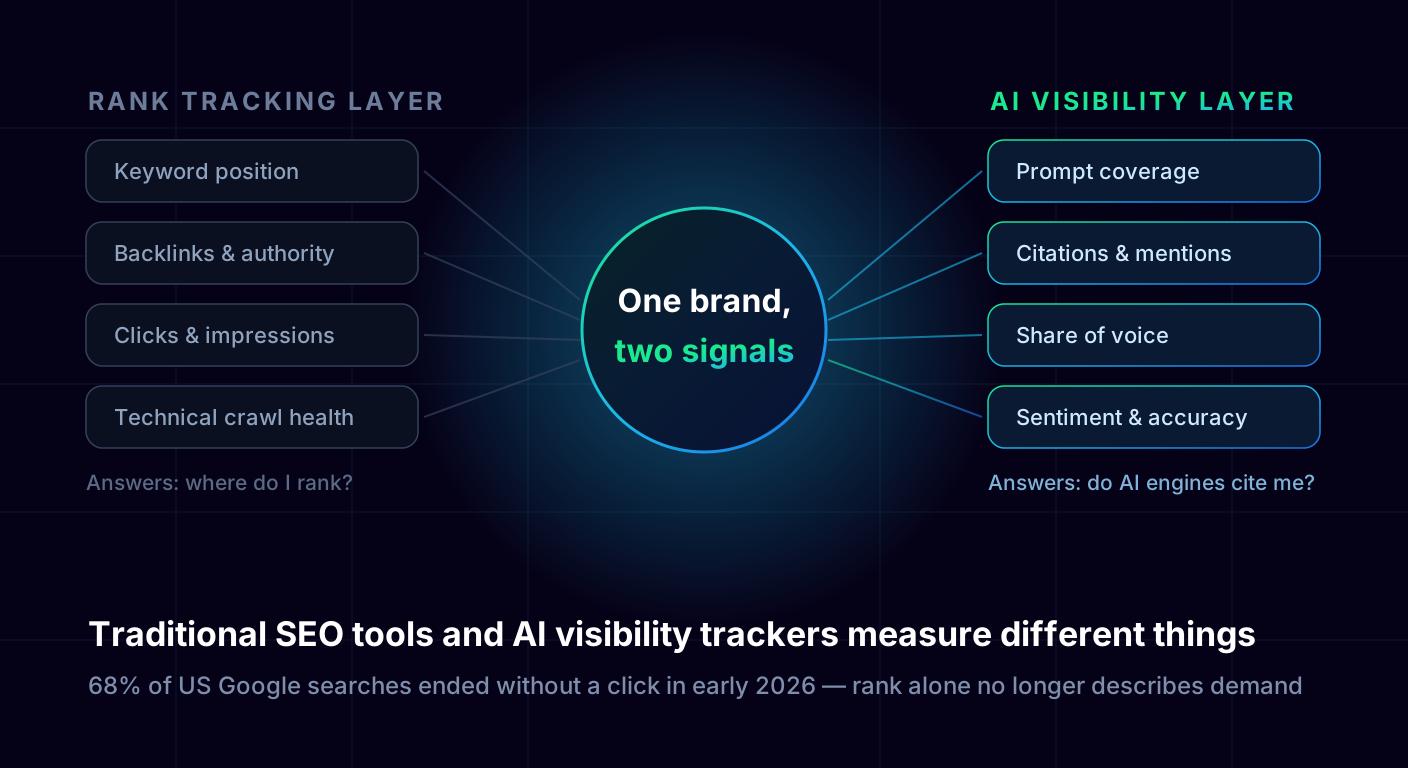
Traditional SEO tools measure a page's position in a ranked list of links, and the inputs that move it. Semrush, Ahrefs, SE Ranking, Moz and BrightEdge all resolve to four core measurements: keyword position over time, referring domains and authority, click and impression data pulled from Search Console, and technical crawl health such as site speed, indexability and structured markup validity.
This is not a legacy category, and it has not stopped working. Google still processes the large majority of search sessions worldwide, and the index those tools monitor is the same corpus that AI assistants retrieve from when they run a live web search. Authority earned for ranking purposes is authority the retrieval layer also reads.
The limitation is specific rather than general. Every metric in that list is anchored to a results page that a user has to look at and click. When the answer resolves above the links — or inside a chat window that never renders a results page at all — the measurement instrument is pointed at the wrong surface. The number can stay green while the demand behind it drains.
What Does an AI Visibility Tracker Measure Instead?
An AI visibility tracker measures whether AI assistants mention, cite, or recommend your brand when someone asks a question in your category — and how that compares to your competitors. The unit of analysis is not a keyword. It is a prompt, which is longer, conversational, and often carries qualifiers a keyword tool would never surface, such as "for a 12-person agency" or "that integrates with HubSpot".
Four measurements define the category. Prompt coverage: across a defined set of buying questions, how many return your brand at all. Citation and mention frequency: how often you appear as a linked source versus an unlinked name-drop, which are materially different outcomes. Share of voice: your presence relative to named competitors on the same prompt set. Sentiment and factual accuracy: whether the description of you is favourable, and whether it is correct.
That last one has no equivalent in traditional SEO and is routinely underrated. A rank tracker cannot tell you that an assistant is confidently describing a feature you discontinued, or quoting pricing you changed two quarters ago. Building the prompt set is the hard part of this work — our guide to finding the right AI prompts to track covers the sourcing method.
Why AI Visibility Became a Separate Tool Category in 2026
Two measured shifts turned AI visibility from a curiosity into a budget line. The first is the disappearing click. SparkToro's analysis of Similarweb clickstream data found 68.01% of US Google searches ended without a click between January and April 2026, up from 60.45% in 2024. On searches where an AI Overview appears, the zero-click rate rises to roughly 83%. Seer Interactive, measuring 25.1 million organic impressions, recorded organic CTR falling from 1.76% to 0.61% when an AI Overview is present — a 61% decline.
The second is where evaluation now begins. G2's March 2026 survey of 1,076 B2B software buyers found 51% start research with an AI chatbot more often than with Google, up from 29% in April 2025. The consequence is the part worth reading twice: 69% chose a different vendor than they had originally planned, and one in three bought from a vendor they had not previously heard of. Forrester's 2026 Buyers' Journey Survey of 18,000 buyers puts overall AI use during a purchase at 94%.
Shortlists are being assembled inside a system that no rank tracker observes. That is what created the category — not a marketing narrative, but a measurement blind spot with revenue attached to it.
SEO Tools vs AI Visibility Trackers: What Each One Sees
| Dimension | Traditional SEO tools | AI visibility trackers |
|---|---|---|
| Unit of analysis | Keyword | Prompt or conversational question |
| Primary metric | Ranking position, clicks, impressions | Citation rate, mention frequency, share of voice |
| Competitor view | Who outranks you on a SERP | Who gets recommended instead of you in an answer |
| Trust signal tracked | Backlinks and domain authority | Third-party corroboration, sourcing, structured data |
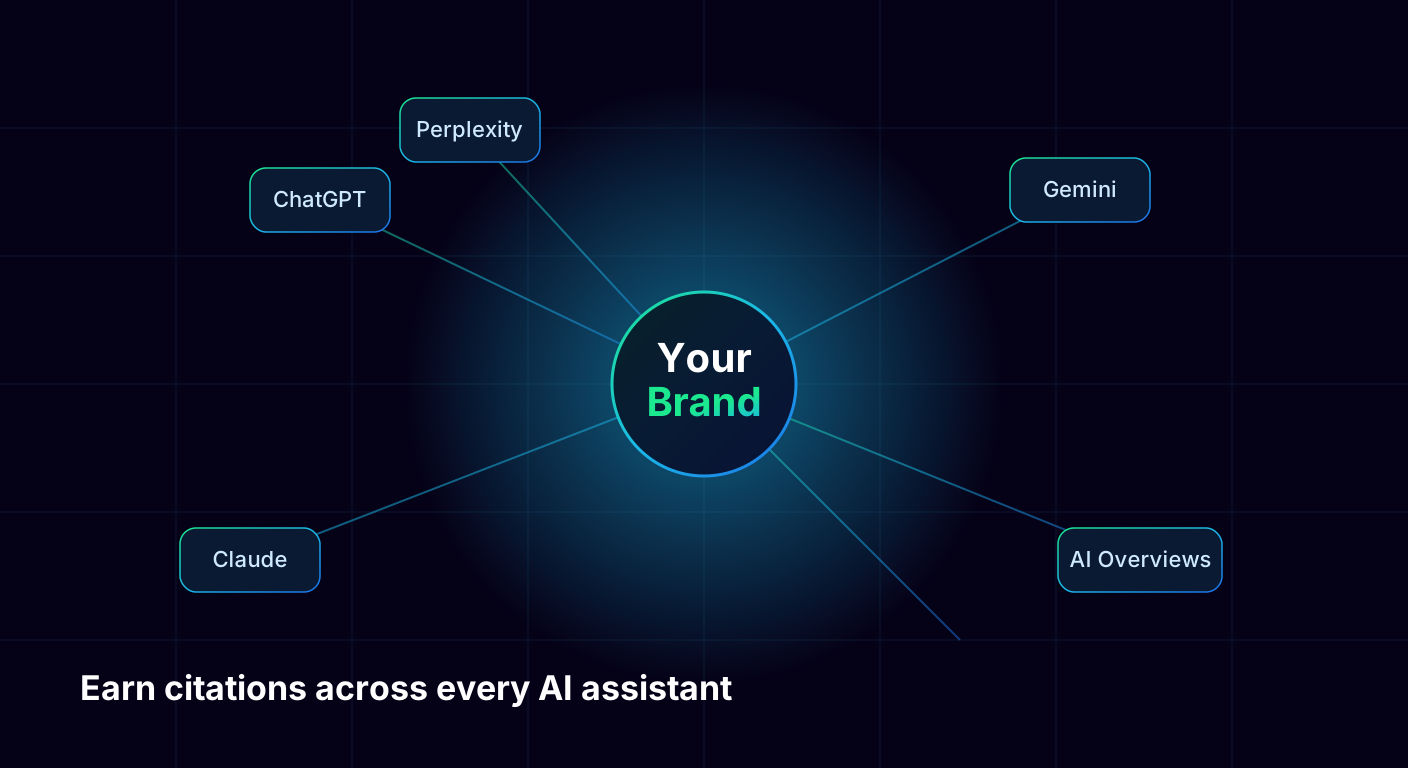
| Surfaces covered | Google, Bing organic results | ChatGPT, Perplexity, Gemini, Claude, Copilot, AI Overviews |
| Accuracy checking | Not applicable | Sentiment and factual correctness of brand descriptions |
| Refresh sensitivity | Weeks to months | Days — answers vary by session and phrasing |
| Question it answers | Where do I rank? | Do AI engines know and cite my brand? |
The two categories overlap less than their marketing suggests. The table below maps each dimension to what the tool actually returns, so you can see which questions simply cannot be answered by the stack you already own.
Isn’t an AI Visibility Add-On From Semrush or Ahrefs Enough?
For a first look, yes. For ongoing measurement, usually not — and this is the part most comparison posts skip. The incumbents have shipped real features here. Semrush launched its AI Visibility Toolkit in 2025 and folded it into Semrush One across late 2025 and early 2026, tracking brand presence in ChatGPT, Google AI Mode, Perplexity and AI Overviews. Ahrefs' Brand Radar covers six surfaces including Claude and Meta AI, and added custom prompt tracking in January 2026.
Three gaps show up once you move past the first report. Platform coverage is uneven, which matters because The Digital Bloom's domain-level analysis found only about 11% of domains cited by ChatGPT are also cited by Perplexity — a module missing one engine is missing a mostly different citation set, not a subset. Sampling depth is usually capped: AI answers vary by session, user and phrasing, so a once-weekly single run produces anecdote, not a trend line. And prompt-set construction is often manual, when the useful version derives prompts from queries people actually search.
The honest read
if AI visibility is a quarterly slide, the add-on is fine and you already own it. If it is a channel you are accountable for, you will outgrow it. We compare the dedicated options in Top 7 GEO platforms for enterprises. Region-specific shortlists with local pricing are available for the US, the UK and India.
How Do You Run Both Layers Without Doubling the Work?
You run both layers by treating AI visibility as a reporting addition rather than a second content operation. The underlying work — authority, structure, sourcing, freshness — is shared. Five steps, in order:
1. Keep the SEO stack running unchanged. Authority built for ranking is the same authority the retrieval layer reads. Cancelling it to fund AI tracking removes the foundation the citations are drawn from.
2. Build a prompt set from real demand. Pull question-form queries from Search Console and Bing Webmaster Tools rather than inventing them; our Search Console and Bing playbook covers the exact filters.
3. Sample on a fixed schedule across every engine your buyers use. Weekly at minimum, on the same prompt set, so variance averages out into a trend.
4. Rewrite for extraction, not for volume. Answer-first passages, a sourced number in most claims, real table headers, named authorship. The failure modes are catalogued in how not to write content for AI citations.
5. Report one AI metric next to your rank metric. Share of voice on your tracked prompt set, trended monthly. One number is enough to make the layer visible to whoever approves the budget.
What Are the Limits of AI Visibility Tracking?
AI visibility tracking has real weaknesses, and a vendor who does not name them is selling rather than advising. There is no single authoritative position number — an assistant may cite you in one session and omit you in the next from an identically phrased prompt, so every figure is a sampled estimate with a confidence interval rather than a fact.
Attribution stays messy. Zero-click is the normal outcome by design: visibility can improve while sessions stay flat, because the citation satisfied the user without a visit. Conversion figures also vary widely by methodology — Semrush reports AI visitors converting at about 4.4x organic, while Ahrefs measured a far larger gap on its own signup data and ecommerce studies have found multiples closer to 1.3x. Directionally consistent, numerically unsettled. Quote the range, not the most flattering point.
Two more
platforms change retrieval behaviour without notice, so a drop may be a model update rather than anything you did. And the work is genuinely cross-functional — content, digital PR, product marketing and engineering all hold pieces of it, which makes it harder to staff than a rank-tracking retainer.
So Should You Switch, or Add?
Add. Switching trades a mature measurement layer for an immature one and leaves you blind on the surface that still drives most of your traffic. Traditional SEO remains the foundation — it builds the authority and the indexed corpus that AI assistants retrieve from in the first place, which is why the two layers are complementary rather than competing.
The decision rule is simple. If AI visibility is not in your reporting at all, you are measuring a shrinking share of how buyers actually find you: 68% of US searches now end without a click, and half of B2B software research starts in a chatbot. If it is in your reporting via a bolt-on module and nobody is accountable for the number, that is fine — keep it there. If someone is accountable for it, fund the dedicated layer.
Yozigo tracks brand citations, share of voice, sentiment and factual accuracy across ChatGPT, Perplexity, Gemini, Claude, Grok, Copilot, Google AI Overviews and Bing AI grounding, and connects to Google Search Console and Bing Webmaster Tools so your prompt set is built from queries people actually search rather than guesses. See how it works.
Frequently Asked Questions About AI Visibility Tools vs SEO Tools
No. It is an additional measurement and optimisation layer, not a replacement. Traditional SEO still drives the majority of organic traffic and builds the domain authority that AI assistants weigh when selecting sources. The two share most of their underlying work — authority, structure, sourcing and freshness — and diverge mainly in what they measure and how often.
A full switch is not worth it. Rank trackers and AI visibility trackers answer different questions — "where do I rank?" versus "do AI engines cite me?" — and dropping the first leaves you unable to see the surface that still produces most of your sessions. Keep the SEO stack and add an AI visibility layer alongside it.
For a quarterly overview, usually yes — Semrush's AI Visibility Toolkit and Ahrefs' Brand Radar both track brand presence across several AI surfaces. For an owned channel, usually not: platform coverage is uneven, sampling frequency is capped, and prompt sets are often built manually rather than derived from real search demand.
Weekly at minimum, on a fixed prompt set. AI answers vary by session, user and phrasing, so a single check proves nothing — repeated sampling across the same prompts is what converts anecdote into a trend. Freshness compounds the need: Ahrefs found 76.4% of top-cited pages had been updated within the previous 30 days.
Categories where buyers research before contacting anyone: B2B SaaS and enterprise software, marketing and AI tooling, financial services, healthcare information, travel, and considered-purchase ecommerce. G2 found 51% of B2B software buyers now start in an AI chatbot and 33% ultimately bought from a vendor they had not previously heard of, which makes shortlist presence the measurable outcome.
Yes, though the size of the gap depends on who is measuring. Semrush reports AI-referred visitors converting at roughly 4.4x standard organic while accounting for about 1.08% of total visits. Other datasets range from a 1.3x advantage in ecommerce to far larger multiples on B2B signup data. Treat the direction as established and the multiple as a range.