Best Tools to Monitor Brand Visibility Across ChatGPT, Gemini and Perplexity (2026)
Which AI visibility tools actually cover ChatGPT, Gemini and Perplexity, and which charge extra or leave one out. An engine-by-engine coverage matrix for nine tools, plus how each engine differs.
Which tools monitor brand visibility across ChatGPT, Gemini and Perplexity?
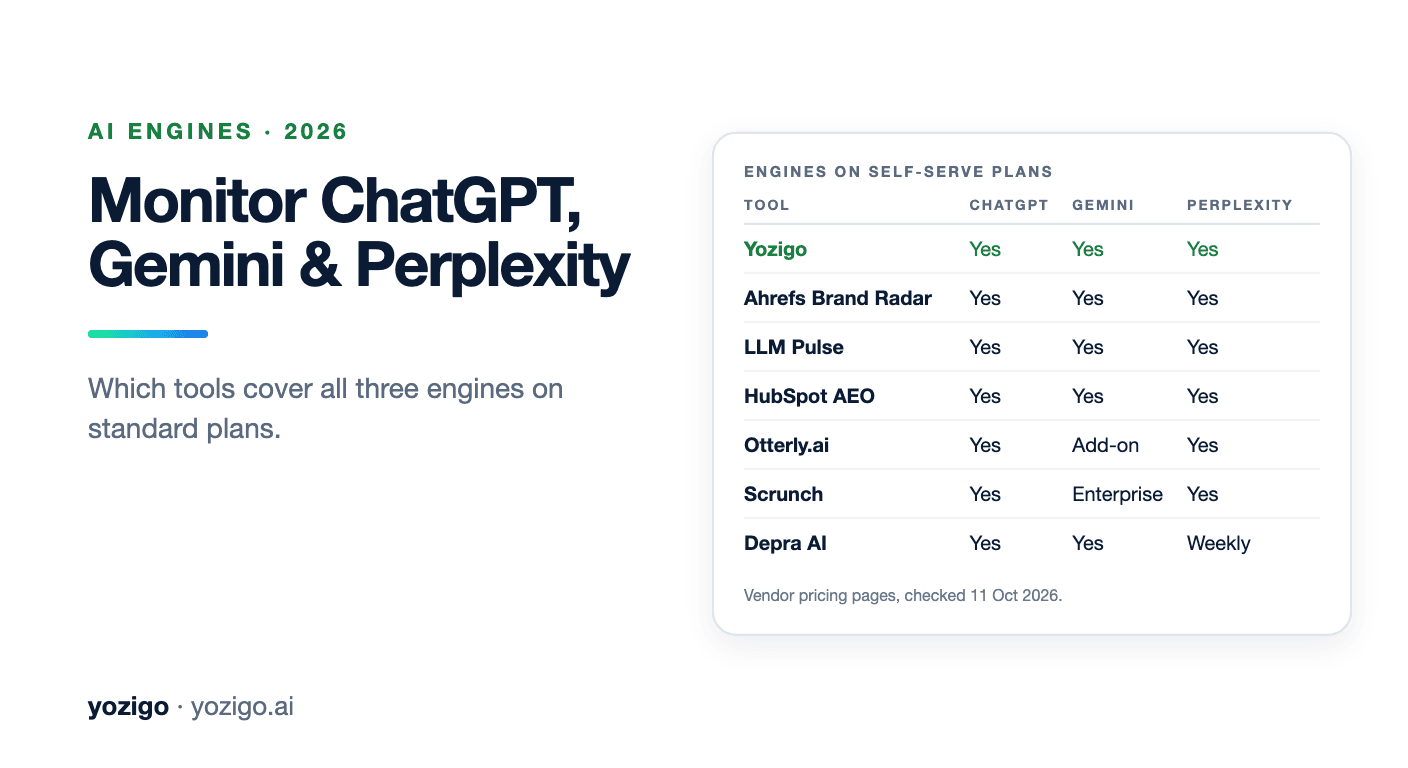
TL;DR: Among AI monitoring tools, Yozigo, Ahrefs Brand Radar, LLM Pulse and HubSpot AEO include ChatGPT, Gemini and Perplexity on their standard plans. Otterly charges extra for Gemini, Scrunch keeps Gemini for Enterprise, Depra AI checks Perplexity weekly, and Peec AI lets you pick any three models. Only Yozigo and Ahrefs Brand Radar also cover Google AI Mode and Copilot without an enterprise contract.
Key takeaways
- Engine coverage, not price, is the first filter: a cheap plan that skips the engine your buyers use measures the wrong thing.
- The three engines behave very differently: ChatGPT cited a median of 39 sources per answer in our data, Perplexity 15 and Gemini 8.
- Being named on one engine says little about the others, so track each one.
- Check whether an engine is included, an add-on or Enterprise-only before you compare prices.
Disclosure
Yozigo publishes this guide. Coverage was checked on each vendor’s pricing page on 11 October 2026.
Four of the nine AI monitoring tools we checked include all three engines on standard plans: Yozigo, Ahrefs Brand Radar, LLM Pulse and HubSpot AEO (vendor pages, 11 October 2026). In our tracking the three engines cited a median of 39, 15 and 8 sources per answer, so each needs its own view.
Which engines does each AI visibility tool cover?
| Tool | ChatGPT | Perplexity | Gemini | AI Overviews | AI Mode | Copilot |
|---|---|---|---|---|---|---|
| Yozigo (Claude as add-on) | Yes | Yes | Yes | Yes | Momentum and up | Momentum and up |
| Ahrefs Brand Radar (billed per check) | Yes | Yes | Yes | Yes | Yes | Yes |
| Otterly.ai | Yes | Yes | Add-on | Yes | Add-on | Yes |
| Scrunch | Yes | Yes | Enterprise | Yes | Enterprise | Yes |
| LLM Pulse | Yes | Yes | Yes | Yes | Yes | No |
| Peec AI (any 3 models per plan) | Pick 3 | Pick 3 | Pick 3 | Pick 3 | Pick 3 | Pick 3 |
| Profound (trial engines shown) | Yes | Enterprise | Yes | Yes | Enterprise | Enterprise |
| HubSpot AEO | Yes | Yes | Yes | No | No | No |
| Depra AI | Yes | Weekly | Yes | Yes | No | No |
Only two of the nine tools, Yozigo (from Momentum) and Ahrefs Brand Radar, cover all six engines in the matrix without an enterprise contract, based on vendor pricing pages checked on 11 October 2026. Peec AI covers any three, and Depra AI and HubSpot AEO leave out Google AI Mode and Copilot entirely.
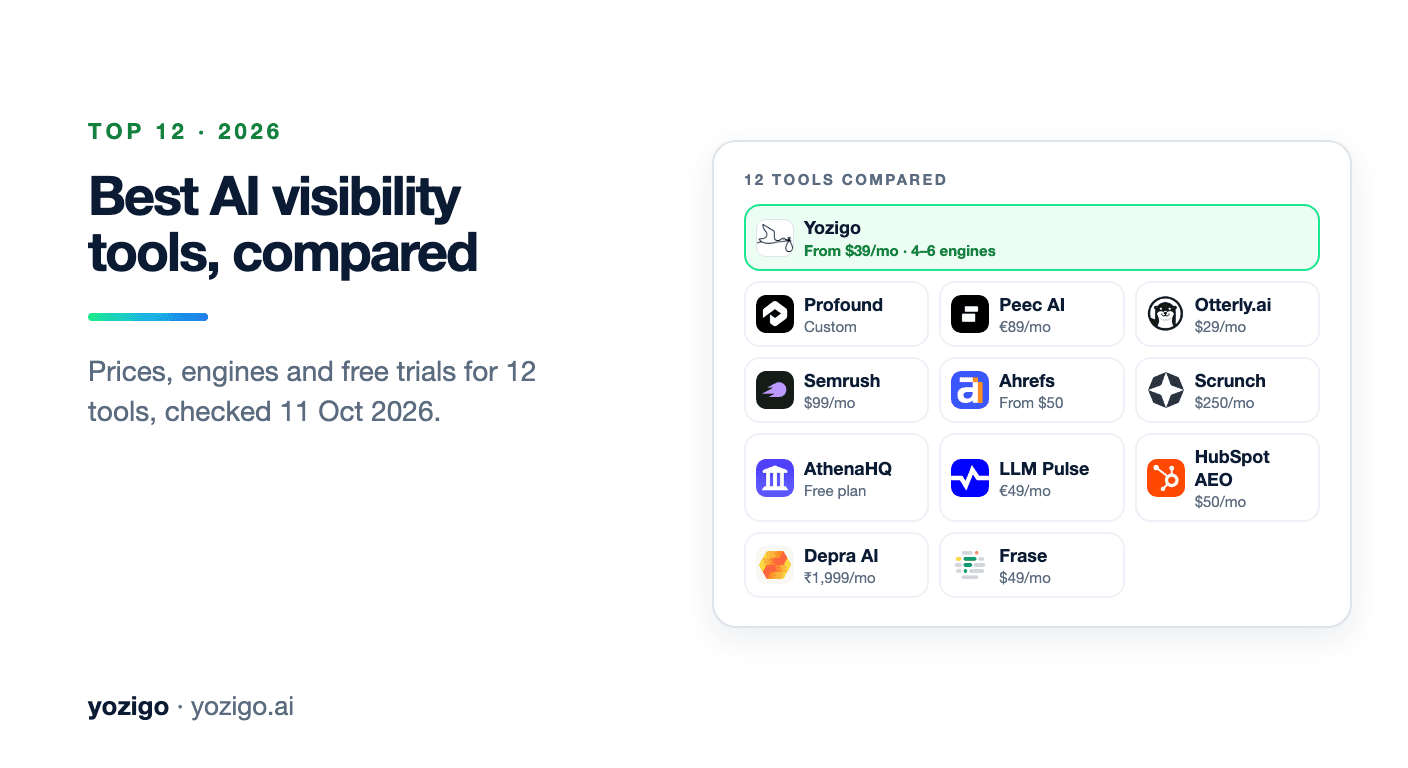
“Add-on” means the engine costs extra on every plan; “Enterprise” means it needs the custom plan. Peec AI lets you choose any three models per plan, so it can cover these three engines but not more without upgrading. Prices for each tool are in our 12 best AI visibility tools comparison.
Why do ChatGPT, Gemini and Perplexity need separate tracking?
Each engine reads the web differently. Across about 26,000 answers we recorded in one week, ChatGPT cited a median of 39 sources and named 14 brands per answer; Perplexity cited 15 and named 16; Gemini cited 8, named 12, and gave no source at all in 12% of answers.
Their favourite sources differ too. LinkedIn appeared in 13% of Perplexity answers, Reddit was Gemini’s top public domain, and ChatGPT leaned on GitHub, Reuters and G2. Only about 11% of domains cited by ChatGPT are also cited by Perplexity (The Digital Bloom, 2025), so a fix that works on one engine may do nothing on another.
Our engine pages go deeper
the ChatGPT visibility tracker, Perplexity visibility tracker and Gemini visibility tracker, with the full comparison on AI search trackers.
Which tool is best for monitoring all three engines?
The cheapest way to cover all three engines is LLM Pulse Starter at €0.20 per prompt per engine or Yozigo Momentum at $0.25, based on prices checked on 11 October 2026. Both include ChatGPT, Gemini and Perplexity on their standard plans with daily tracking.
Lowest cost for all three
LLM Pulse Starter (€49/month, 50 prompts, five models) and Yozigo Solo ($39/month, 30 prompts, four engines) both include ChatGPT, Gemini and Perplexity.
All three plus Google AI Mode and Copilot
Yozigo Momentum ($149/month, 100 prompts, six engines) or Ahrefs Brand Radar custom prompts, billed per check.
You already use HubSpot
HubSpot AEO ($50/month) covers the three engines, but not Google AI Overviews.
You only need ChatGPT, AI Overviews, Perplexity and Copilot
Otterly Lite ($29/month) covers those four; Gemini is an add-on.
Indian D2C brand
Depra AI covers all three with Hinglish tracking, but checks Perplexity weekly.
How do you monitor these engines without a tool?
Manual monitoring works for about ten questions. Twenty questions on three engines, checked three times, is 180 answers to read per round, and in our data ChatGPT named about 14 brands per answer, so each answer takes time to log properly (Yozigo tracking, October 2026).
You can, for a handful of questions. Ask each engine your buyer questions in a fresh session, note whether you are named, your position and the sources, and repeat on three different days. Our manual tracking guide gives a template.
It stops scaling quickly. Twenty questions on three engines, checked three times, is 180 answers to read and log each round. That is the point where a tool pays for itself, and where daily data starts to show trends instead of noise.
How did we pick these brand monitoring tool alternatives?
We started from the tools AI engines themselves name when buyers ask about brand monitoring tool. In our tracking of 87 unbranded buyer prompts from 11 September to 10 October 2026, ChatGPT searched for vendor names before answering, so the tools on its shortlist are the ones most buyers end up comparing.
We then kept tools that publish a price or a free tier, track at least three AI engines, and run prompts on a schedule rather than once. Each price and plan limit comes from the vendor’s own pricing page on the date shown in the table. Where a vendor does not publish a figure, we say so instead of estimating it. How Yozigo collects its own data is on our methodology page.
What does it cost to monitor all three engines?
| Tool and plan | Monthly price | Prompts | Engines | Per prompt per engine |
|---|---|---|---|---|
| Yozigo Solo | $39 | 30 | 4 | $0.33 |
| Yozigo Momentum | $149 | 100 | 6 | $0.25 |
| Yozigo Authority | $349 | 200 | 6 | $0.29 |
| Otterly.ai Lite | $29 | 15 | 4 | $0.48 |
| Otterly.ai Standard | $189 | 100 | 4 | $0.47 |
| Otterly.ai Premium | $489 | 400 | 4 | $0.31 |
| Peec AI Starter | €89 | 50 | 3 | €0.59 |
| Peec AI Pro | €199 | 150 | 3 | €0.44 |
| LLM Pulse Starter | €49 | 50 | 5 | €0.20 |
| Scrunch Core | $250 | 125 | 4 | $0.50 |
Covering ChatGPT, Gemini and Perplexity costs least per prompt on LLM Pulse Starter (€0.20 per prompt per engine) and Yozigo Momentum ($0.25). Yozigo Solo is $0.33 and includes all three. Otterly looks cheap at $29, but its Lite plan has no Gemini; adding Gemini costs extra on every plan.
Per prompt per engine = monthly price ÷ (prompts × engines included). Use it to compare plans that trade prompts against engines, then check the engines your buyers actually use.
What should you test before switching from a single-engine tool?
Run the same prompts in both tools for at least two weeks. AI answers change between sessions and days: in our tracking, ChatGPT named about 14 brands per answer and Perplexity about 16, and the lists shifted daily, so a single run proves nothing. Run your questions on all three engines in the new tool and compare which brands each engine names; the differences show why one engine is not enough.
Your real buyer questions
Use 15 to 30 questions your customers actually ask, not questions that already name you. Our prompt discovery framework shows how to pick them.
Branded and unbranded separately
Questions that contain your name are mentioned almost every time and inflate visibility. Check that the tool reports them apart, as explained in branded vs unbranded AI visibility.
The engines your buyers use
Confirm Google AI Overviews and AI Mode for Google-heavy markets, and Copilot for B2B buyers on Microsoft 365.
The sources behind each answer
A tool should show which pages each engine cited, so you know where to get mentioned. See how to track your brand in ChatGPT, Gemini and Perplexity for the manual version of this check.
Exports and history
Make sure you can export prompts, answers and citations, so a future switch does not cost you your trend lines.
Which tools show how often competitors get cited by AI chatbots vs you?
AI search monitoring tools that track competitors on the same questions show it directly. In our tracking of 13,162 unbranded answers, the two most-named specialist tools were named in 32% and 28% of answers, while most brands appeared in under 5%, so the gap between you and a category leader is usually large and visible within days.
Look for three views
share of voice (your mentions against each competitor’s), citation rate by domain (whose pages each chatbot cites), and the questions each competitor wins. Yozigo, Peec AI, Otterly and Profound all benchmark named competitors; Yozigo also shows the sources behind each competitor mention so you can see where they are winning. Share of model explains how to read the numbers.
Frequently asked questions: monitoring ChatGPT, Gemini and Perplexity
Yozigo, Ahrefs Brand Radar, LLM Pulse and HubSpot AEO include all three on standard plans. Otterly charges extra for Gemini and Scrunch keeps it for Enterprise.
Often not. They cite different sources: in our data ChatGPT cited a median of 39 sources, Perplexity 15 and Gemini 8, and their most-cited sites differ, so lists of recommended brands differ too.
Daily is best, because answers change between sessions. At minimum, check the same questions weekly on the same engines and compare trends rather than single answers.
Some do: Otterly and Yozigo as paid add-ons, and Scrunch on Enterprise.