ChatGPT vs Perplexity vs Gemini: How AI Engines Cite Brands
How six AI engines differ in citing and naming brands, from 232,838 answers: ChatGPT names 9.6 brands per unbranded answer, AI Overviews 2.1; Perplexity cites brand sites most.
How do AI engines differ in citing brands?
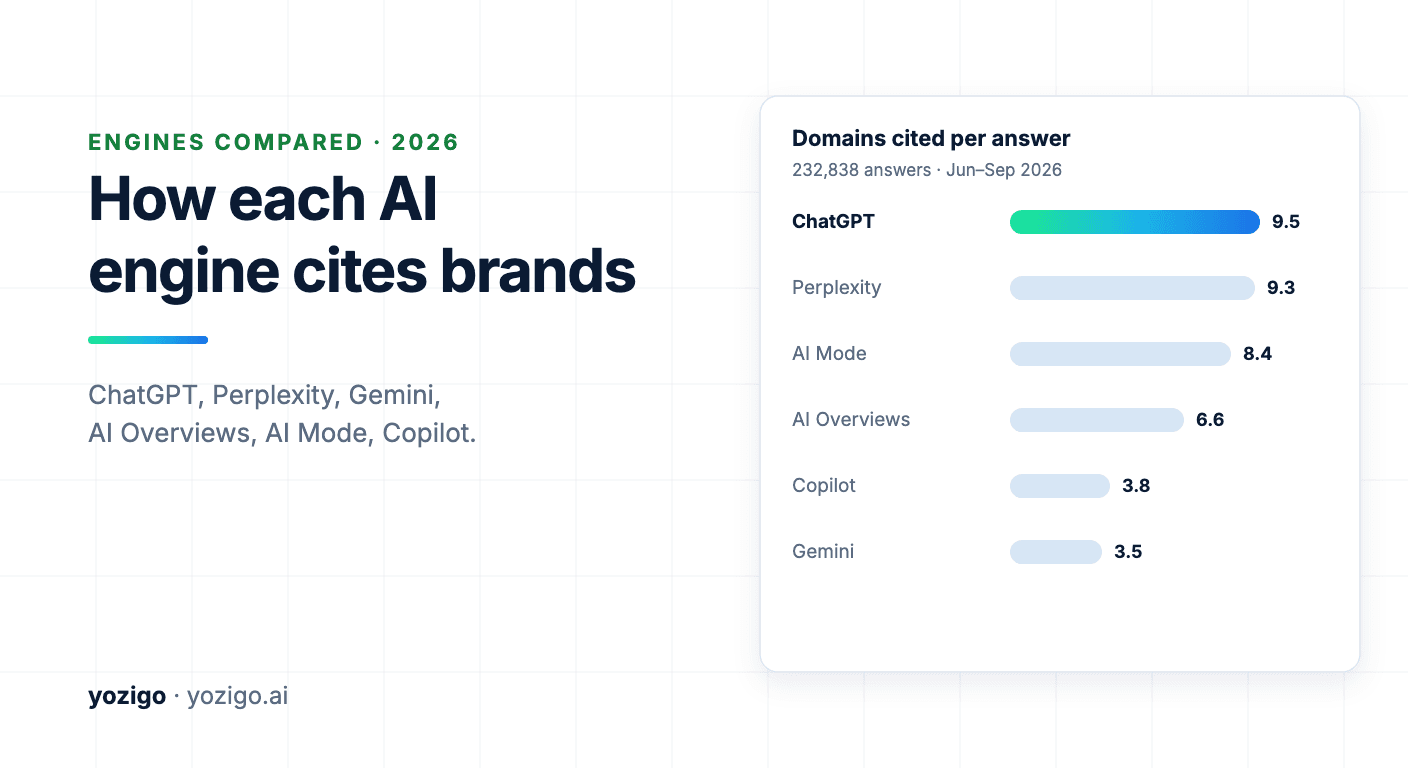
TL;DR: The six main AI engines cite and name brands differently. In 232,838 answers, ChatGPT cited 9.5 domains per answer and Gemini 3.5, and Google’s AI features took about a fifth of their citations from social platforms. Track and optimise each engine separately.
Across 232,838 answers over 90 days, ChatGPT cited the most domains per answer (9.5) and Gemini the fewest (3.5), while unbranded answers named 9.6 brands on average in ChatGPT against 2.1 in Google AI Overviews (Yozigo study, June–September 2026).
Key takeaways
- ChatGPT and Perplexity cite about 9.5 domains per answer; Gemini and Copilot about 3.5–3.8.
- ChatGPT names 9.6 brands per unbranded answer; AI Overviews names 2.1.
- Perplexity cites brands' own websites most often.
- Each engine needs a slightly different plan.
The engines behave very differently. In 232,838 answers Yozigo tracked between 29 June and 27 September 2026, ChatGPT cited 9.5 domains per answer and Perplexity 9.3, while Gemini cited 3.5 and Copilot 3.8. On unbranded questions, ChatGPT named 9.6 brands per answer, while Google AI Overviews named just 2.1.
In practice, ChatGPT gives many brands a chance to appear, while AI Overviews picks a very small shortlist. Being one of two names is harder, and worth more.
How do the six AI engines compare on citations and mentions?
| Engine | Domains cited per answer | Brands named (unbranded) | Mentioned (unbranded) | Own site cited (unbranded) |
|---|---|---|---|---|
| ChatGPT | 9.5 | 9.6 | 3.5% | 7.9% |
| Perplexity | 9.3 | 5.6 | 3.5% | 11.1% |
| Google AI Mode | 8.4 | 2.6 | 2.4% | 4.1% |
| Google AI Overviews | 6.6 | 2.1 | 3.2% | 7.0% |
| Microsoft Copilot | 3.8 | 3.4 | 2.9% | 4.4% |
| Gemini | 3.5 | 2.6 | 4.8% | 6.0% |
Mention rates across all prompts ranged from 12.3% on Google AI Overviews to 17.2% on Copilot, and answers citing the brand’s own site from 14.9% on AI Mode to 20.7% on Perplexity, in 232,838 answers over 90 days (Yozigo study, 2026).
All prompts (branded and unbranded) for sources per answer; unbranded prompts only for brands named and mention rate.
What does each engine reward?
ChatGPT searches most (2.64 sub-searches per answer in our fan-out data) and lists the most brands. Broad coverage across comparison pages and lists pays off here. ChatGPT search draws heavily on Bing's index, so Bing Webmaster Tools matters.
Perplexity cites brands' own websites more than any engine: 11.1% of unbranded answers. Clear, current, well-structured pages on your own site work best here.
Google AI Overviews and AI Mode name few brands, 2.1 and 2.6 per unbranded answer, and draw on pages that already rank in Google. Classic SEO strength is the entry ticket.
Gemini named brands most often on unbranded prompts (4.8%) while citing only 3.5 domains, so strong entity signals such as Wikipedia, Google Business profiles and consistent descriptions help.
Copilot searches once per answer on average (1.10) and cites 3.8 domains, so the top Bing result for a query carries a lot of weight.
Each engine documents its crawlers
OpenAI, Perplexity and Google list the user agents to allow in robots.txt.
Where does each engine get its sources?
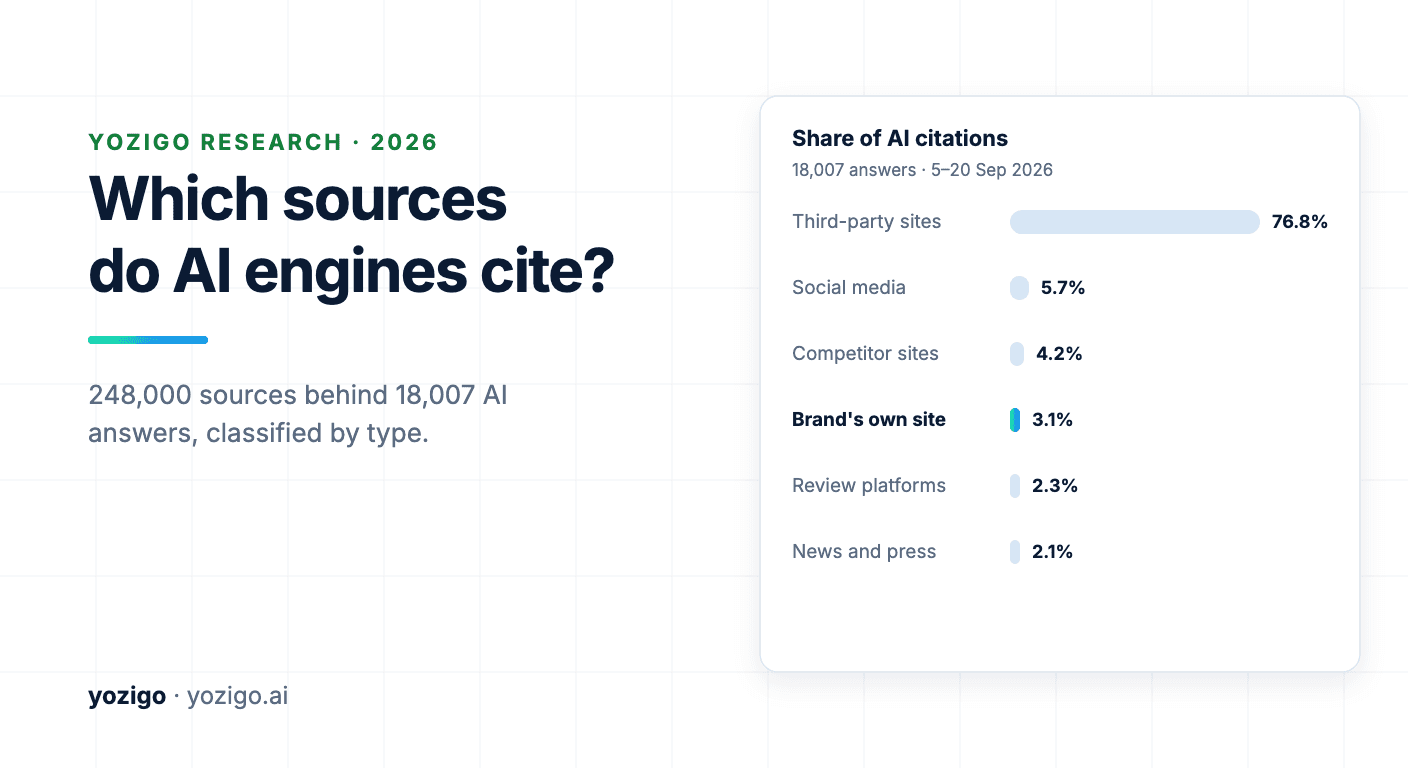
Third-party sites dominated every engine, from 62.1% of AI Mode’s citations to 83.0% of Gemini’s, but Google’s AI features took 18.7–20.0% of their citations from social platforms against 2.6% for ChatGPT (Yozigo study, September 2026).
Google's AI features lean on video and social posts: 9.3% of AI Overview citations and 10.0% of AI Mode citations were YouTube, against 0.2% for ChatGPT and Perplexity. If Google's AI answers matter to you, a YouTube explainer for your category is one of the highest-return pieces you can make.
ChatGPT takes more from knowledge hubs such as Wikipedia (3.0% of its citations). Perplexity takes 4.8% from LinkedIn. Gemini cites Reddit most (2.1%). Copilot relies on third-party company sites for 81.9% of its citations. Full numbers are in our AI citation study.
Should you optimise for every AI engine?
Usually yes, because the engines rarely agree: only about 11% of domains cited by ChatGPT are also cited by Perplexity (The Digital Bloom, 2025), and in our data each engine’s source mix differed sharply.
Start with the engines your buyers use, then fix the common base: third-party mentions, clear pages and correct facts. That base helps everywhere. Yozigo tracks all six engines on its Momentum and Authority plans (four on entry plans), so you can see where a change worked and where it didn't. See pricing.
How we measured
Yozigo ran the same tracked prompts daily on all six engines for 37 brands, 29 June to 27 September 2026, and analysed the cited sources of 18,007 answers between 5 and 20 September. AI Mode and Copilot were tracked for 12 brands, so their samples are smaller.
Frequently Asked Questions: ChatGPT vs Perplexity vs Gemini
ChatGPT, at 9.5 domains per answer in 232,838 answers we tracked in 2026, just ahead of Perplexity at 9.3. Gemini cited 3.5.
Google AI Overviews and AI Mode named only 2.1 and 2.6 brands per unbranded answer, so the shortlist is small. AI Mode had the lowest unbranded mention rate at 2.4%.
More than other engines: brands' own sites were cited in 11.1% of unbranded Perplexity answers, versus 4.1% to 7.9% elsewhere.
Yes, as a paid add-on on any plan. Solo includes four engines (ChatGPT, Perplexity, Gemini and Google AI Overviews); Momentum and up include all six, adding Google AI Mode and Microsoft Copilot.