ChatGPT Checks the Same Vendors First: What 7,116 Fan-Out Searches Show
We logged 7,116 web searches ChatGPT ran before answering questions about AI visibility software. It wrote vendor names into its own searches over 4,800 times and checked vendor sites 1,279 times. Here is what that means for getting onto its shortlist.
Does ChatGPT decide which brands to recommend before it searches?
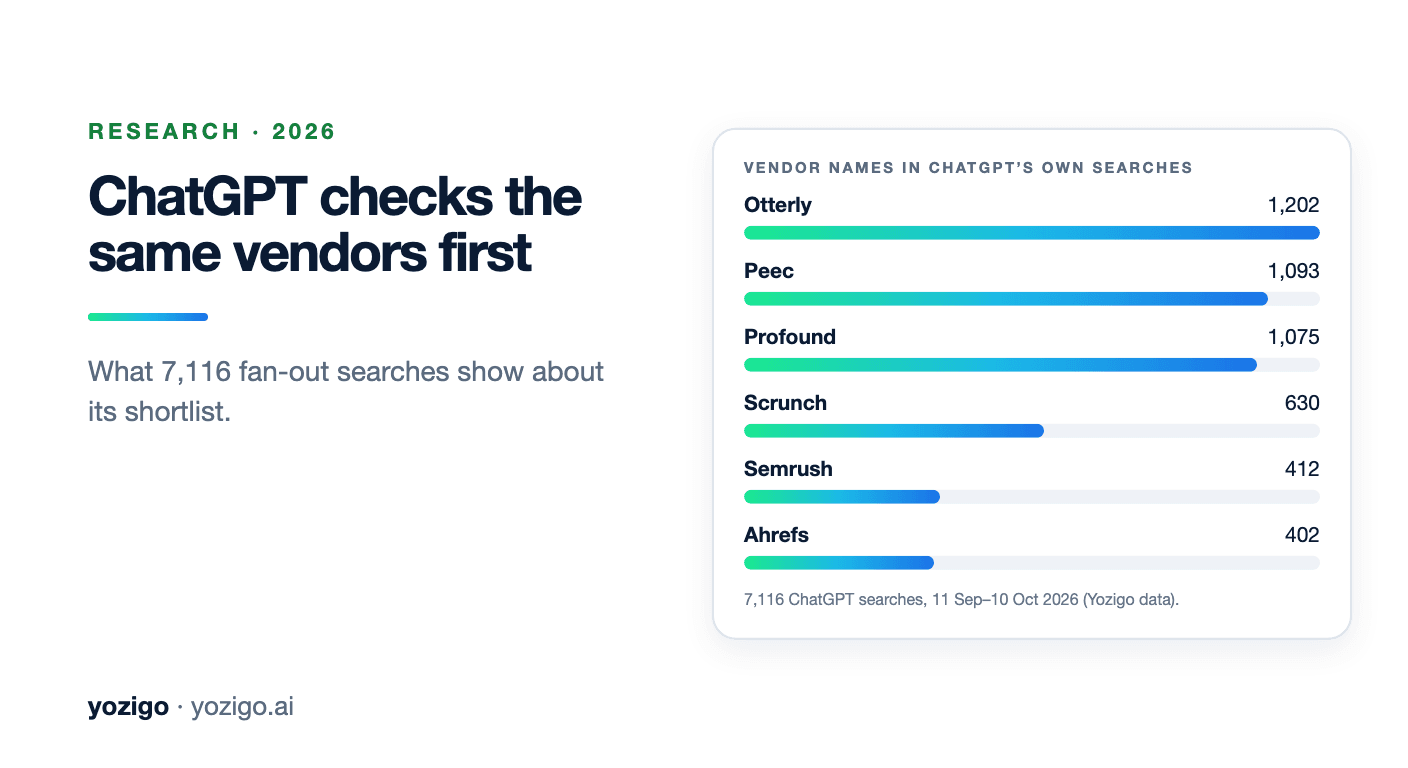
TL;DR: Often, yes. Across 7,116 web searches ChatGPT ran while answering 87 unbranded questions about AI visibility software, it typed vendor names into its own queries more than 4,800 times, led by Otterly (1,202), Peec (1,093) and Profound (1,075). It then checked vendors’ own sites with 1,279 site: searches. Brands missing from its starting list were rarely searched for at all.
Key takeaways
- ChatGPT’s searches are not neutral: 26% contained “2026” and many named three or four vendors at once.
- It verifies vendors directly on their domains, so a clear pricing and facts page gets read.
- It sometimes guesses domains wrong: it searched “profund.ai” 98 times.
- Perplexity behaves differently: its searches rarely named vendors and mostly mirrored the question.
How did we collect the data?
Yozigo tracks its own category every day. From 11 September to 10 October 2026 we ran 87 unbranded buyer questions, such as “best AI visibility tools for tracking brand mentions”, on ChatGPT and Perplexity in five countries, and recorded every web search each engine exposed before answering. ChatGPT exposed 7,116 searches and Perplexity 2,816.
The questions never named Yozigo or any other vendor, so every vendor name in a search came from the engine itself. A classifier sorted searches by type, and our fan-out analysis grouped them into 357 clusters of similar searches. More on how we record searches is on the methodology page, and the concept is explained in what query fan-out is.
The dataset covers 9,932 web searches that ChatGPT and Perplexity ran before answering 87 unbranded questions, in five countries, over 30 days ending 10 October 2026 (Yozigo fan-out data). No question named a vendor, so every vendor name in a search came from the engine.
Which vendors did ChatGPT search for by name?
| Vendor named in the search | ChatGPT searches | Perplexity searches |
|---|---|---|
| Otterly | 1,202 | 19 |
| Peec | 1,093 | 19 |
| Profound | 1,075 | 18 |
| Scrunch | 630 | 4 |
| Semrush | 412 | 26 |
| Ahrefs | 402 | 29 |
| LLM Pulse | 0 | 1 |
| Dageno | 0 | 0 |
Six vendors dominated ChatGPT’s own searches: Otterly appeared in 1,202, Peec in 1,093 and Profound in 1,075 of 7,116 searches (Yozigo fan-out data, 11 September–10 October 2026). Perplexity named the same vendors fewer than 30 times each in 2,816 searches.
A typical ChatGPT search looked like “best answer engine optimization AEO tools 2026 Profound Scrunch Otterly Writesonic”: the question plus a shortlist. The same six vendors led by a wide margin. LLM Pulse and Dageno, which are cited often as sources in the same answers, were never searched by name.
Perplexity named vendors in under 1% of its searches. Its searches mostly restated the question, which is why a page titled with the buyer’s exact question does well there, as our Perplexity visibility tracker page explains.
Why does ChatGPT run site: searches on vendor domains?
To verify. After building a shortlist, ChatGPT checked vendors’ own sites for prices, features and engine coverage: otterly.ai 231 times, peec.ai 202, semrush.com 120 and ahrefs.com 96. Profound was checked under five spellings, including 98 searches for “profund.ai” and 28 for “profund.com”.
Two lessons follow. First, your own site is read during verification, so it needs plain, current facts: what you sell, prices, engines or features, and limits. That is why we publish /ai-facts. Second, make your brand and domain easy to get right: one spelling, one domain, used the same way everywhere.
In our data, 18% of ChatGPT’s searches were site: checks on a vendor’s own domain, 1,279 of 7,116 (Yozigo fan-out data, September–October 2026). That makes a vendor’s pricing and facts pages part of the answer, not just its marketing.
What else do ChatGPT’s searches reveal?
| Pattern | Searches | Share |
|---|---|---|
| Contains “2026” | 1,819 | 26% |
| site: check on a vendor domain | 1,279 | 18% |
| “best” or “top” | 662 | 9% |
| Price, pricing or cost | 311 | 4% |
| Mentions Reddit | 109 | 2% |
ChatGPT’s searches are time-stamped and commercial. Of 7,116 searches, 1,819 (26%) included “2026”, 662 used “best” or “top”, and 311 asked about price (Yozigo fan-out data, September–October 2026), which tells you what words a page needs to match its searches.
Across both engines, among searches our classifier could label, about half looked for recommendations, 16% compared tools, 15% asked about pricing and 10% about implementation. The year matters: a quarter of searches added “2026”, so pages without a current year in the title compete at a disadvantage for these queries.
How do you get onto ChatGPT’s shortlist?
Be on the lists it already reads
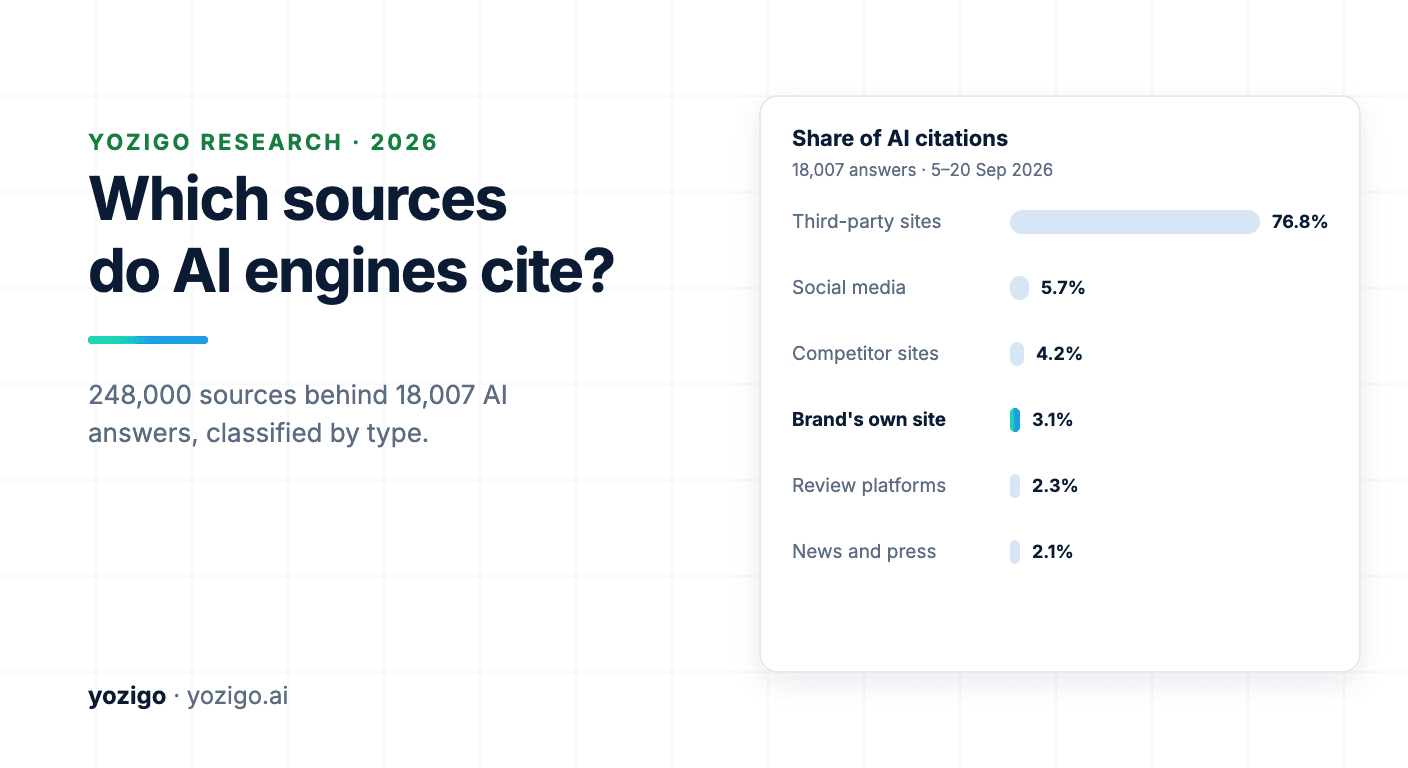
The shortlist comes from somewhere. In our data the same third-party lists were cited across hundreds of answers; brands are 6.5 times more likely to be cited through third-party sources than their own domain (AirOps, 2025).
Win the generic searches
A vendor that is not searched by name can still be cited if its page ranks for the generic search ChatGPT runs. Category pages titled with the category, the engines and the year earned citations this way.
Make verification easy
A pricing page and a facts page in plain text answer site: checks quickly.
Track it
Watch whether your name starts appearing inside ChatGPT’s searches. Yozigo shows the fan-out searches behind each answer; see the ChatGPT visibility tracker.
Can a brand that ChatGPT never searches for still get cited?
Yes, through generic searches. In the same month, one young vendor that ChatGPT never searched for by name was still cited in hundreds of ChatGPT answers. Its cited pages were category lists at short URLs, titled with the category, the engines covered and the year, such as a “best AI visibility tools (2026)” page. They matched the generic searches ChatGPT ran, like “best AI brand visibility tools ChatGPT Perplexity Google AI Overviews 2026”.
So there are two routes into ChatGPT’s answers. The shortlist route needs third-party lists and reputation. The generic-search route needs pages that match the searches ChatGPT writes: category, use case, engines and year in the title, with a direct answer and a comparison table. The second route is faster to build, which is why our 12 best AI visibility tools page follows that pattern.
How did Perplexity’s searches differ from ChatGPT’s?
| Pattern | Perplexity searches | Share |
|---|---|---|
| “best” or “top” | 447 | 16% |
| Contains “2026” | 248 | 9% |
| site: check on a vendor domain | 92 | 3% |
| Names any one vendor | under 30 per vendor | under 1% |
Perplexity mostly searched the question as asked. In 2,816 searches it used “best” or “top” 447 times and checked a vendor domain only 92 times, against 1,279 site: checks by ChatGPT (Yozigo fan-out data, September–October 2026).
Perplexity searched like a reader, ChatGPT like an analyst with a shortlist. Perplexity’s searches mostly restated the question, rarely named vendors and rarely checked vendor sites. That makes Perplexity more open to newer brands with well-titled pages, and ChatGPT more dependent on reputation built elsewhere. Our ChatGPT vs Perplexity vs Gemini study shows how this carries through to the brands each engine names.
What are the limits of this study?
Treat these figures as one category’s pattern, measured on 87 questions and 9,932 exposed searches over 30 days (Yozigo fan-out data, 2026). The method is reusable: record the searches behind your own buyer questions and count which brands the engine names before it answers.
One category
All 87 questions were about AI visibility software. Vendor counts will differ in other categories.
Exposed searches only
ChatGPT exposed its searches on about 86% of answers; the rest are not counted.
Classification
Our classifier labelled about a fifth of searches by type; the shares quoted are of labelled searches.
Our own brand
The questions came from Yozigo’s own tracking, and Yozigo is one of the vendors in this category. We report it because the method is reusable; the tables can be downloaded from our research page.
How do ChatGPT search citations work, according to OpenAI?
ChatGPT search cites the web pages it retrieves, and OpenAI’s documentation is clear on the first requirement: sites that opt out of OAI-SearchBot are not shown in ChatGPT search answers (OpenAI). GPTBot, which collects training data, is controlled separately, so a site can block training and still appear in ChatGPT search.
Beyond access, ChatGPT ranks what it retrieves across its several searches. An AirOps study of 16,851 queries found pages in the first retrieval position were cited 58.4% of the time against 14.2% at position ten, and strong heading matches earned 41% citations against 29% for weak ones (AirOps, April 2026). Our own search data shows what ChatGPT retrieves for; the next sections show what that means for brands.
Frequently asked questions: ChatGPT fan-out searches
A web search ChatGPT runs on its own before answering. One question can trigger several; in our data ChatGPT exposed about two searches per answer.
Yes. In 7,116 searches about AI visibility software it named vendors over 4,800 times, mostly the same six, before writing its answer.
Not in the ChatGPT app. Yozigo records them for about 86% of ChatGPT answers and groups them into clusters.
We measured one category in depth. Other categories will have different vendors on the shortlist, so check the searches behind your own buyer questions.