What Is Query Fan-Out? How AI Engines Search (2026 Data)
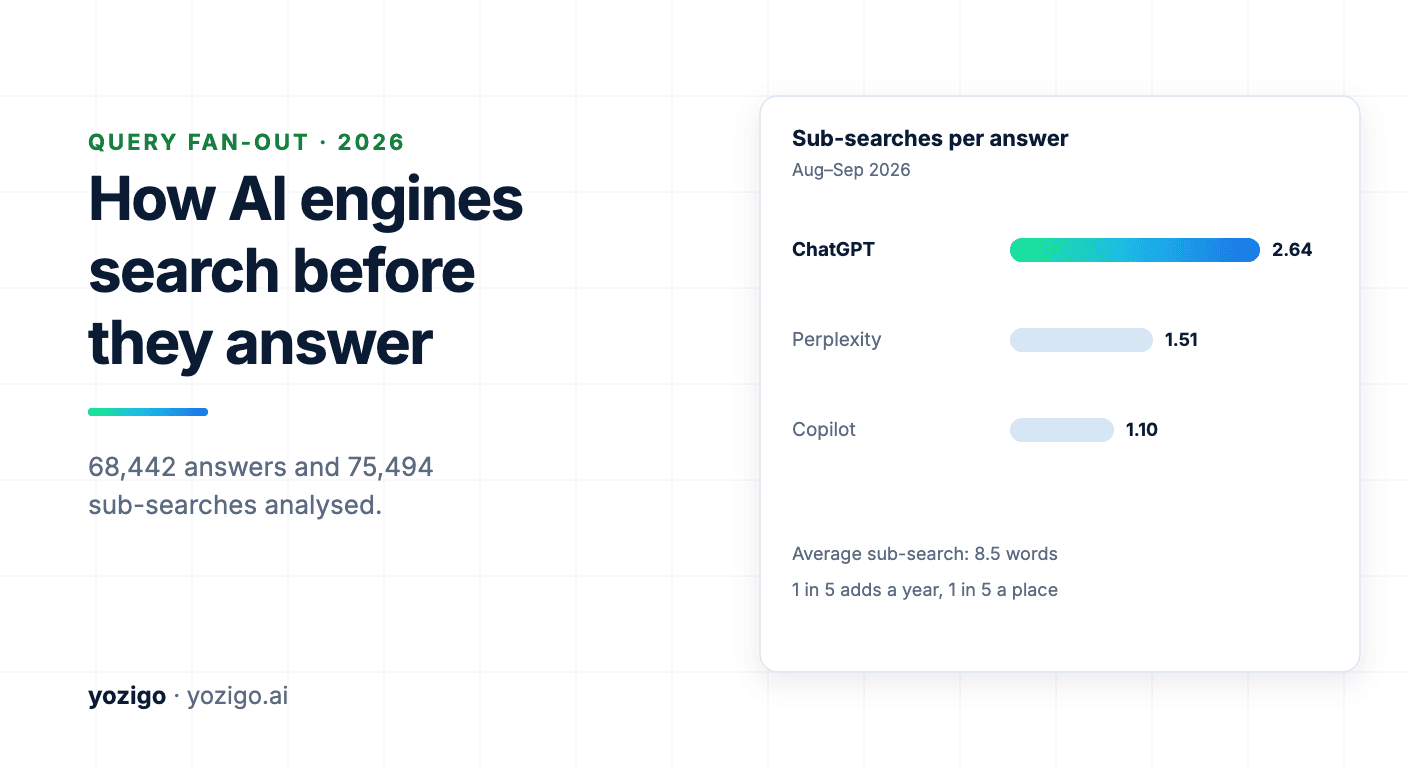
Query fan-out is how AI engines split one question into several web searches. Data from 68,442 answers: ChatGPT ran 2.6 searches per answer, Perplexity 1.5, Copilot 1.1.
What is query fan-out?
Key takeaways
- Query fan-out means an AI engine splits your question into several web searches before answering.
- In 68,442 answers, ChatGPT ran 2.64 searches per answer, Perplexity 1.51 and Copilot 1.10.
- Sub-searches average 8.5 words, and one in five adds a year.
- Pages that answer those sub-searches get retrieved.
Query fan-out is the step where an AI engine turns one question into several searches, reads the results, and writes one answer. Google described the technique publicly when it launched AI Mode, and ChatGPT, Perplexity and Copilot work the same way when they browse.
So when a buyer asks "best AI visibility tool for agencies", the engine might also search "AI visibility tool white label pricing" and "Yozigo vs Peec AI". Your page needs to match those sub-searches, not only the original question.
How many searches does each AI engine run?
| Engine | Sub-searches | Answers | Per answer |
|---|---|---|---|
| ChatGPT | 71,508 | 27,069 | 2.64 |
| Perplexity | 48,177 | 31,870 | 1.51 |
| Microsoft Copilot | 9,873 | 8,946 | 1.10 |
| Gemini (small sample) | 1,646 | 557 | 2.96 |
ChatGPT runs the most
2.64 searches per answer across 27,069 answers, against 1.51 for Perplexity and 1.10 for Copilot.
Yozigo records the searches engines report while answering tracked prompts. Figures cover answers where searches were captured, 8 August to 27 September 2026.
What do AI sub-searches look like?
Sub-searches are longer and more specific than what people type. Across 75,494 distinct sub-searches, the average was 8.5 words. 20.3% added a year such as 2026, 20.3% added a place or country, 9.1% included "best" or "top", and 5.9% included a price word.
Where we could classify intent, 44.4% were looking for recommendations, 19.0% for how-to steps, 17.5% for pricing and 10.8% for comparisons. For GEO-tool prompts, for example, engines searched "Yozigo Peec AI comparison GEO", "Otterly AI AI search visibility tracking features pricing" and "Google Search Console AI Overviews clicks impressions documentation".
How do you optimise content for query fan-out?
Match the four intents that make up 91.7% of classified sub-searches: recommendations, how-to, pricing and comparisons.
1. Answer the sub-questions on the page. Pricing, comparisons, how-to steps and "for [audience]" sections match the four biggest sub-search intents.
2. Put the year and the market in your headings when they're true. One in five sub-searches includes each.
3. Publish comparison pages for the names engines pair you with, such as Yozigo vs Peec AI.
4. Show prices on the page. 17.5% of classified sub-searches were about pricing, and engines can't cite a price hidden behind a form.
5. Find your own fan-out. Yozigo shows the sub-searches engines run for your prompts, alongside Prompt Volumes for demand.
Is query fan-out the same on every engine?
No. ChatGPT searches most per answer in our data and cites about 9.5 domains per answer; Copilot searches once and cites about 3.8. That's why the same page can win on one engine and miss on another. We compare the engines in ChatGPT vs Perplexity vs Gemini vs AI Overviews.
How we measured
Yozigo records the web searches engines report while answering tracked prompts for 30 brands. This covers 68,442 answers from 8 August to 27 September 2026; Google AI Overviews and AI Mode don't expose their searches, so they aren't included.
Frequently Asked Questions: query fan-out
It's how an AI engine breaks one question into several web searches, reads the results, and combines them into one answer. Google uses the term for AI Mode; ChatGPT, Perplexity and Copilot do the same when they browse.
2.64 on average in 27,069 ChatGPT answers Yozigo captured between August and September 2026. Perplexity ran 1.51 and Copilot 1.10.
Yes. Yozigo records the searches engines run for each tracked prompt, 75,494 distinct sub-searches across 30 brands so far, so you can write content that answers them.
Yes. It rewards pages that answer follow-up questions about price, comparisons and how-to steps. In our data 17.5% of classified sub-searches were about pricing and 20.3% named a year.