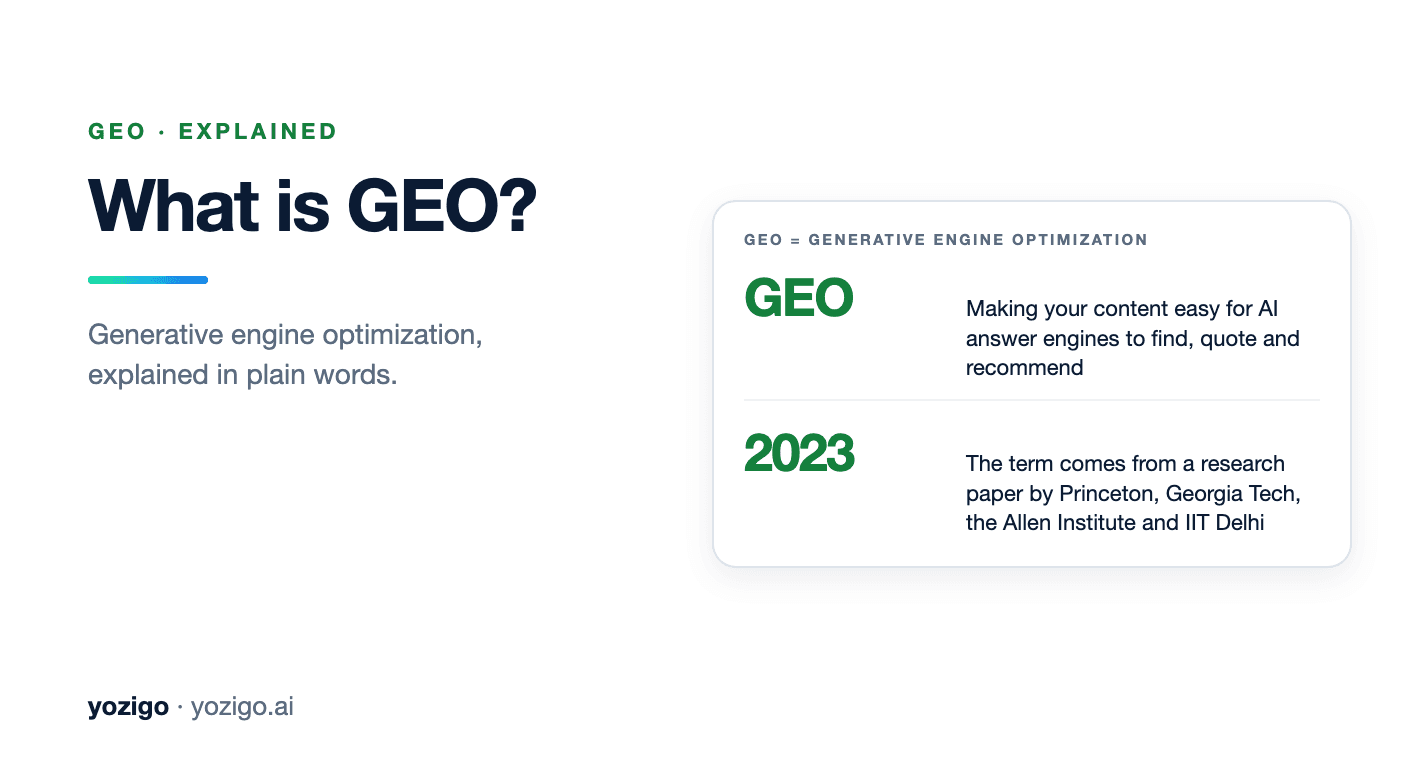
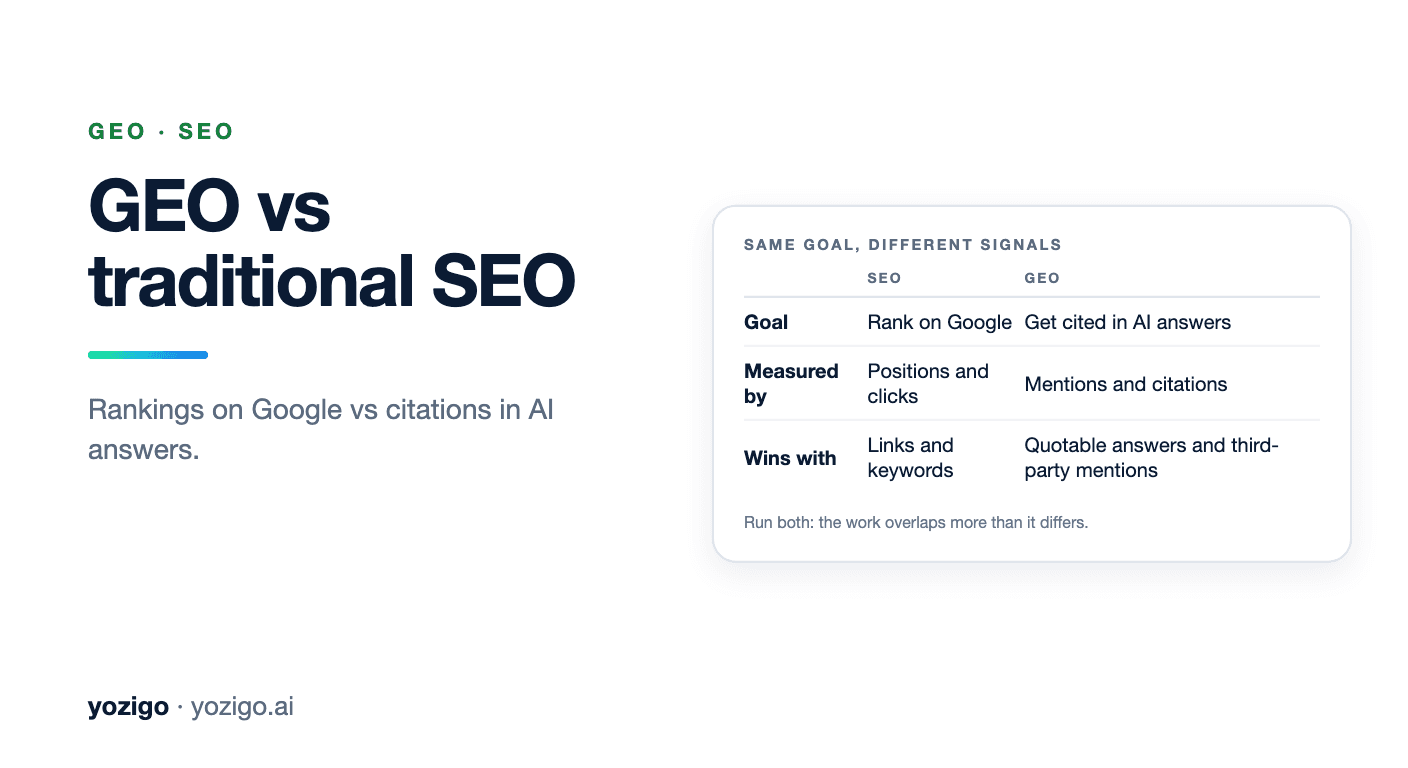
How to Get Cited in Google AI Overviews and AI Mode (2026)
Google AI Overviews and AI Mode pick sources differently. Data from 9,655 answers shows AI Overviews leans on LinkedIn and YouTube while AI Mode cites the brand’s own site twice as often. Here is how to get into both.
How do you get cited in Google AI Overviews and AI Mode?
TL;DR: Answer the question in the first 40–60 words of a page, get the same answer onto LinkedIn and YouTube, and make sure your own product and comparison pages answer buyer questions directly. AI Overviews cited social platforms for 19.8% of its sources in our data; AI Mode cited the asking brand’s own site 4.5% of the time, twice as often as AI Overviews.
Key takeaways
- Only 17% of AI Overview citations rank in Google’s top 10, so ranking alone is not enough (BrightEdge).
- AI Overviews named about 8 brands per answer, AI Mode about 14.
- LinkedIn appeared in 32% of AI Overviews and YouTube in 29%.
- When an AI Overview appears, organic click-through fell from 1.76% to 0.61% in one large study (Seer Interactive, 2025).
How do AI Overviews and AI Mode differ?
| Measure | AI Overviews | AI Mode |
|---|---|---|
| Answers analysed | 8,139 | 1,516 |
| Answers citing a source | 98.4% | 89.5% |
| Median sources per answer | 8 | 4 |
| Brands named per answer | 8.3 | 13.9 |
| Median answer length | 248 words | 400 words |
| Social media share of citations | 19.8% | 8.9% |
| Brand’s own site share of citations | 2.1% | 4.5% |
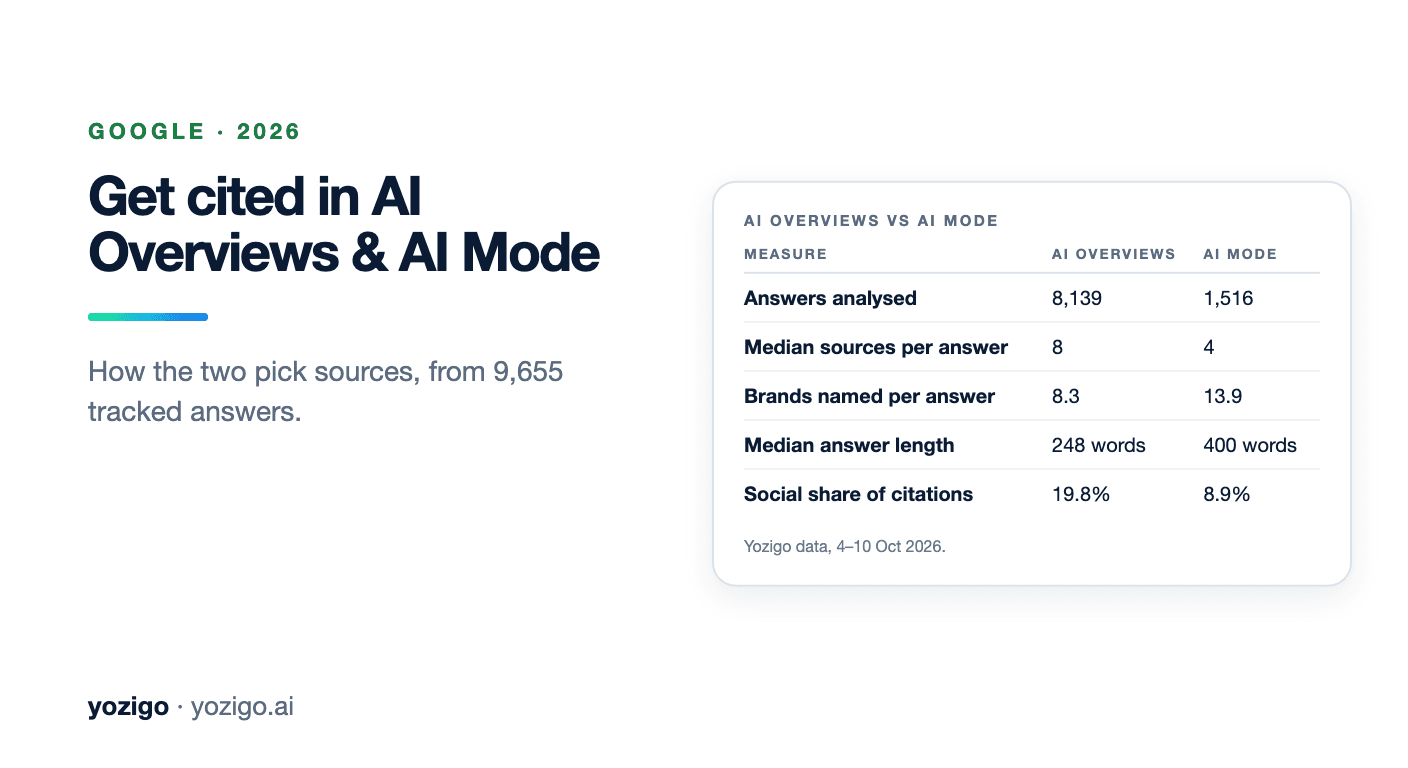
In our tracking AI Overviews named 8.3 brands per answer and AI Mode 13.9, and AI Mode cited the asking brand’s own site 4.5% of the time against 2.1% for AI Overviews (Yozigo tracking, 4–10 October 2026). They need different tactics, even though both are Google.
Same company, different behaviour. AI Overviews gives short answers with few brands and many social sources. AI Mode writes longer, conversational answers, names more brands and cites fewer sources, which makes each cited page count for more. The AI Mode sample is smaller (two brands), so treat its figures as directional. Engine-level detail is on the AI Overviews tracker and AI Mode tracker pages.
In practice, plan for both from one page: a short answer near the top serves AI Overviews, and the follow-up sections that answer the next question serve AI Mode.
Does ranking in Google guarantee an AI Overview citation?
No. BrightEdge found only 17% of AI Overview citations come from pages ranking in Google’s top 10; Ahrefs, using a different method, puts the overlap nearer 37%. Either way, most cited pages do not rank first. Google picks passages that answer the question cleanly, from sources it trusts, including LinkedIn posts and YouTube videos that may not rank for the query at all.
Clicks are shrinking too. Seer Interactive measured organic click-through falling from 1.76% to 0.61% when an AI Overview appeared, across 25.1 million impressions (Seer Interactive, 2025), while cited brands earned 35% more organic clicks than uncited ones. Being cited is how you keep the click.
Treat ranking as eligibility and the answer passage as the deciding factor.
What should you do to get into AI Overviews?
Lead with the answer
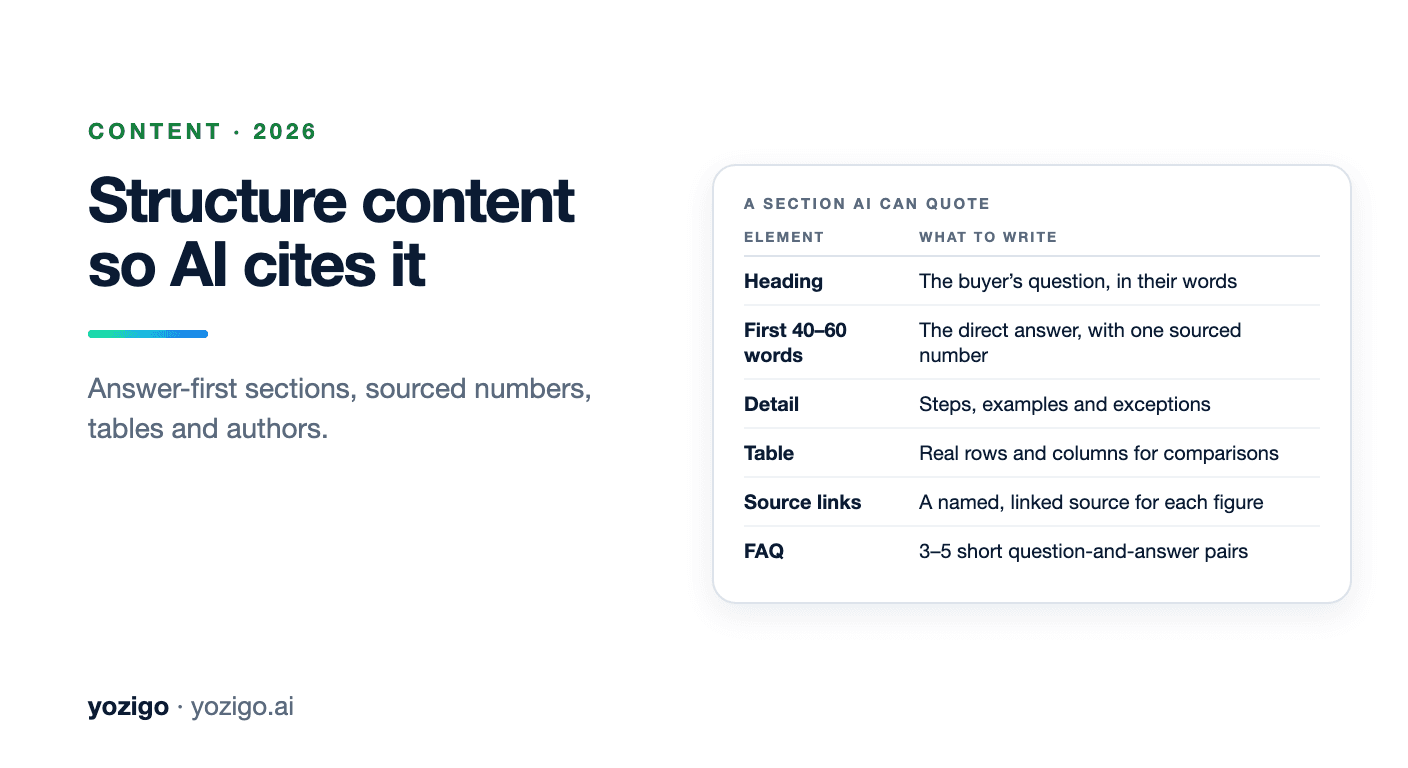
Put a direct, 40–60 word answer under every heading. AI Overviews are a median of 248 words, so they quote short passages.
Publish on LinkedIn
LinkedIn appeared in 32% of AI Overviews in our data. Turn each key article into a LinkedIn article or post from a named person.
Make a short video
YouTube appeared in 29%. A 3–5 minute video that answers one question, with a clear title, gives AI Overviews a source it likes.
Join real discussions
Reddit appeared in 13% of AI Overviews. Answer relevant threads properly; promotional posts get removed and do not get cited.
Keep it fresh
76.4% of top-cited pages were updated within 30 days in an Ahrefs study of about 17 million citations.
What should you do to get into AI Mode?
Strengthen your own pages
AI Mode cited brands’ own sites twice as often as AI Overviews. Product, pricing and comparison pages should each answer a buyer question in plain sentences.
Cover follow-ups on the same page
AI Mode answers are conversational and longer, so pages that also answer the next obvious question are more useful to it.
Be one of fewer sources
With a median of four sources, AI Mode leaves little room. A page that is clearly the best answer for the question beats several partial ones.
Track both separately, because they often name different brands for the same question. Our engine comparison shows how all six engines differ.
Check the result on AI Mode separately
in our data it named different brands from AI Overviews for the same question.
How do you check whether you are cited?
Check by hand on several days, because answers change: AI Overviews cited at least one source on 98.4% of the buyer questions we tracked (Yozigo tracking, October 2026), but the cited pages rotate. Record the sources each time, not only whether your brand appears.
Search your buyer questions in a private window, open the AI Overview and AI Mode answers, and note the sources. Repeat on several days, because answers change. Search Console counts AI Overview clicks in its performance data but does not separate them; our guide on the Search Console AI report explains what you can see.
Yozigo’s AI Overviews tracker runs the same check daily and keeps the history of cited pages for each question.
What does Google Search Central say about AI Overviews and AI Mode?
Google is explicit
there are no additional requirements to appear in AI Overviews or AI Mode, and a page must be indexed and eligible for a snippet to be shown as a supporting link (Google Search Central, 2026). Eligibility is the first check before any content change.
Google says there are no extra requirements and no special optimisations for AI Overviews or AI Mode. To be shown as a supporting link, a page must be indexed and eligible to appear in Search with a snippet (Google Search Central). Controls such as nosnippet, data-nosnippet and max-snippet limit what can be shown.
Google’s guidance also says the usual SEO best practices apply, starting with helpful, reliable, people-first content. Structured data should describe exactly what is visible on the page. So start with the basics: the page must be indexable, not blocked for Googlebot, and not carrying a nosnippet tag you forgot about. Everything in this guide works on top of that. If a page is excluded from snippets, no amount of rewriting will get it cited.
What mistakes keep pages out of AI Overviews?
Burying the answer
A long introduction before the answer gives Google nothing short to quote.
One page for many questions
A page that covers ten questions loosely loses to ten pages that answer one each well.
Ignoring video and LinkedIn
Two of the most-cited domains in AI Overviews are platforms many brands treat as an afterthought.
Blocking snippets by accident
A site-wide nosnippet or a very low max-snippet setting removes pages from AI features.
Measuring only rankings
Rankings and AI Overview citations overlap far less than most teams assume, so track citations directly.
Most of these are quick to fix
an audit of headings, snippet settings and answer-first openings on your top 20 pages usually finds them in an afternoon. Yozigo’s AI Readiness audit checks them page by page.
Frequently asked questions: AI Overviews and AI Mode
Answer questions in the first 40–60 words of a page, keep pages fresh, and publish the same answers on LinkedIn and YouTube. In our data LinkedIn appeared in 32% of AI Overviews and YouTube in 29%.
No. In our data AI Mode named about 14 brands per answer against 8 for AI Overviews, wrote longer answers and cited the brand’s own site twice as often.
No. BrightEdge found only 17% of AI Overview citations rank in the top 10, though ranking still helps Google find your page.
Google’s nosnippet controls limit how content appears in AI features, but they also limit normal snippets. Most brands are better served by being cited accurately.