End-to-End GEO Platform: What It Should Do (2027)
Tracking shows where AI leaves you out; it doesn’t fix it. What an end-to-end GEO platform should do at each stage, from tracking to content, placements and proof, and how to evaluate one.
What is an end-to-end GEO platform?
TL;DR: An end-to-end generative engine optimization (GEO) platform tracks how AI engines answer your buyers’ questions, finds why you’re missing, creates the content and placements that fix it, and proves the result. Tracking alone isn’t enough: 77% of ChatGPT citations in our September study went to third-party sites (AI citation sources study), so most fixes happen off your site.
Key takeaways
- Five stages: track, diagnose, create, place and prove.
- Each stage needs its own data, from cited URLs to crawler logs.
- Changes wait for a person’s approval by default.
- Judge a platform on whether its fixes move the numbers it tracks.
Disclosure
Yozigo publishes this guide and is an end-to-end platform.
What should each stage of a GEO platform do?
| Stage | What it should do | Data it needs |
|---|---|---|
| Track | Run your buyer questions daily on each engine and country | Answers, brands named, position, cited URLs |
| Diagnose | Find why competitors are named and you aren’t | Cited pages, fan-out searches, crawler access |
| Create | Draft answer-first pages for the gaps, approved by a person | Target questions, your own facts and voice |
| Place | Get you onto the pages AI already cites | Most-cited pages per engine, editor contacts |
| Prove | Show the change in mentions, citations and visits | Before-and-after tracking, AI referrals, Search Console |
Each stage should feed the next with data, not opinions. ChatGPT cited about 45 sources and named about 12 brands per answer to tool questions in our tracking (Yozigo tracking, 15–19 Nov 2026), so diagnosis needs the full source list, not only a visibility score.
When do you need end-to-end rather than tracking only?
When nobody on your team has time to act on what the tracker shows. A tracker shows you the gap; turning it into pages, pitches and fixes is the work.
Tracking only suits teams with writers and an SEO lead who will act on the data each week. End-to-end suits teams that want the implementation done, with approval at each step. Our GEO trackers study compares tracking tools if you have the team.
What did we learn running GEO on our own site?
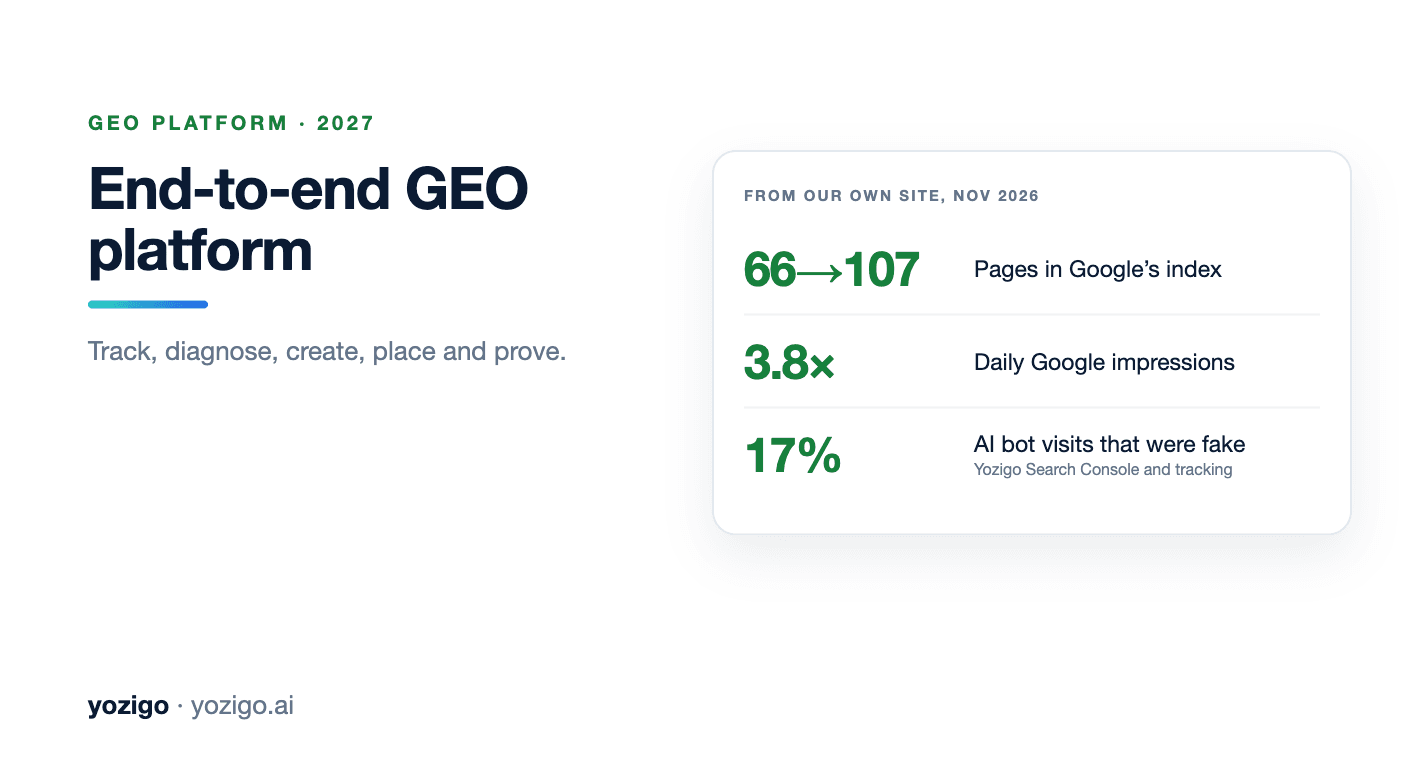
That the technical stage comes first. In November 2026 we found 43 of our 109 sitemap pages weren’t in Google’s index; after we requested indexing, 107 were indexed by 19 November, and impressions averaged 2,438 a day from 11 to 19 November, up from 648 a day from 28 October to 10 November (Yozigo Search Console).
Clicks moved much less, from 5 to 7 a day, which is why the prove stage needs AI mentions and citations alongside clicks. We also found that 17.1% of requests claiming to be AI bots on the 11 sites we track failed IP or DNS checks (30 days to 20 Nov 2026), so crawler data needs verifying before it’s trusted.
How do you evaluate an end-to-end GEO platform?
Ask to see each stage working on your own questions during a trial. A platform that shows you the cited pages, drafts a fix and tracks the result in one place is easier to prove than one that only reports a score.
Tracking depth
Engines, countries and daily runs, with cited URLs per answer.
Diagnosis
Does it show why a competitor was named, not only that it was?
Creation
Are drafts grounded in your facts, and do you approve every one?
Placements
Does it find the pages AI cites and help you get onto them?
Proof
Can it show before-and-after mentions, citations and AI-referred visits?
How does Yozigo handle each stage?
Yozigo is built for brands that want a done-for-you service on an end-to-end platform that handles implementation, feedback and impact. It tracks your questions daily on four engines from $39 a month (Solo) and all six from $149 (Momentum), finds opportunities, and its AI employees draft content, LinkedIn posts and outreach for your approval. For each stage in depth, see AI content writers for GEO, how many placements you need and LinkedIn automation for AI visibility, or features and pricing.
Frequently asked questions: end-to-end GEO platforms
A tracker reports where AI names and cites you. An end-to-end platform also diagnoses gaps, creates content and placements, and proves the result.
Because most fixes happen off your site: 77% of ChatGPT citations in our September study went to third-party pages, which you change by getting listed, not by editing your own site.
Track daily and compare four-week periods. On our own site, Google impressions rose in the nine days after we fixed indexing; AI mentions are slower to move.
Yes. Google says its AI answers draw on pages that are indexed and eligible to show with a snippet (Google Search Central), so technical SEO is the first stage.