Best Generative Engine Optimization Trackers (2026)
We checked 3,268 US and UK AI answers to “which GEO tool should I use?” questions to see which generative engine optimization trackers AI recommends. ChatGPT named Profound, Peec AI, Semrush and Otterly in about 8 of 10. Here is how the main GEO trackers compare on price, engines and daily tracking.
What are the best generative engine optimization trackers in 2026?
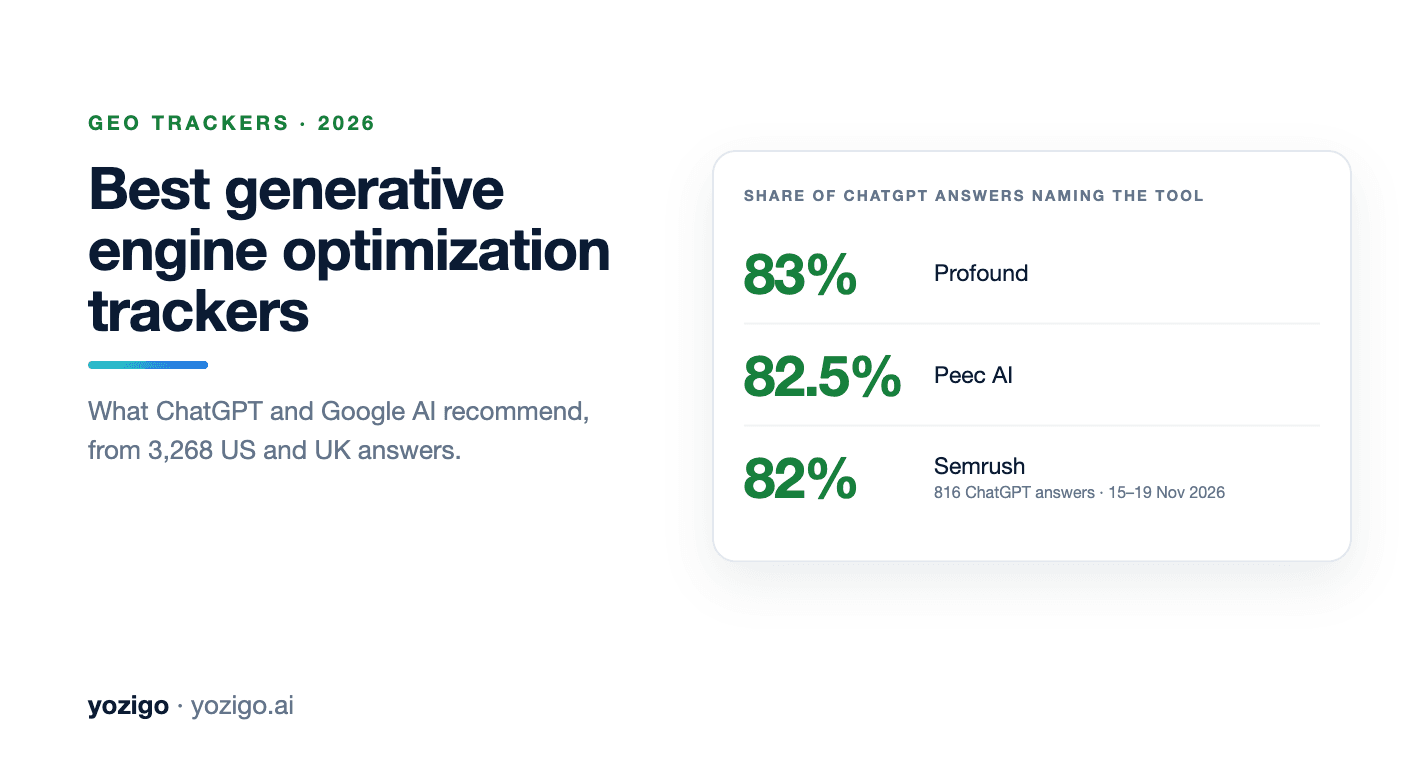
TL;DR: In 3,268 US and UK AI answers to tool-selection questions (Yozigo tracking, 15–19 Nov 2026), ChatGPT named Profound in 83% of answers, Peec AI in 82.5%, Semrush in 82% and Otterly in 81.5%. Google AI Overviews leaned on Semrush (83%) and Ahrefs (63%). Pick a tracker on engines covered, prompts per day and source data, not on one test answer.
Key takeaways
- A generative engine optimization (GEO) tracker runs your buyer questions on AI engines every day and records who gets named and cited.
- ChatGPT and Perplexity recommend the same five vendors most often; Google AI Overviews and Gemini name Semrush most (83% and 88%), with Ahrefs and Profound next.
- Answers change day to day, so single checks mislead.
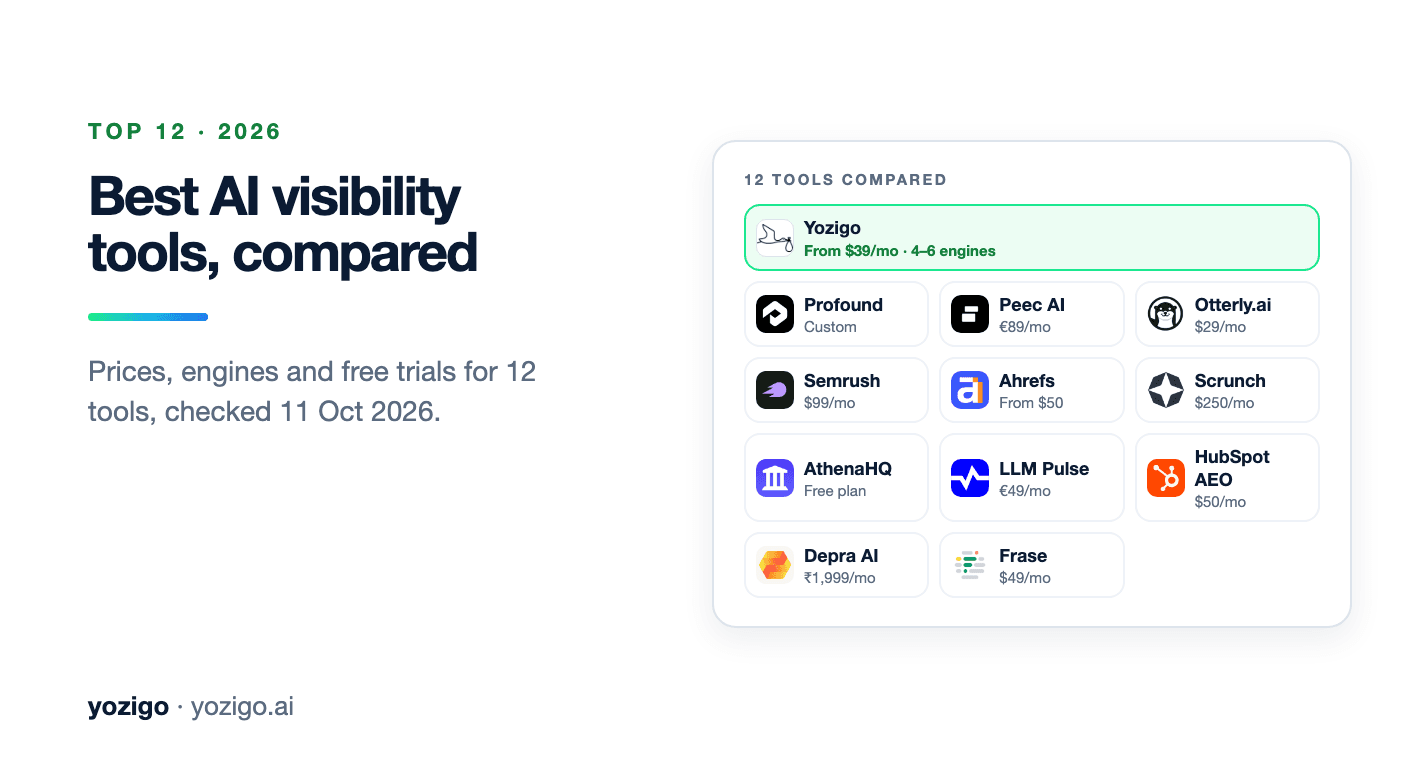
- Entry plans run from €29 (Otterly Lite) to $295 a month (AthenaHQ Starter); Profound sells a custom Enterprise plan only.
Disclosure
Yozigo publishes this guide and ran the tracking behind it. We leave Yozigo out of the AI-mention figures and list it in the price table like every other tool. Every price links to the vendor’s own page.
What is a generative engine optimization tracker?
A GEO tracker sends a fixed list of buyer questions to AI engines such as ChatGPT, Perplexity, Gemini and Google AI Overviews on a schedule. It saves each answer and reports whether your brand was named, where it ranked, which competitors appeared and which pages were cited. A typical ChatGPT answer to a tool question names 12 brands and cites about 45 sources (Yozigo tracking, 15–19 Nov 2026), so there is a lot to record.
It answers a question your rank tracker can’t. Google says there are “no additional requirements to appear in AI Overviews or AI Mode” beyond normal SEO (Google Search Central). Ranking well doesn’t guarantee a place in the AI answer, though. Only a tracker that reads the answers shows you whether you’re in it.
You will see the same category called a GEO tool, an AEO (answer engine optimization) tool, an AI visibility tracker or an LLM visibility platform. The core job is the same. The differences are which engines each tool covers, how many questions it runs and how often, and whether it shows the sources behind each answer. For the wider category, see our guide to the 12 best AI visibility tools.
Which GEO trackers do AI engines recommend most?
| Tracker | ChatGPT | Google AI Overviews | Gemini | Perplexity |
|---|---|---|---|---|
| Semrush | 82% | 83% | 88% | 93% |
| Profound | 83% | 62% | 74% | 85% |
| Peec AI | 82.5% | 45% | 54% | 85% |
| Otterly.ai | 81.5% | 48% | 69% | 84% |
| Ahrefs | 73% | 63% | 72% | 84% |
| Scrunch | 53% | 10% | 20% | 65% |
| AthenaHQ | 35% | 17% | 21% | 67% |
| SE Ranking | 25% | 41% | 37% | 59% |
| HubSpot | 22% | 15% | 19% | 48% |
| Rankscale | 13% | 10% | 17% | 53% |
| LLM Pulse | 0.2% | 0% | 6% | 20% |
ChatGPT names the same four vendors in about eight of every ten answers. Across 816 ChatGPT answers to tool-selection questions in the US and UK (Yozigo tracking, 15–19 Nov 2026), Profound appeared in 83%, Peec AI in 82.5%, Semrush in 82% and Otterly in 81.5%. Ahrefs followed at 73% and Scrunch at 53%.
Google’s two answer surfaces lean hardest on Semrush. Google AI Overviews named Semrush in 83% of answers and Ahrefs in 63%, with Profound at 62%. Gemini looked similar: Semrush 88%, Profound 74% and Ahrefs 72%. Perplexity lists far more vendors per answer, so nearly every major tool scores high there.
Why does this matter for choosing a tracker? These are the tools your buyers already hear about when they ask AI for advice. It is also a fair test of the trackers themselves: a tool that can’t show you this table for your own category isn’t doing the core job.
How do the best GEO trackers compare on features, price and engines?
| Tool | Best for | Entry price | AI engines | Where it falls short |
|---|---|---|---|---|
| Semrush AI Visibility Toolkit | Teams already paying for Semrush | $99/month per domain, billed yearly | ChatGPT, Google AI, Gemini, Perplexity | Priced per domain; extra users from $45/month |
| Profound | Enterprise teams that want agents and the widest answer-engine data | Custom (Enterprise) | Up to 10 engines, including ChatGPT, Perplexity, Gemini, AI Overviews, AI Mode and Claude | No published price; Enterprise contract only |
| Peec AI | SEO and marketing teams that want clean benchmarking dashboards | $95/month (Starter) | Any 3 of ChatGPT, Perplexity, AI Overviews, AI Mode, Gemini and others; extra models from $30/month; up to 26 on Enterprise | Only 3 models per plan below Enterprise |
| Otterly.ai | Low-cost daily monitoring | €29/month (Lite) | 4 of 7 engines per plan (ChatGPT, AI Overviews, Perplexity, Copilot, Gemini, AI Mode, Claude), paid in credits | Credits run out faster with more engines; 16 prompts on Lite |
| Ahrefs Brand Radar | Researching any brand across a 470M-prompt database | Custom prompts from $50/month; AI Visibility Index from $199/month | AI Overviews, AI Mode, ChatGPT, Perplexity, Gemini, Copilot (Claude uses 8 checks per update) | Index figures are modelled from search data; own-prompt tracking is billed per check |
| Scrunch | Brands that also want an AI-agent version of their site | $250/month billed yearly, $300 monthly (Starter) | ChatGPT, Claude, Gemini, Perplexity, Google AI Mode, AI Overviews, Meta AI | Higher entry price than monitoring-only tools |
| AthenaHQ | Trying many engines on free credits | Free (Essential); Starter $295/month | 5 engines free; 11 on Starter incl. ChatGPT, Perplexity, AI Overviews, AI Mode, Gemini, Claude, Copilot | Nothing between the free plan and $295 |
| Rankscale | Tracking many brands on credits | €99/month (Pro) | 17+ AI engines, paid in credits | Daily multi-engine tracking uses credits quickly |
| LLM Pulse | Many prompts per euro | €49/month weekly tracking; €79 daily (Starter) | ChatGPT, Perplexity, AI Mode, AI Overviews, Gemini on every plan | Daily tracking costs more than weekly |
| HubSpot AEO | HubSpot customers who want a quick AI brand check | $50/month, $45 billed yearly (or included in Marketing Hub Pro and Enterprise) | ChatGPT, Perplexity, Gemini | No Google AI Overviews, AI Mode or Copilot |
| Yozigo | Brands that want a done-for-you service on an end-to-end platform that handles implementation, feedback and impact | $39/month (Solo) | ChatGPT, Perplexity, Google AI Overviews, Gemini on Solo; all 6 incl. AI Mode and Copilot from $149 (Momentum); Claude as a paid add-on | Claude is a paid add-on on every plan; AI Mode and Copilot from Momentum |
Entry plans for GEO trackers run from €29 a month (Otterly Lite) to $295 a month (AthenaHQ Starter). Rankscale starts at €99 a month on credits, and Profound sells a custom Enterprise plan only. Engine coverage varies as much as price: Peec AI tracks any 3 models per plan, Otterly 4 on Lite, and Ahrefs Brand Radar all six, billed per check.
Both price tables use each vendor’s own pricing page, checked on 20 November 2026. Prices change often, so confirm on the vendor’s site before you buy. The next table shows what each entry plan includes, so you can compare questions tracked, not only price. For low-cost plans in more depth, see our guide for small businesses.
What does each GEO tracker’s entry plan include?
| Tool | Entry price | What the entry plan includes | Free trial |
|---|---|---|---|
| Semrush AI Visibility Toolkit | $99/month per domain, billed yearly | 25 custom prompts daily, 1 domain | No toolkit-specific trial listed |
| Profound | Custom (Enterprise) | Enterprise only since September 2026 (Starter and Growth retired); custom prompts, daily runs, unlimited seats | No trial listed; demo on request |
| Peec AI | $95/month (Starter) | 50 prompts daily, 3 models of your choice, 1 project; Pro $245 for 150, Advanced $495 for 350 | Free trial (length not stated) |
| Otterly.ai | €29/month (Lite) | 16 prompts daily, 2,000 credits; Standard €189 for 120, Premium €489 for 403 | Free trial (length not stated) |
| Ahrefs Brand Radar | Custom prompts from $50/month; AI Visibility Index from $199/month | 5 custom prompts included with Ahrefs Lite ($129/month); $50 package = 2,500 checks a month (about 83 prompts daily on 1 platform) | No free trial |
| Scrunch | $250/month billed yearly, $300 monthly (Starter) | 350 custom prompts, 1,000 industry prompts, 3 users | 7 days on Starter, no card |
| AthenaHQ | Free (Essential); Starter $295/month | 300 credits free; 3,600 credits on Starter | Free plan with $25 credit |
| Rankscale | €99/month (Pro) | Unlimited prompts, 1,200 credits (about 4,800 AI answers a month), 10 brand dashboards | 7 days on Pro |
| LLM Pulse | €49/month weekly tracking; €79 daily (Starter) | 50 prompts, 1 project | 14 days, card required |
| HubSpot AEO | $50/month, $45 billed yearly (or included in Marketing Hub Pro and Enterprise) | 25 prompts on 3 engines, updated daily; free one-time grader | Free trial on 25 prompts, no card |
| Yozigo | $39/month (Solo) | 30 prompts daily on 4 engines, unlimited seats | 14 days, no card |
Entry plans differ most in how many questions they track. Otterly Lite covers 16 prompts for €29, LLM Pulse 50 prompts on 5 models for €49 (weekly) or €79 (daily), and Peec AI Starter 50 prompts on 3 models for $95 (vendor pricing pages, checked 20 November 2026). Divide price by prompts × engines to compare plans fairly.
Per prompt per engine, LLM Pulse daily is cheapest at about €0.32 a month (€79 ÷ 50 prompts × 5 engines). Yozigo Solo works out at $0.33 ($39 ÷ 30 × 4) and Otterly Lite at €0.45 (€29 ÷ 16 × 4). Peec AI Starter costs $0.63 ($95 ÷ 50 × 3). All figures use each vendor’s published plan limits on 20 November 2026.
Free trials range from none (Semrush’s toolkit, Ahrefs Brand Radar) to 14 days without a card. Use the trial to run your own 20 to 30 buyer questions every day for the full period; a single run tells you little.
Which GEO tracker covers each AI engine?
| Tool | ChatGPT | Perplexity | Gemini | AI Overviews | AI Mode | Copilot |
|---|---|---|---|---|---|---|
| Yozigo (Claude as add-on) | Yes | Yes | Yes | Yes | Momentum and up | Momentum and up |
| Ahrefs Brand Radar (billed per check) | Yes | Yes | Yes | Yes | Yes | Yes |
| Otterly.ai (4 of 7 engines per plan) | Credits | Credits | Credits | Credits | Credits | Credits |
| Scrunch | Yes | Yes | Yes | Yes | Yes | No |
| LLM Pulse | Yes | Yes | Yes | Yes | Yes | No |
| Peec AI (any 3 models per plan) | Pick 3 | Pick 3 | Pick 3 | Pick 3 | Pick 3 | No |
| Profound (Enterprise only) | Yes | Yes | Yes | Yes | Yes | No |
| HubSpot AEO | Yes | Yes | Yes | No | No | No |
Most trackers cover ChatGPT, Perplexity and Google AI Overviews; far fewer include Google AI Mode and Microsoft Copilot on their entry plans. That gap matters more than price for many teams. Copilot reaches buyers inside Microsoft 365, and AI Mode is Google’s conversational search.
Pick engines by where your buyers ask. B2B teams selling to Microsoft-heavy companies should check Copilot coverage first. Consumer brands should start with ChatGPT and Google AI Overviews. Each engine also cites different sources, as our ChatGPT vs Perplexity vs Gemini citation study shows.
For a closer look at tracking one engine, see our pages on the ChatGPT visibility tracker, Perplexity tracker, Gemini tracker, Google AI Overviews tracker, Google AI Mode tracker and Copilot tracker. The AI search trackers overview explains how the six engines differ.
The matrix above covers the tools that publish an engine-by-engine list. Semrush, AthenaHQ and Rankscale list engines differently, so their coverage is in the comparison table instead.
Why do GEO tracker results change from day to day?
AI answers are not fixed, so one check proves very little. In our five-day sample, Scrunch, which ChatGPT names in about half of its answers, appeared on some days but not others for 45% of ChatGPT prompt-and-country pairs, 59% on Google AI Overviews and 83% on Gemini (Yozigo tracking, 15–19 Nov 2026). Only Perplexity, which lists about 31 brands per answer, was steadier at 21%.
The size of each answer explains part of it. A typical ChatGPT answer named 12 brands, Gemini 14 and Google AI Overviews 8. When an engine names only eight vendors, small changes in its sources push brands in and out of the list.
ChatGPT also reads a lot before it answers: about 45 cited sources per answer in our data, against 9 for Gemini and 7 for AI Overviews. Our study of ChatGPT’s fan-out searches shows how it searches vendor names before it writes the list.
So what should you do? Run each question at least daily, read trends over two weeks or more, and judge a tracker on how it reports change, not on one screenshot.
Do US and UK answers recommend different GEO trackers?
| Engine · tracker | US | UK |
|---|---|---|
| Gemini · Peec AI | 63% | 51% |
| Gemini · Rankscale | 11% | 19% |
| AI Overviews · Rankscale | 11% | 18% |
| AI Overviews · Profound | 57% | 64% |
| Perplexity · SE Ranking | 57% | 50% |
| ChatGPT · Ahrefs | 76% | 80% |
| ChatGPT · Semrush | 81% | 81% |
Yes, by up to 12 points on the same questions. On the 9 questions we ran in both markets, Gemini named Peec AI in 63% of US answers and 51% of UK ones, and Google AI Overviews named Rankscale in 18% of UK answers against 11% in the US (Yozigo tracking, 15–19 Nov 2026).
ChatGPT was the most consistent across markets. Its five most-named vendors moved by less than five points: Profound and Ahrefs were each named in 80% of UK answers against 76% in the US, and Semrush in 81% in both. Perplexity named SE Ranking more often in the US (57% against 50%).
The lesson for buyers is simple. If you sell in both markets, track each country separately, because Google’s engines differ more than ChatGPT does. Ask any tracker you trial whether it runs questions from a UK location as well as the US.
How should you choose a GEO tracker?
Judge every tracker on five things before price: engines, questions per day, run frequency, source data and exports. In our data ChatGPT cited about 45 sources per answer, so a tracker that shows those sources tells you where to get mentioned. One that only shows a score doesn’t.
Engines your buyers use
Confirm ChatGPT, Google AI Overviews and Perplexity at minimum. Add AI Mode and Copilot if your market needs them.
Enough questions
25 to 100 unbranded buyer questions covers most brands. Our prompt discovery guide shows how to choose them.
Daily runs
Answers change day to day, so weekly checks miss movement.
Sources behind each answer
You need the cited pages to act. Research on generative engines found that targeted content changes can raise a source’s visibility in AI answers by up to 40% (Aggarwal et al., KDD 2024).
Branded and unbranded split
Questions that name you inflate the score. See branded vs unbranded AI visibility.
Which GEO tracker fits which team?
Match the tracker to your budget and the tools you already use. Entry plans start at €29 a month, and the five vendors ChatGPT names most were each named in 73% to 83% of its answers in our sample (Yozigo tracking, 15–19 Nov 2026). Each is a name your buyers are likely to hear from ChatGPT.
Tightest budget
Otterly Lite (€29/month) for low-cost daily monitoring, or LLM Pulse (€49/month on weekly tracking) for more prompts per euro.
Already on Semrush or HubSpot
Semrush’s AI Visibility Toolkit ($99/month) or HubSpot AEO ($50/month, or included in Marketing Hub Pro and Enterprise).
Benchmarking dashboards
Peec AI ($95/month) for SEO and marketing teams that want clean benchmarking on 3 models of their choice.
Research across any brand
Ahrefs Brand Radar, with custom prompts from $50/month.
Enterprise
Profound for the widest answer-engine data, or Scrunch ($250/month) if you also want an AI-agent version of your site.
Done for you
Yozigo (Solo, $39/month) for brands that want an end-to-end platform that handles implementation, feedback and impact. Agencies running several clients can follow our multi-client tracking playbook.
How did we collect this data?
We ran 20 unbranded tool-selection questions, such as “Best generative engine optimization tools” and “best ai visibility tools”, on ChatGPT, Google AI Overviews, Gemini and Perplexity from US and UK locations between 15 and 19 November 2026. That produced 3,268 answers: 2,298 from the US and 970 from the UK.
A tracker counts as named when the answer text or its list of recommended vendors includes the vendor’s name. Semrush and Ahrefs counts include mentions of the wider suites, not only their AI visibility add-ons, and HubSpot counts include answers that cite HubSpot’s blog. Each question ran one or more times a day per engine. Percentages are the share of answers for that engine and market.
This sample has limits. Five days is a short window, and only 9 of the 20 questions also ran in the UK, so US and UK comparisons use those 9 questions only. ChatGPT search relies on OpenAI’s own crawler, OAI-SearchBot, to find pages (OpenAI), so results can shift as its index changes. How Yozigo collects answers in general is on our methodology page.
Frequently asked questions: GEO trackers
There is no single best one. In 3,268 US and UK AI answers we tracked in November 2026, ChatGPT most often recommended Profound (83%), Peec AI (82.5%), Semrush (82%) and Otterly (81.5%). Choose by engines covered, questions per day and whether you can see cited sources.
Entry plans run from €29 a month (Otterly Lite) to $295 a month (AthenaHQ Starter), and AthenaHQ has a free plan. Semrush’s AI Visibility Toolkit starts at $99 a month (billed yearly) and Peec AI at $95. Profound sells a custom Enterprise plan only. Prices were checked on vendor pages on 20 November 2026.
No. A rank tracker records your position in Google’s links. A GEO tracker reads AI answers and records whether your brand is named and which pages are cited. Google says AI Overviews need no special optimization beyond SEO, but ranking does not guarantee inclusion.
Daily. In our five-day sample, Scrunch appeared on some days and not others for 45% of ChatGPT prompt-and-country pairs. Weekly checks miss that movement; read trends over at least two weeks.
Yes, if you sell in both. On the same 9 questions, Gemini named Peec AI in 63% of US answers and 51% of UK ones, and AI Overviews named Rankscale in 18% of UK answers against 11% in the US. ChatGPT’s five most-named vendors moved by less than five points.