How Agencies Track AI Visibility for Clients (2026)
A step-by-step setup for tracking AI visibility across many clients: one workspace per client, unbranded prompt sets, engines and countries, daily runs and client reports. Built on what AI engines tell agencies to check.
How should an agency track AI visibility across clients?
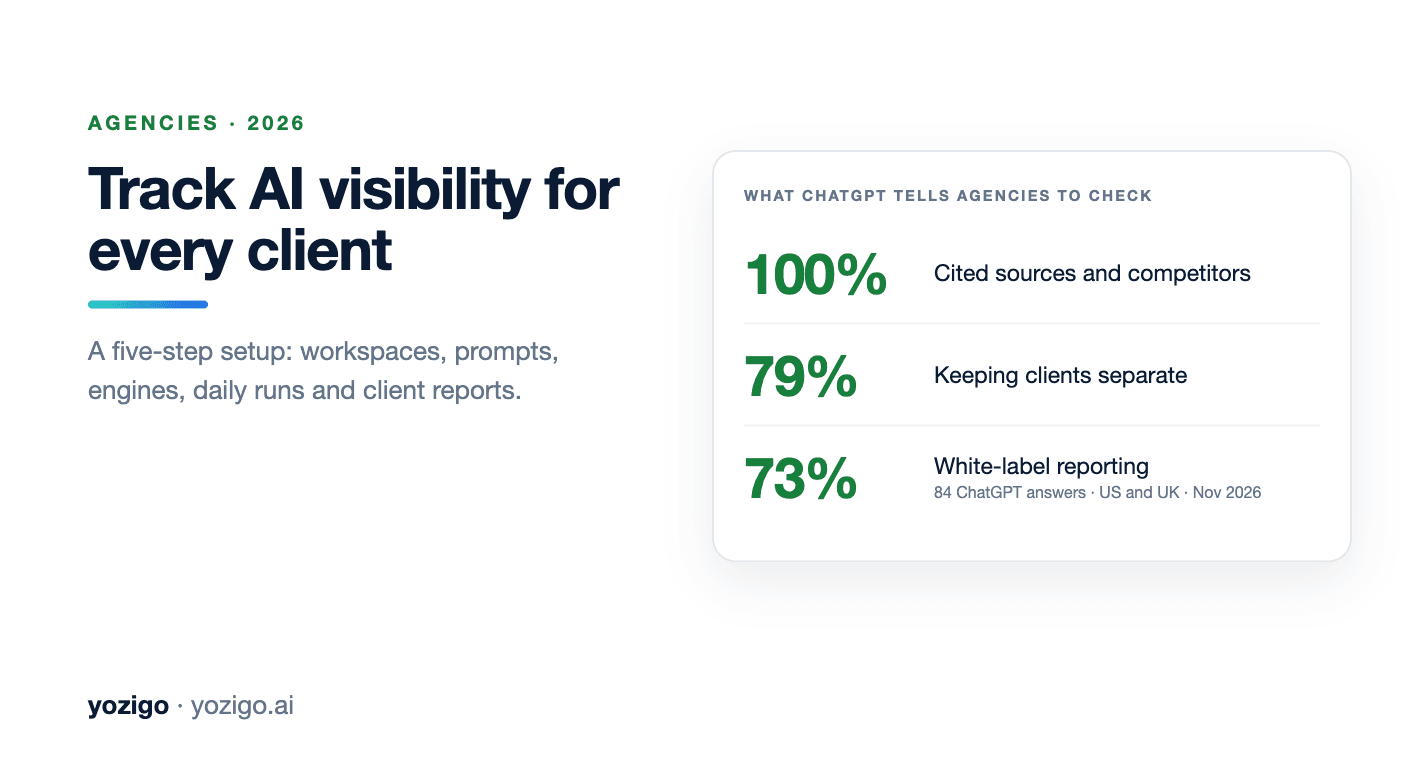
TL;DR: Give each client its own workspace, 25 to 50 unbranded buyer questions, and the engines and countries its buyers use. Run them daily and report trends, not single answers. When ChatGPT is asked how agencies should choose a GEO platform, 79% of answers mention keeping clients separate and 73% mention white-label reporting, against 52% and 53% across all five engines (Yozigo tracking, 21 Oct–20 Nov 2026).
Key takeaways
- Separate workspaces stop one client’s data and competitors bleeding into another’s.
- Unbranded questions show category visibility; a few branded ones catch wrong facts AI states about the client.
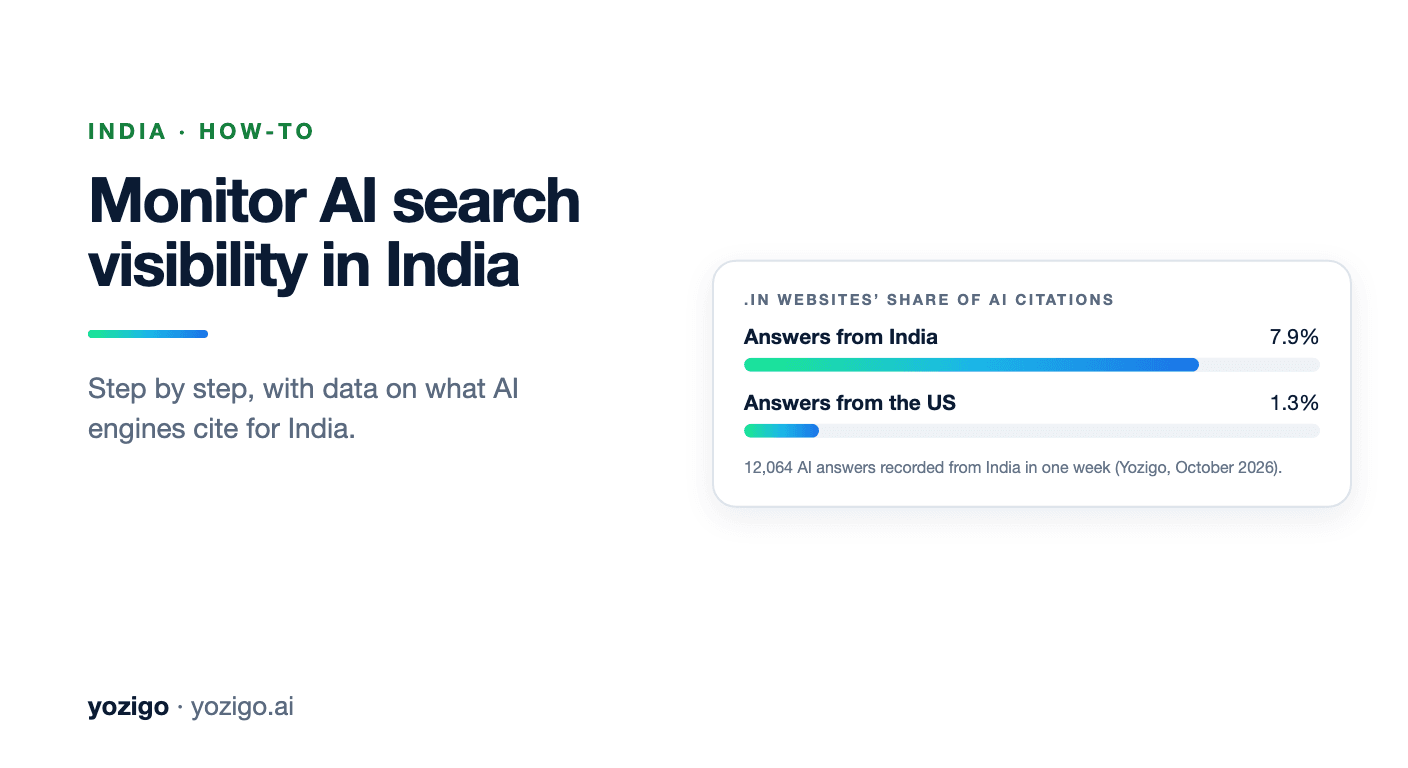
- In our GEO tracker study, US and UK answers to the same questions differed by up to 12 points, so split by country.
- AI answers change day to day, so no agency can promise a citation.
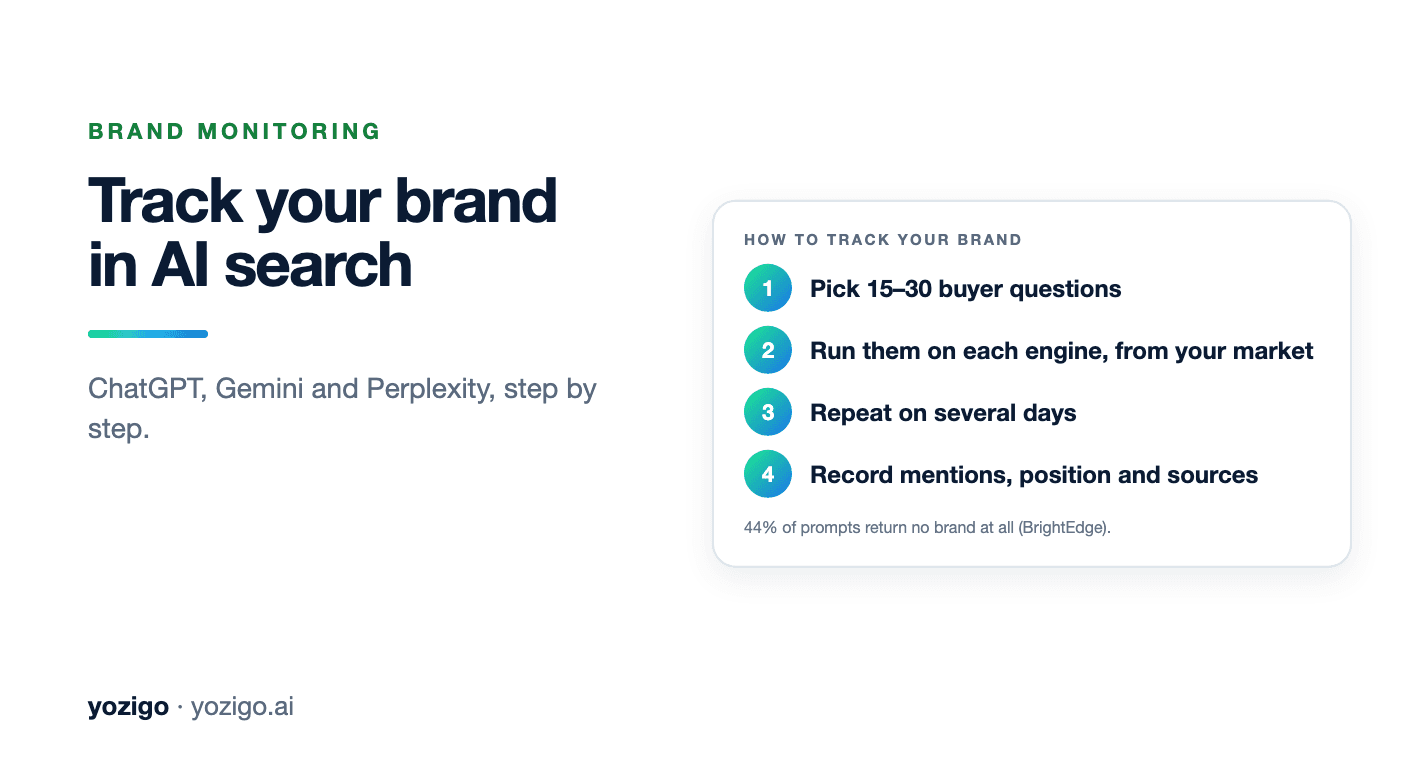
This guide covers the setup and the routine. To choose the tool itself, see our comparison of AI visibility tools for agencies and the data on which GEO trackers AI engines recommend. For tracking a single brand, start with our guide to tracking your brand in ChatGPT, Perplexity and Gemini.
Disclosure
Yozigo publishes this guide. Every figure except the KDD 2024 research result comes from Yozigo’s own tracking.
What must an agency’s AI visibility tracking cover?
Your tracking setup must show sources, competitors and clean client reporting, because that is what AI engines tell agencies to look for. In 84 ChatGPT answers to questions like “How do agencies decide which AI visibility tool to recommend to clients?”, every answer mentioned cited sources and competitor benchmarking, 99% mentioned reporting and 92% mentioned data accuracy (Yozigo tracking, US and UK, 30 days to 20 Nov 2026).
Per-client separation came up in 79% of ChatGPT answers and white-label reporting in 73%. Across all five engines these questions ran on (ChatGPT, Gemini, Google AI Overviews, Google AI Mode and Perplexity), the figures were 52% and 53% of 272 answers. Build each client’s setup so it can show all of these.
Engine coverage was mentioned less often, in 57% of ChatGPT answers. That doesn’t mean it matters less. Our engine comparison shows how differently each engine picks sources.
Step 1: Should each client get its own workspace?
Set up one workspace per client with its own brand name, domain, aliases and competitor list. In our GEO tracker study, a typical ChatGPT answer named about 12 brands (Yozigo tracking, 15–19 Nov 2026). With that many names per answer, a client’s visibility only means something against the right competitors.
Add every name the brand goes by, including product names, the old brand name, the domain and common misspellings. Missed aliases make a tracker under-count mentions, so add them before the first run.
Keep competitor lists to the five to eight brands the client actually loses deals to. Ask the client’s sales team, not only the marketing team. Then check which brands AI already names for the client’s category; they belong on the list even if the client doesn’t see them as rivals yet.
Step 2: Which prompts should you track for each client?
Track 25 to 50 questions buyers ask before they know the client’s name. Across 232,838 answers we tracked from June to September 2026, brands were named in 2.4% to 4.8% of unbranded answers but 77% to 97% of branded ones. Branded questions such as “Is [client] good?” inflate the score, which is why we split them out in branded vs unbranded AI visibility.
A working set mixes four types of question. Include “best [category] for [use case]” questions, comparisons with named competitors, how-to questions the client can answer well, and price or plan questions. Pull real wording from the client’s Search Console, sales calls and support tickets. Our prompt discovery guide walks through it.
Use the same wording every day. Changing a question resets its trend line, so add new questions alongside the old ones instead of editing them.
Step 3: Which engines and countries should each client get?
Match engines and countries to where each client sells. On the same questions, Gemini named Peec AI in 63% of US answers but 51% of UK ones, and Google AI Overviews named Rankscale in 18% of UK answers but 11% of US ones (Yozigo tracking, 15–19 Nov 2026). A blended number would hide both gaps.
Start with ChatGPT, Google AI Overviews, Gemini and Perplexity. Add Google AI Mode for clients who depend on Google search, and Microsoft Copilot for B2B clients whose buyers work in Microsoft 365. Our pages on the ChatGPT tracker, AI Mode tracker and Copilot tracker explain what each engine needs.
Run each country separately. A UK client should be tracked from a UK location, and a client selling in both markets needs both.
Step 4: How often should you run prompts and report?
Run every prompt daily and report on weekly or monthly averages. In our five-day sample, Scrunch, a GEO tracker ChatGPT names in about half its answers, appeared on some days and not others for 45% of ChatGPT prompt-and-country pairs, 59% on Google AI Overviews and 83% on Gemini (Yozigo tracking, 15–19 Nov 2026). A weekly snapshot would catch only part of that.
Report four numbers per client. They are visibility (share of answers that name the client), share of voice against the tracked competitors, the client’s average position in AI lists, and the pages the engines cite. Our explainers on the AI visibility score and share of model define each one.
Compare like with like. Keep the same prompt set and engines across reporting periods, or say clearly in the report what changed.
Step 5: How do you turn the data into billable work?
The billable work starts with the sources behind each answer. ChatGPT cited about 45 sources per answer in our tool-question sample (Yozigo tracking, 15–19 Nov 2026). Across 124,581 ChatGPT citations we classified in September 2026, 77% pointed to third-party sites and 3% to the brand’s own site (AI citation sources study). Each third-party page is one the client could be added to or out-write.
Sort the work three ways. Get the client named on pages AI already cites, rewrite the client’s own pages so each section answers one question in its first sentences, and fill questions where no page answers well. Our guide to structuring content so AI cites it covers the second.
Then measure. Research on generative engines found that targeted content changes can raise a source’s visibility in AI answers by up to 40% (Aggarwal et al., KDD 2024). Check the client’s questions again two to four weeks after each change.
How do you scale tracking to 10 or 30 clients?
| Setting | Starting point | Where it comes from |
|---|---|---|
| Workspace | One per client | Your tracking tool |
| Aliases | Product names, old name, domain, misspellings | Client brand team |
| Competitors | 5 to 8 | Sales team, plus brands AI already names |
| Questions | 25 to 50 unbranded, plus a few branded | Search Console, sales calls, support tickets |
| Engines | ChatGPT, AI Overviews, Gemini, Perplexity; add AI Mode or Copilot if needed | Where the client’s buyers search |
| Countries | One workspace setting per market | Where the client sells |
| Runs | Daily | Answers change day to day |
| Reports | Weekly or monthly trends | Client’s reporting cycle |
Plan the daily answer volume before you onboard. Ten clients with 40 questions on four engines is 1,600 answers a day, and each extra country doubles that client’s share.
Take one worked example. A software client selling in the US and UK, with 40 unbranded questions on four engines in two countries, needs 320 answers a day. Check your plan’s daily prompt limit against that number before you sign the client, not after.
Reuse what you can. Keep a starter question set per industry and edit it for each client, so a new client starts from tested wording. Use the same onboarding checklist every time, as in the table, so no client is missing aliases, competitors or a country. Decide who sees what before launch: give each client view-only access to its own workspace, or send reports only, so no client ever sees another’s competitor list.
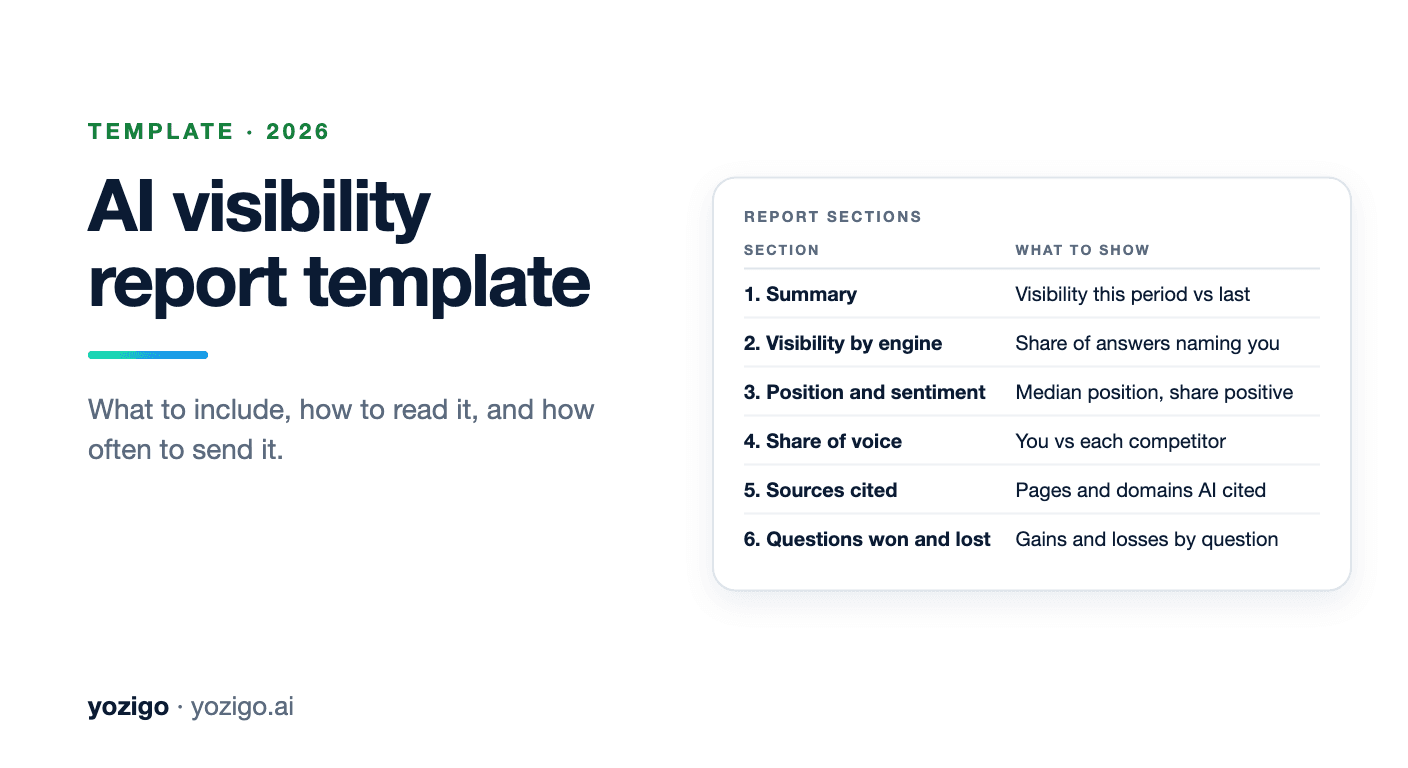
What goes in a white-label AI visibility report?
A client report should show visibility, share of voice, citations and the next actions, under your agency’s brand. White-label reporting came up in 73% of ChatGPT answers about how agencies choose a tool (Yozigo tracking, 21 Oct–20 Nov 2026), so expect clients to ask for it.
Headline trend
Visibility and share of voice for the period, by engine and country.
Wins and losses
Questions where the client gained or lost a mention, with the answer text.
Sources
The pages each engine cited most for the client’s questions.
Actions
What the agency changed, and what it will do next.
Our AI visibility report template has a full layout you can copy.
Can an agency guarantee AI citations?
No. AI answers change from one day to the next: Scrunch appeared on some days but not others for 45% of ChatGPT prompt-and-country pairs in our sample (Yozigo tracking, 15–19 Nov 2026), and no engine publishes exactly how it picks sources. Google says there are “no additional requirements to appear in AI Overviews or AI Mode” beyond normal SEO (Google Search Central), so there is no switch an agency can flip.
What an agency can promise is a measured process: a fixed prompt set, daily tracking, named actions and a trend report. If a pitch guarantees a ChatGPT citation by a date, ask how it will be measured and what happens on the days it drops out.
ChatGPT also needs to find the page first. OpenAI says its OAI-SearchBot crawler is what surfaces sites in ChatGPT search (OpenAI), so check each client’s robots.txt allows it before you report on ChatGPT.
How did we collect this data?
The figures on what AI tells agencies come from 272 answers to questions such as “How do agencies decide which AI visibility tool to recommend to clients?”, tracked on ChatGPT, Gemini, Google AI Overviews, Google AI Mode and Perplexity from US and UK locations in the 30 days to 20 November 2026. 84 of the answers came from ChatGPT. Figures are combined across the brands that track these questions; no client is named.
A topic counts as mentioned when the answer uses its terms, for example “white label” for white-label reporting or “each client”, “per client” or “workspaces” for client separation. Almost every answer on this topic uses the word “citation”, so the 100% figure mostly reflects vocabulary.
The US and UK and day-to-day figures come from our GEO tracker study: 3,268 answers to 20 tool-selection questions, 15–19 November 2026. How Yozigo collects answers in general is on our methodology page.
Frequently asked questions: agency AI visibility tracking
Give each client a separate workspace with its own competitors, 25 to 50 unbranded questions and the engines and countries it sells in. Run the questions daily and report weekly or monthly trends. In our data, 79% of ChatGPT answers about agency tools mentioned keeping clients separate.
Most clients need 25 to 50 unbranded buyer questions, plus a few branded ones, tracked separately, to catch wrong facts AI states about the client. Keep the wording fixed so trends stay comparable, and add questions rather than editing them.
Yes. On identical questions in November 2026, Gemini named Peec AI in 63% of US answers and 51% of UK answers. A combined figure hides which market needs work.
No. AI answers change daily; in our sample Scrunch appeared on some days and not others for 45% of ChatGPT prompt-and-country pairs. Agencies can promise a measured process and trend reporting, not a fixed citation.
Visibility and share of voice by engine and country, questions won and lost, the pages AI cites most and the actions taken. White-label reporting came up in 73% of ChatGPT answers about choosing an agency tool.