How to Measure AI Search ROI When Organic Clicks Fall
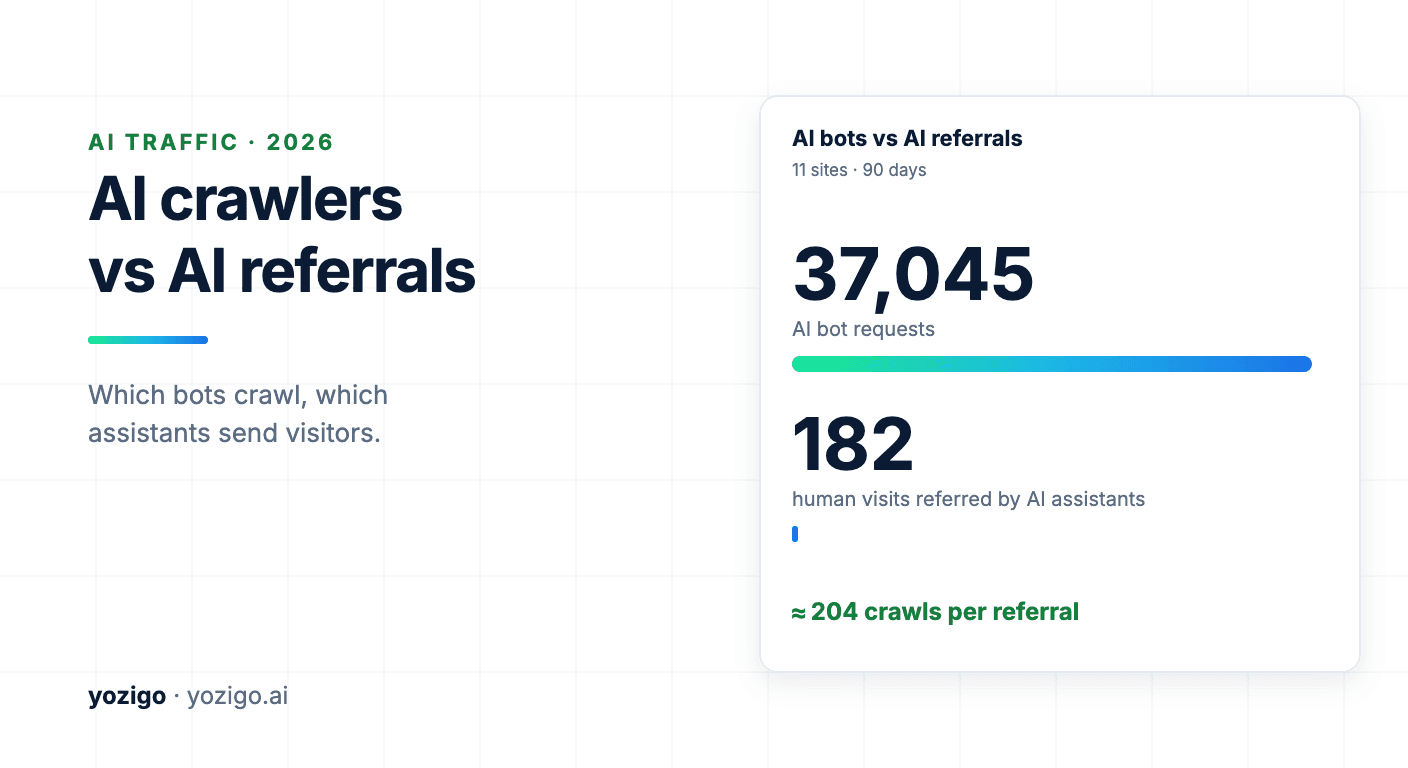
AI referrals are small: 182 visits against 37,045 AI bot requests across 11 sites in 90 days. A four-layer way to measure AI search ROI: visibility, citations, crawls and referrals.
How do you measure ROI from AI search?
Key takeaways
- Clicks alone undercount AI search: across 11 sites, AI assistants sent 182 visits while AI bots made 37,045 requests.
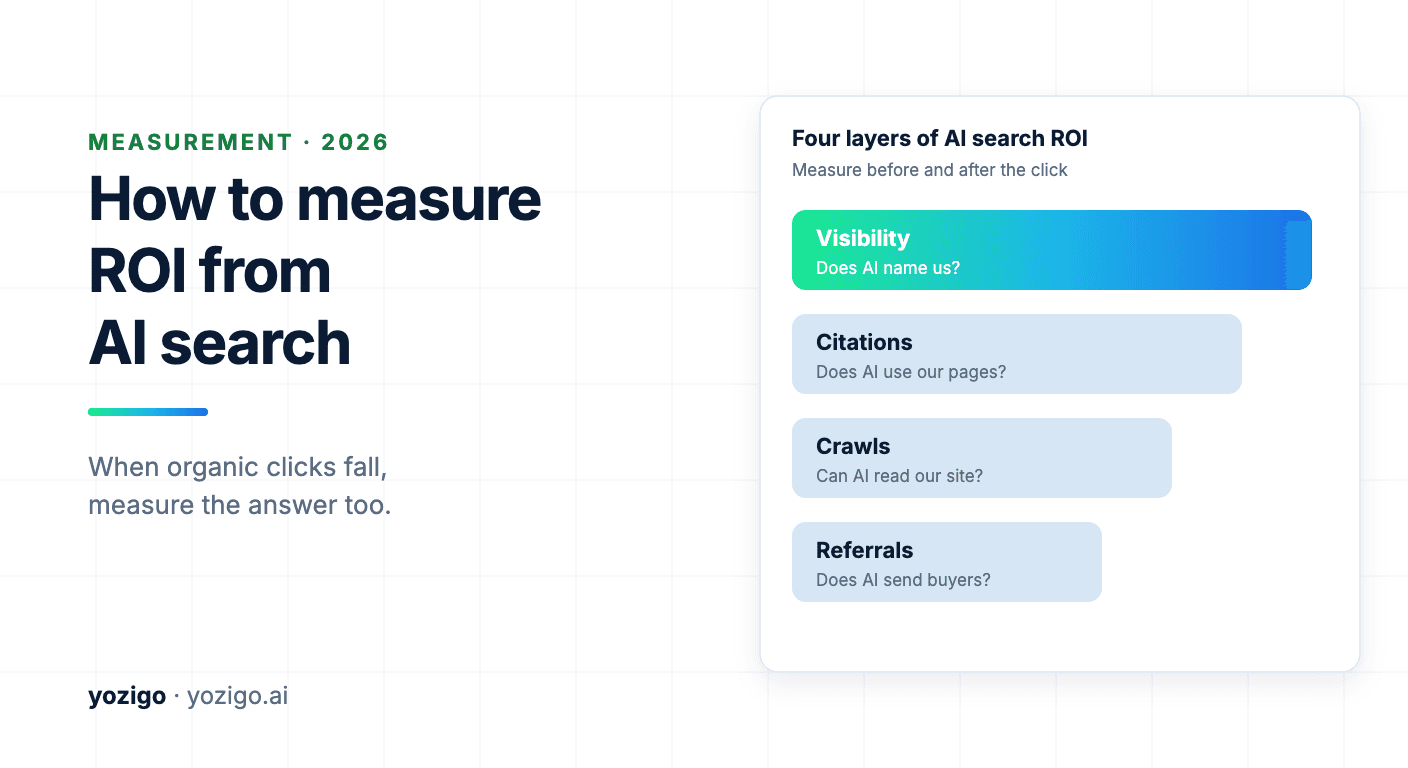
- Measure four layers: visibility, citations, crawls and referrals.
- Tie them to pipeline with self-reported attribution and AI-referred conversions.
- Compare against the same prompts over time.
Measure it in layers, because clicks are only the last one. Most AI answers are read, not clicked: across 11 sites using the Yozigo tracker from 29 June to 27 September 2026, AI assistants referred 182 human visits while AI bots made 37,045 requests. If you only count referrals, you miss most of the influence.
The fix is to measure what happens before the click (are you named and cited?) as well as after it (do those visitors convert?).
What are the four layers of AI search ROI?
| Layer | Question it answers | Metric | Where to get it |
|---|---|---|---|
| Visibility | Does AI name us when buyers ask? | Unbranded mention rate, Share of Model | Daily prompt tracking (AI Visibility) |
| Citations | Does AI use our pages? | Own-site citation rate, cited URLs | Source tracking per answer |
| Crawls | Can AI read our pages? | Verified AI bot requests per page | Server-side logs (AI Traffic) |
| Referrals | Does AI send buyers? | AI-referred sessions and conversions | Analytics plus referrer detection |
Each layer answers a different question. Together they show whether AI search is working, even when organic clicks fall.
How do you connect AI search to revenue?
Four habits connect the 182 AI-referred visits, and the far larger unseen influence, to pipeline.
1. Tag AI referrals as their own channel. ChatGPT sent 157 of the 182 AI-referred visits in our sample; group ChatGPT, Perplexity, Gemini, Copilot and Claude referrers together.
2. Ask "How did you hear about us?" with "ChatGPT or another AI assistant" as an option. Self-reported attribution catches buyers who read an answer and came back later by typing your URL.
3. Watch branded search. Rising branded searches while generic clicks fall often means AI answers are introducing you.
4. Compare before and after on fixed prompts. When you publish a page or earn a placement, re-run the same prompts and record whether you're now named or cited.
Why is Google Search Console not enough?
Because it covers 2 of the 6 AI engines we track and reports only impressions.
Search Console now has a Generative AI performance report, but it counts impressions only: no clicks, no queries, no position. It also only covers Google's AI features, not ChatGPT or Perplexity. We explain what it does show in Google Search Console's AI Overviews report.
Google documents the report's limits in Search Console Help.
What does a monthly AI search report look like?
Five numbers on one page is enough for most teams.
Keep it to one page
unbranded mention rate and Share of Model per engine, the three pages AI cites most, verified AI crawls on key pages, AI-referred sessions and conversions, and what you changed this month. Yozigo produces this as a client-ready report with before-and-after scores. See pricing for the 14-day free trial.
Frequently Asked Questions: AI search ROI
Track four layers: whether AI names you (visibility), uses your pages (citations), can read your site (crawls), and sends buyers (referrals and conversions). Clicks alone undercount, because most AI answers aren't clicked.
Not much yet for most sites: 182 visits across 11 sites in 90 days in our 2026 sample, 157 of them from ChatGPT. Its influence on decisions is larger than its traffic.
AI answers now satisfy many searches without a click; across 11 sites we saw about 204 AI bot requests for every AI-referred visit. Track citations and mentions to see that influence.
Yes, as referrals from chatgpt.com when users click, and ChatGPT sent 86% of AI-referred visits in our sample. Visits from people who typed your URL later appear as direct.