What Is an AI Visibility Score and How Is It Calculated?
An AI visibility score is the share of AI answers that mention your brand. How tools calculate it, the other numbers that should sit beside it, and what a typical score looks like for branded and unbranded questions.
What is an AI visibility score?
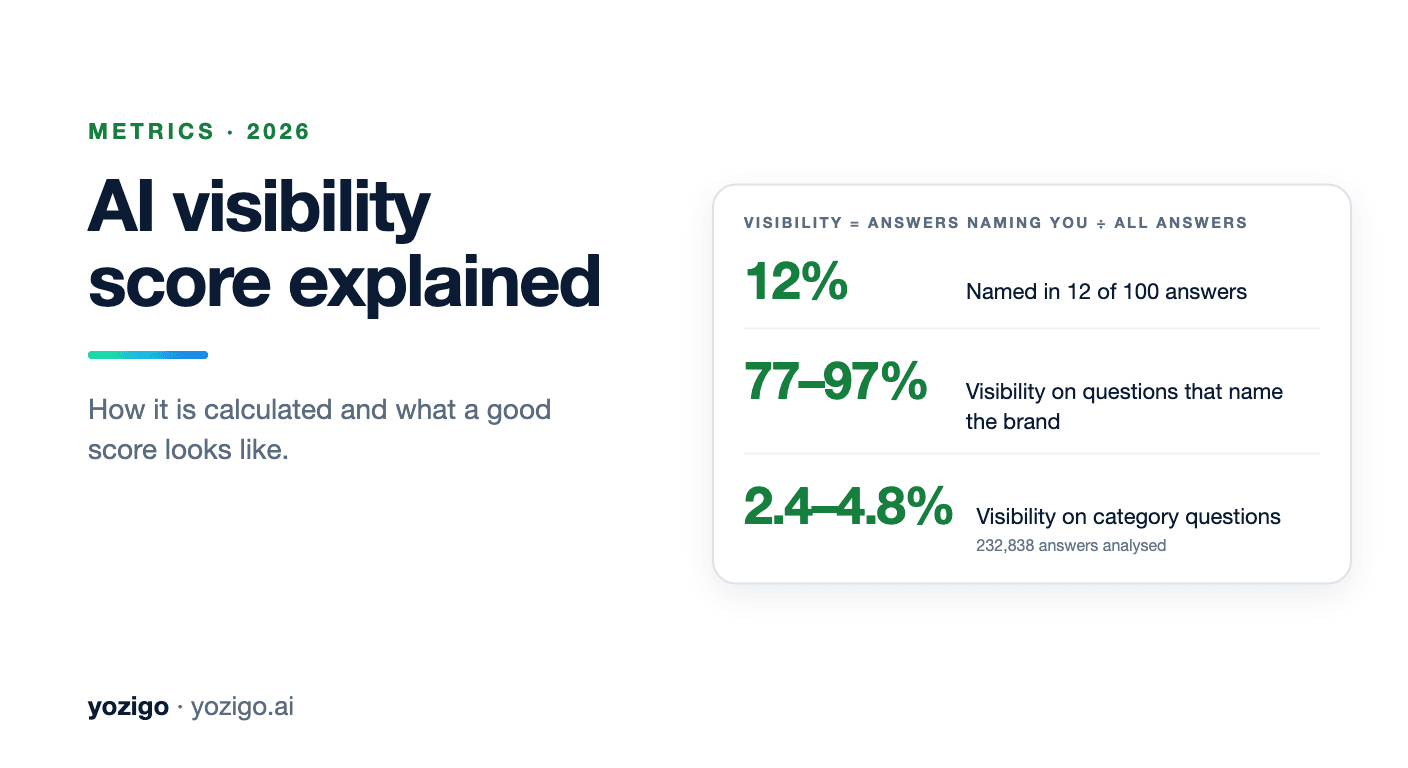
TL;DR: An AI visibility score is the percentage of AI answers to a set of questions that mention your brand. If ChatGPT, Gemini, Perplexity and Google AI Overviews answer 100 of your buyers’ questions and name you in 12, your visibility is 12%. In 232,838 answers we analysed, brands were named in 77–97% of questions that contained their name but only 2.4–4.8% of category questions.
Key takeaways
- Visibility = answers mentioning you ÷ all answers × 100; it is the core metric of generative engine optimization (GEO).
- Search Console does not report it, so it has to be measured by running questions.
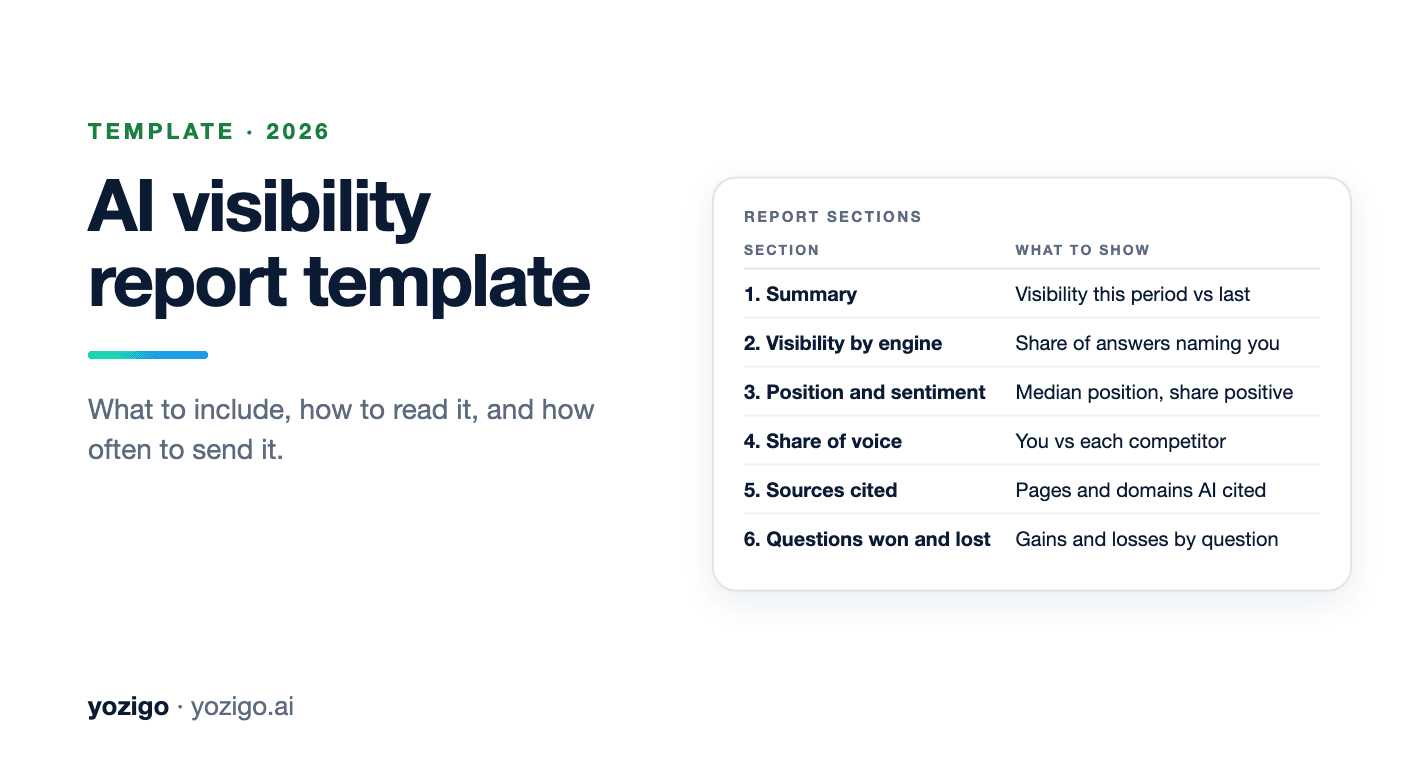
- Read it beside position, sentiment, citation rate and share of voice.
- Split branded and unbranded questions, or the score is inflated.
- Some tools blend several measures into one score; check how before comparing tools.
How is an AI visibility score calculated?
| Metric | Formula |
|---|---|
| Visibility | Answers that mention your brand ÷ all answers × 100 |
| Position | Median rank among brands named, only where you are mentioned |
| Sentiment | Average of positive (+1), neutral (0) and negative (−1), scaled to 0–100 |
| Citation (grounding) rate | Answers citing your domain as a source ÷ all answers × 100 |
| Share of voice | Your mentions ÷ (your mentions + tracked competitors’ mentions) × 100 |
Visibility is answers that mention your brand divided by all answers, times 100. If 49 of 700 answers name you, your score is 7%. Yozigo marks a figure as low confidence under 5 responses and high confidence at 15 or more (methodology), because small samples swing widely.
The base is always a fixed set of questions run on fixed engines. Change the questions and the score changes, even if nothing else did. Full definitions, including how we flag low-confidence numbers, are on our methodology page.
Run the same calculation per engine and per region as well as overall, because a blended score can hide one engine where you are missing entirely.
Why can two tools give different scores for the same brand?
Because they measure different things. HubSpot’s free AI Search Grader, for example, scores five weighted dimensions out of 100, with sentiment worth up to 40 points, from the engines’ training data at one moment. A tracker like Yozigo reports the share of live, web-searched answers that name you, every day. Neither is wrong; they answer different questions.
Before comparing tools, check four things: which questions were asked, which engines, whether the answers used live web search, and whether branded questions were mixed in. Our 12 best AI visibility tools guide compares the tools themselves.
The safest comparison is your own trend in one tool over time, on a fixed question set.
What is a good AI visibility score?
It depends on the question set. On questions that already contain your name, scores near 100% are normal and tell you little. On unbranded category questions, brands in our data averaged 2.4–4.8%, so 10% would be strong in most categories.
The better benchmark is your competitors on the same questions. Share of voice shows that directly; our guide to share of model explains how to read it.
A good score depends on the question set
brands were named in 2.4–4.8% of unbranded category questions in 232,838 answers we analysed (Yozigo research, 2026), so beating your competitors’ share matters more than reaching any fixed number.
Compare like with like
the same questions, engines and dates for you and each competitor.
How do you improve your AI visibility score?
Start with the sources, not the score. In 18,007 AI answers we analysed, 77% of citations came from third-party sites (Yozigo citation study), so the fastest gains usually come from being mentioned on pages the engines already cite for your questions.
Find the questions where competitors are named and you are not, then look at the sources the engines cited for those answers. Get mentioned on those pages, and make your own pages answer the questions directly. How to structure content so AI cites it covers the page side; the Opportunity Finder ranks the gaps for you.
Then fix your own pages for the questions you lose, opening each section with a direct, sourced answer, and re-measure after two to four weeks.
What does a worked example look like?
Say you track 25 unbranded questions on four engines, once a day for a week. That is 700 answers. If 49 of them name your brand, your visibility is 49 ÷ 700 = 7%. If your two tracked competitors were named 120 and 81 times, your share of voice is 49 ÷ (49 + 120 + 81) = 19.6%.
Now split by engine. You might find 15% on Perplexity and 2% on Google AI Overviews. The blended 7% hides that AI Overviews is the problem, and the fix there (LinkedIn, video, short answers) is different from the fix elsewhere. Our engine comparison shows why.
The same split by region often tells a similar story, especially for brands selling in more than one country.
What mistakes do people make with AI visibility scores?
Including branded questions
They push the score towards 100% and hide category performance.
Comparing different question sets
A score from 10 questions and one from 50 are not comparable.
Reading one day
AI answers change between sessions; use weekly averages.
Ignoring citations
You can be named without being cited, and cited without being named. Track both; our mention gap study shows how often each happens.
Treating the score as the goal
The score is a proxy for whether AI recommends you to buyers. Pair it with AI-referred visits and pipeline where you can track them, as covered in measuring AI search ROI.
Frequently asked questions: AI visibility score
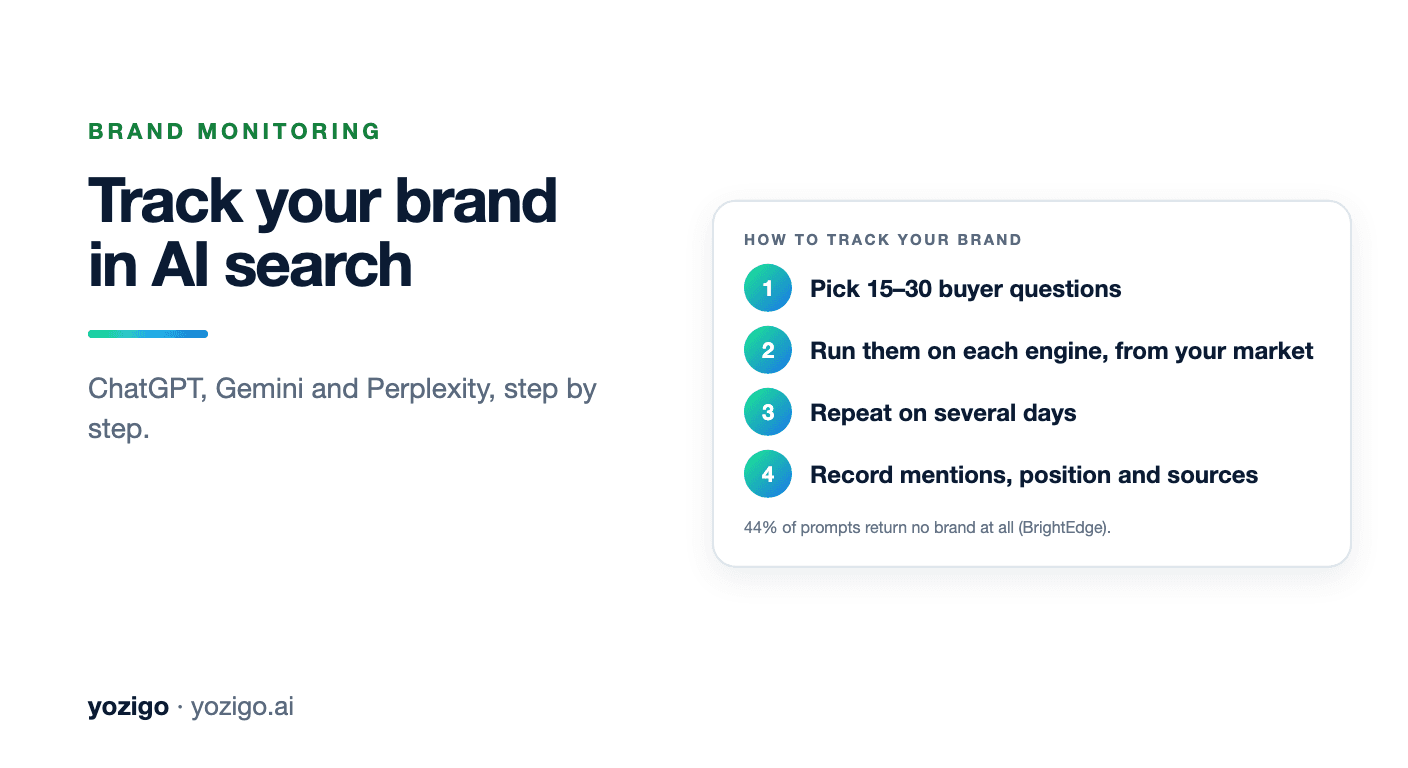
Answers that mention your brand divided by all answers to your tracked questions, times 100. Track it per engine and separately for branded and unbranded questions.
On unbranded category questions, brands in our data were named in 2.4–4.8% of answers, so beating your competitors’ share matters more than any fixed number.
No. Visibility is your share of all answers; share of voice is your share of brand mentions among you and the competitors you track.
Daily or weekly on a fixed set of questions. AI answers change between sessions, so trends over weeks are more reliable than a single score.