Bing Indexing vs AI Answer Citations: Why Indexed Pages Don’t Get Cited
Being indexed by Bing makes a page eligible for Copilot answers; it does not make it cited. How Bing’s new AI Performance report shows the difference, and what our Copilot data says about the gap.
What is the difference between Bing indexing and AI answer citations?
TL;DR: Indexing means Bing has stored your page and can retrieve it; a citation means an AI answer, such as Microsoft Copilot, actually used the page as a source. Indexing is the entry ticket, not the result. In our data Copilot searched the web before 99.9% of answers but cited a median of only four sources each.
Key takeaways
- Bing launched an AI Performance report in Webmaster Tools in February 2026 that shows citations and the grounding queries behind them.
- Copilot named about 15 brands per answer but cited only four sources.
- Third-party sites were 88% of Copilot’s citations; review sites like G2 and Clutch appear often.
- Fix indexing first, then make pages the best answer for the grounding queries you see.
How do you check if Bing’s AI answers are citing your website?
In February 2026 Bing added AI Performance to Webmaster Tools as a public preview (Bing Webmaster Blog). It reports how often your pages are cited in Microsoft Copilot and Bing’s AI answers, which pages are cited, and grounding queries: the phrases the AI used to retrieve your content.
Grounding queries are not what users typed. They are the searches the AI generated for itself, the same idea as the fan-out searches we record for ChatGPT, explained in what query fan-out is. They show which questions your page is being used to answer.
On 16 June 2026 Bing added four views
Intents (grounding queries grouped into types such as informational or commercial), Topics (related queries clustered by theme), Citation Share (your share of citations for a query against all cited sources) and Compare (one period against another) (Bing Search Blog). Citation Share does not reveal which competitor domains were cited.
Set it up through Bing Webmaster Tools; our guide to Search Console and Bing Webmaster Tools for AI visibility walks through verification.
Why do indexed pages miss out on citations?
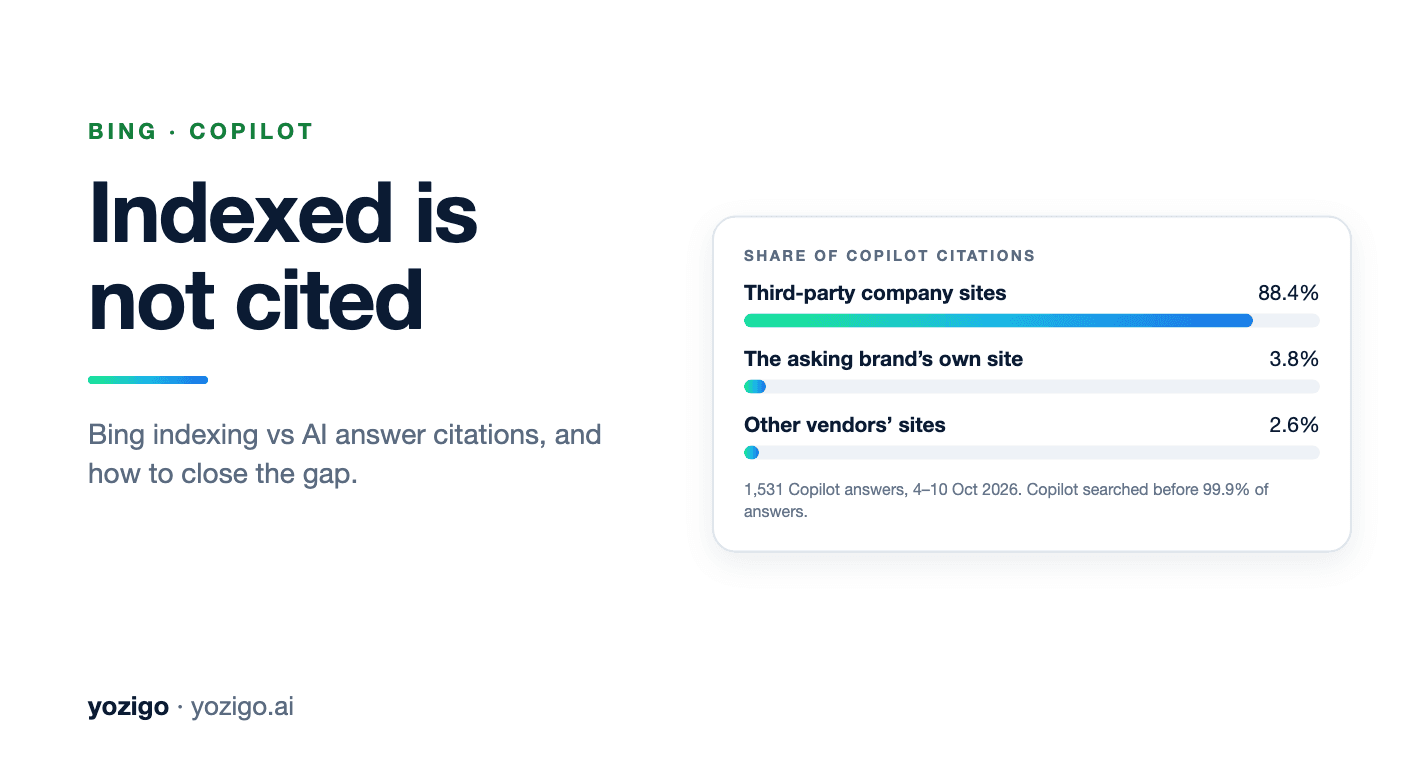
Copilot retrieves more than it cites. It searched the web before 99.9% of the 1,531 answers we tracked but cited a median of four sources per answer (Yozigo tracking, 4–10 October 2026), so an indexed page competes with every other retrieved page for a handful of slots.
Because retrieval and citation are different steps. Copilot searches, reads several candidate pages, then cites the few that answered best. With a median of four sources per answer in our data, most retrieved pages are not cited.
Common reasons a page is retrieved but not cited: the answer is buried below the fold, the page covers a broader topic than the grounding query, figures have no source, or a third-party page answers the same question more directly. Copilot cited third-party sites for 88% of its sources, so a competitor listed on a review site can win even when your page is indexed.
How do you turn indexed pages into cited pages?
Confirm indexing
Verify your site in Bing Webmaster Tools, submit your sitemap and use IndexNow so changes are picked up quickly. Pages Bing has not indexed cannot be cited.
Read the grounding queries
For each cited page, note the grounding queries. For important pages that are never cited, compare them with pages that are.
Answer the grounding query directly
Add a section whose heading matches the query and whose first 40–60 words answer it with a sourced fact. See how to structure content for AI citations.
Cover the review sites
Complete your G2 and Clutch profiles; both appeared among Copilot’s cited public domains in our data.
Measure answers, not only citations
Bing’s report shows your citations; it does not show whether your brand was named or which competitors were. Track Copilot answers directly on the Copilot visibility tracker.
What does Microsoft Copilot cite most?
| Source type | Share of citations |
|---|---|
| Third-party company sites | 88.4% |
| The asking brand’s own site | 3.8% |
| Other vendors’ sites | 2.6% |
Third-party business sites dominate Copilot’s sources: 88.4% of its citations in 1,531 tracked answers, against 3.8% for the asking brand’s own site (Yozigo tracking, 4–10 October 2026). Review platforms such as G2 and Clutch appeared among its cited public domains.
Copilot leans on third-party business sites more than any other engine we track. Among public domains, LinkedIn appeared in 4.3% of answers and the review sites G2 and Clutch in about 1% each. The sample is small (two brands), so treat it as directional; the full comparison with other engines is on the AI search trackers page.
For B2B brands, that makes complete review-site profiles one of the quickest ways into Copilot’s answers.
How is Copilot different from Google’s AI answers?
Copilot shows its searches; Google does not. Copilot exposed a web search on 99.9% of answers, and Bing’s report shows grounding queries, so you can see what it looked for. Google AI Overviews and AI Mode do not expose their searches, so you work from outcomes only.
Their sources differ too. Social media was 19.8% of Google AI Overview citations in our data, led by LinkedIn and YouTube, while Copilot cited mostly business websites and review platforms. A B2B brand that wants Copilot citations should prioritise complete review-site profiles and clear product pages; for AI Overviews, LinkedIn and video matter more. See how to get cited in Google AI Overviews and AI Mode.
Track the two separately, since a page cited by one is often ignored by the other.
Frequently asked questions: Bing indexing and AI citations
No. Indexing makes a page eligible. In our data Copilot cited a median of four sources per answer, so most retrieved pages are not cited.
The search phrases Bing’s AI generated to retrieve your content for an AI answer, shown in the AI Performance report Bing launched in February 2026.
No. It shows citations of your own pages, and since June 2026 your citation share, but not which competitor domains were cited. To see which competitors Copilot names, you need to track Copilot answers to your buyer questions.
Verify your site in Bing Webmaster Tools and open the AI Performance report. For answer-level tracking with competitors, use an AI visibility tool that covers Copilot.