How Indian Businesses Can Monitor Brand Visibility Across AI Search (2026)
A step-by-step way for Indian businesses to track how ChatGPT, Perplexity, Gemini and Google’s AI answers mention them, with data on what AI engines cite for Indian searches.
How can Indian businesses monitor brand visibility across AI search engines?
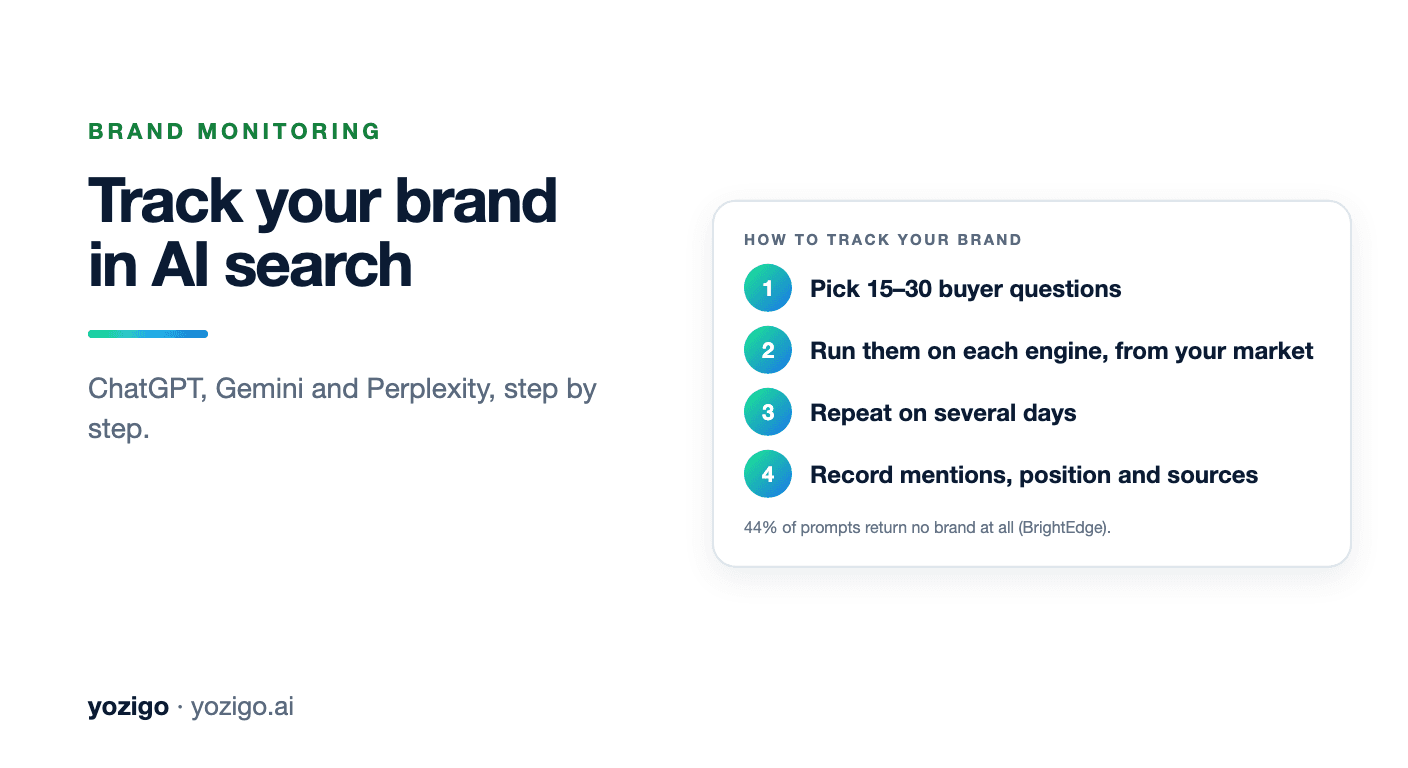
TL;DR: Pick 15–30 questions your Indian buyers ask, run them on ChatGPT, Perplexity, Gemini and Google AI Overviews from India every day, and record whether you are named, your position and the sources cited. Track India separately from other markets: in our data, Indian answers cited .in websites six times more often than US answers.
Key takeaways
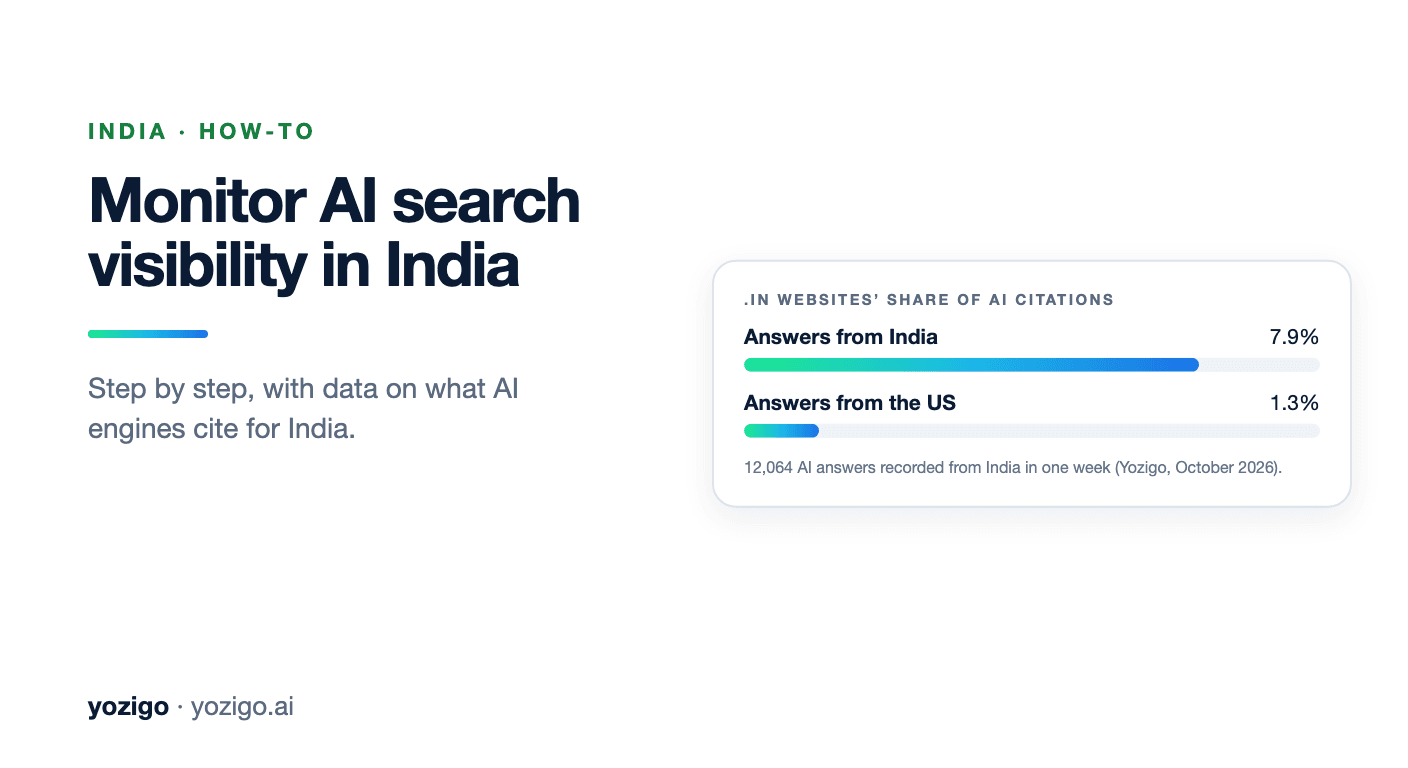
- In 12,064 AI answers recorded from India in one week, 7.9% of citations went to .in domains, against 1.3% in the US.
- LinkedIn was cited in 15.3% of Indian answers, more than in the US.
- Most citations come from third-party sites, so getting listed on Indian pages matters more than your home page.
- Claude is harder to track at scale; start with the four engines most Indian buyers use.
Why do AI answers differ for Indian searches?
AI engines localise. Between 4 and 10 October 2026 we compared answers recorded from India and the US across ChatGPT, Perplexity, Gemini and Google AI Overviews. Indian answers cited .in websites six times as often (7.9% of citations against 1.3%) and cited LinkedIn in 15.3% of answers against 13.9%. YouTube and Reddit were cited less often in India.
So an Indian buyer asking “best CRM for small businesses in India” can get a different list from a US buyer asking the same thing. If you only track from the US, you will not see how Indian buyers see you. Our guide to the best AI search visibility tools for Indian brands shows which tools let you set the market.
AI engines localise their sources. Across 12,064 answers recorded from India in one week, 7.9% of citations went to .in websites, against 1.3% in 13,377 US answers (Yozigo tracking, 4–10 October 2026), so the same question can return a different brand list in India.
How do you set up AI visibility monitoring in India, step by step?
Choose the questions
Start from the questions your sales team hears, add “in India” or a city where buyers would, and keep questions that already name your brand separate. Our prompt discovery framework explains how to pick them.
Choose the engines
ChatGPT and Google AI Overviews reach the most people; add Gemini and Perplexity for research-heavy buyers, and Copilot for B2B buyers on Microsoft 365.
Run them from India
Answers depend on location. A tool should let you pick India as the region; if you check by hand, use a connection in India.
Record four things
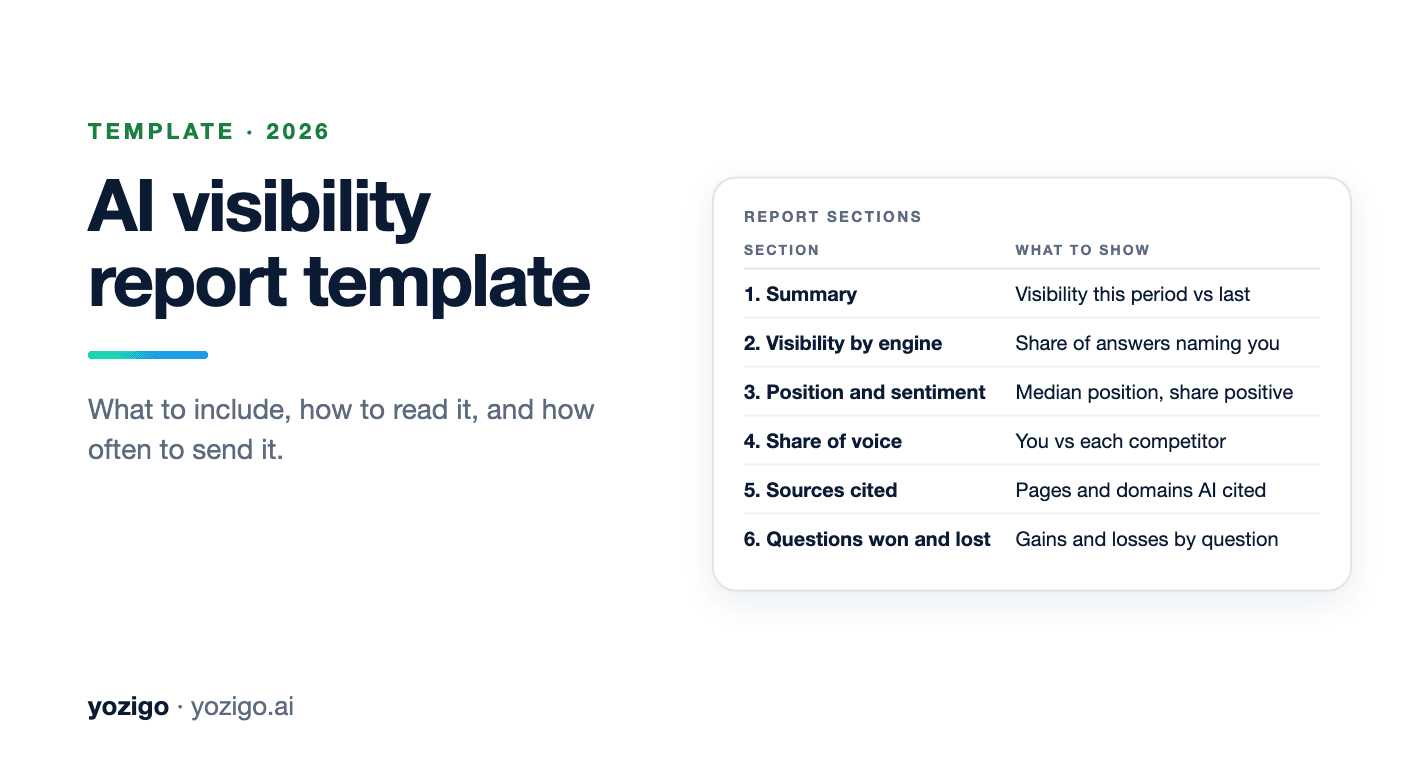
Whether you are named, your position in the list, the sentiment, and every source the engine cited.
Repeat daily or weekly
One answer is a sample. Compare trends over at least two weeks before you act.
Compare with competitors
Track two or three Indian competitors on the same questions, so you can see who wins each question and from which sources.
Which engines should Indian businesses track, and what about Claude?
Start with the engines that reach most Indian buyers. In our India data, ChatGPT, Gemini, Perplexity and Google AI Overviews together produced 12,064 answers in one week, each with its own cited sources (Yozigo tracking, October 2026).
Start with ChatGPT, Google AI Overviews, Gemini and Perplexity. They are the engines most tracking tools cover and the ones Indian buyers meet in Google Search and on their phones. Add Copilot if you sell to companies that run on Microsoft 365, and Google AI Mode if your buyers search on Google a lot.
Some buyers, often developers, use Claude. Fewer tools track it; Yozigo offers it as a paid add-on on any plan. Claude can search the web and cite its sources (Anthropic), and Anthropic’s crawlers (ClaudeBot, Claude-SearchBot and Claude-User) each follow robots.txt separately (Anthropic support). If Claude matters for your buyers, allow Claude-SearchBot and add Claude tracking, or check a few key questions by hand each month.
For how each engine picks sources, see the AI search trackers comparison.
What should you do with the results?
Look at the sources first. In 705 answers to Indian buyer questions about AI tools, 75% of citations went to third-party sites and only 0.6% to the asking brand’s own site. The quickest wins are usually the Indian lists, directories and LinkedIn posts the engines already cite.
Then fix your own pages so they answer Indian questions directly: rupee prices if you sell in INR, Indian customer examples, and India-specific FAQs. Adding cited statistics and quotations raised visibility by up to 40% in the Princeton GEO study (Aggarwal et al., ACM KDD 2024).
Measure again after two to four weeks. If you work with an agency, Yozigo’s partner network lists certified GEO agencies in India.
Act on the sources first. In 705 answers to Indian buyer questions, 75% of the 14,692 citations went to third-party sites and only 0.6% to the asking brand’s own site (Yozigo tracking, September–October 2026), so getting listed matters more than your home page.
How much does AI visibility monitoring cost in India?
| Tool and plan | Monthly price | Prompts | Engines | Per prompt per engine |
|---|---|---|---|---|
| Yozigo Solo | $39 | 30 | 4 | $0.33 |
| Yozigo Momentum | $149 | 100 | 6 | $0.25 |
| Yozigo Authority | $349 | 200 | 6 | $0.29 |
| Otterly.ai Lite | $29 | 15 | 4 | $0.48 |
| Otterly.ai Standard | $189 | 100 | 4 | $0.47 |
| Otterly.ai Premium | $489 | 400 | 4 | $0.31 |
| Depra AI Starter | ₹1,999 + GST | 16 | 4 | ₹31 (Perplexity runs weekly) |
| Depra AI Growth | ₹7,499 + GST | 70 | 4 | ₹27 (Perplexity runs weekly) |
Rupee-priced tools start lowest on paper
Depra Starter is ₹1,999 a month plus GST for 16 prompts, about ₹31 per prompt per engine. Yozigo Solo is $39 a month for 30 prompts on four engines, about ₹29 per prompt per engine at ₹88 to the dollar, with daily Perplexity and a 14-day trial without a card.
Compare per prompt and per engine, not the headline price, and check whether Perplexity runs daily or weekly. Full price tables are in our guide to the best AI search visibility tools for Indian brands.
Monitoring can start at zero
AITLAS has a free plan and HubSpot’s AI Search Grader is a free one-time check, while paid daily tracking starts around ₹1,999 a month plus GST for Depra Starter or $39 for Yozigo Solo (vendor pages, 11 October 2026).
What mistakes do Indian businesses make when tracking AI visibility?
The costliest mistake is not tracking at all while search traffic shifts. When a Google AI Overview appears, organic click-through rate fell from 1.76% to 0.61% in a study of 25.1 million impressions (Seer Interactive, 2025). Buyers who get their answer from AI never reach a results page.
Tracking only from the US
Indian answers cite different sites, as the data above shows. Set India as the region.
Mixing branded and unbranded questions
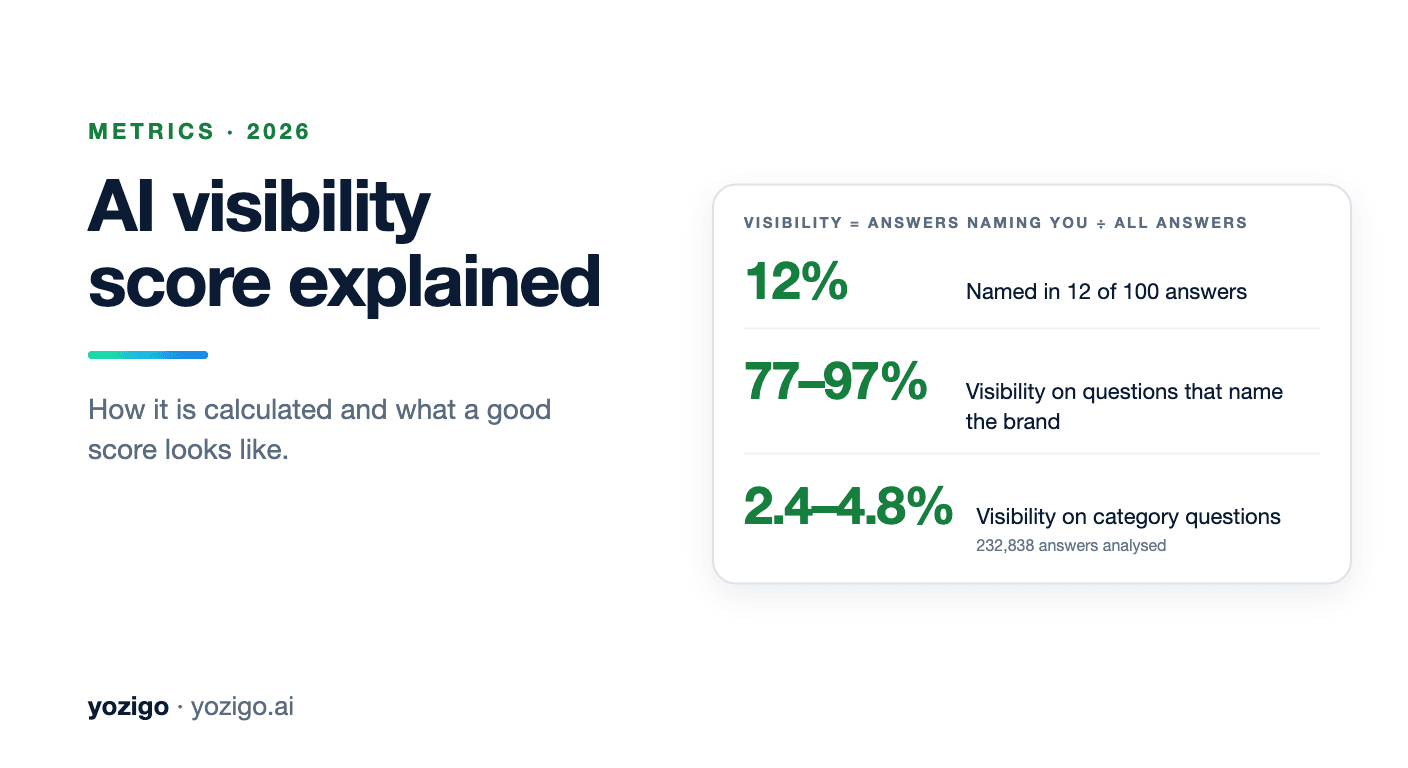
Questions that name you score 77–97% visibility and hide how category questions perform. Report them separately.
Checking one engine
ChatGPT, Gemini and Perplexity cite different sources, so a win on one rarely carries over.
Ignoring Indian third-party pages
Most citations go to third-party sites. Indian lists, directories and LinkedIn posts are where engines look for India-specific answers.
Letting pages go stale
76.4% of top-cited pages had been updated within 30 days in an Ahrefs study of about 17 million citations (Ahrefs). Refresh prices and examples monthly.
Frequently asked questions: monitoring AI visibility in India
Yes. In our data, answers recorded from India cited .in websites 7.9% of the time against 1.3% from the US, and cited LinkedIn more often. Track India as its own market.
Check a few questions by hand each week, or start with a free plan or trial. AITLAS has a free plan, and Yozigo’s 14-day trial needs no card; Yozigo Solo is $39/month (Solo) afterwards.
Consumer brands should test Hinglish questions, because answers can change by language. Most B2B buyers in India research in English.
Pages that engines already read can be cited within weeks of an update. New third-party mentions usually take longer to show up across engines.