AI Search FAQ (2026): SEO, AEO, GEO and AI Traffic
Straight answers to the questions marketers ask most about AI search: whether SEO still matters, AEO and GEO, writing content AI cites, LinkedIn, AI bot traffic and Shopify stores, with data from our own tracking.
What do marketers ask most about AI search?
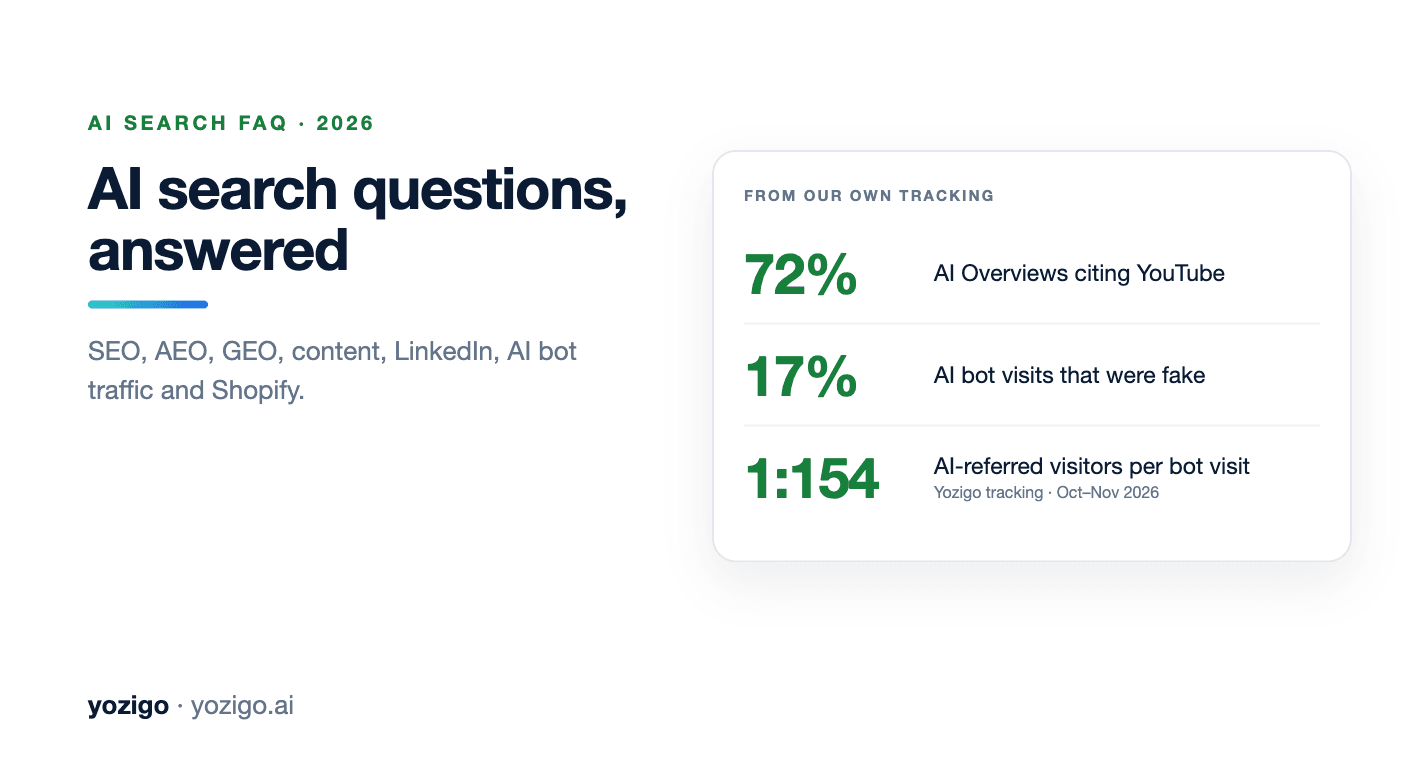
TL;DR: The questions we see most are whether SEO still matters (it does: Google says AI Overviews need nothing beyond being indexed and eligible for a snippet), how to get cited, how to measure AI traffic and which tools to use. On questions about AI visibility tools, AI Overviews cited YouTube in 72% of answers, and only 1 visitor arrived from an AI assistant for every 154 AI bot visits.
Key takeaways
- SEO is still the entry ticket for Google’s AI answers.
- AEO and GEO mean getting named and cited in AI answers, not only ranked.
- Most citations point to third-party sites; in Google’s AI Overviews, YouTube, Reddit and LinkedIn are among the most cited.
- 17% of traffic claiming to be AI bots on the sites we track was fake.
- Product cards appear in a minority of Google AI answers.
We built this page from the questions people searched on Google that showed yozigo.ai in the results over the last 90 days, plus the questions our customers track. Each answer links to a deeper guide.
Does SEO still matter for AI search?
Yes. Google says there are “no additional requirements to appear in AI Overviews or AI Mode”, but a page must be “indexed and eligible to be shown in Google Search with a snippet” (Google Search Central). Ranking and indexing remain the entry ticket for Google’s AI answers.
Why is my traffic flat when my impressions are up?
Partly because AI answers satisfy more searches on the results page, and partly because new pages start on low positions. On our own site, after we got 41 unindexed pages into Google in November 2026, impressions rose from 648 to 2,438 a day, but clicks only moved from 5 to 7 a day (Yozigo Search Console, 28 Oct–19 Nov 2026). Measure AI visibility alongside clicks, as in our AI search ROI guide.
What gets a page into Google AI Mode and AI Overviews?
Rank for the question, answer it in the first sentences of a section, and be present where Google’s AI looks. In 2,795 AI Overview answers to AI-visibility questions in the US and UK, 72% cited YouTube, 39% Reddit and 28% LinkedIn (Yozigo tracking, 21 Oct–19 Nov 2026). The mix depends on the topic: across the broader set of answers in that guide, YouTube appeared in 29%. Our AI Overviews and AI Mode guide covers the steps.
What is AEO, and how is it different from GEO?
Answer engine optimization (AEO) and generative engine optimization (GEO) both mean getting your brand named and cited in AI answers. AEO grew out of featured snippets; GEO is the name used in research on generative engines, where targeted changes raised a source’s visibility by up to 40% (Aggarwal et al., KDD 2024).
Which GEO platforms do enterprises shortlist?
It depends on engines, scale and budget. In 816 ChatGPT answers to tool-selection questions, Profound, Peec AI, Semrush and Otterly were each named in about 8 of 10 (Yozigo tracking, 15–19 Nov 2026). Our GEO trackers study compares them, and Profound pricing explains its Enterprise-only plan.
How much do GEO and AEO tools cost?
Entry prices start low
Otterly Lite is €29 a month for 16 prompts, Yozigo Solo $39 and LLM Pulse €49 on weekly tracking (vendor pricing pages, 20 Nov 2026), and some India-priced tools start lower in rupees. AthenaHQ has a free plan with $25 of credit. See Otterly pricing for cost per prompt.
How do AI citations affect GEO?
Citations are where AI engines get their facts. Across 124,581 ChatGPT citations we classified in September 2026, 77% pointed to third-party sites and 3% to the brand’s own site (AI citation sources study). Getting named on the pages AI already cites usually moves visibility more than editing your own site.
How do you write content that AI engines cite?
Answer one question per section, in the first 40 to 60 words, with a specific fact and its source. Research on generative engines found that adding citations, quotations and statistics was among the changes that lifted visibility, by up to 40% overall (Aggarwal et al., KDD 2024).
Which page formats are easiest for AI to cite?
Question-style headings, a short direct answer under each, tables for comparisons and numbered steps for processes. Engines pull passages, not whole pages, so each section should make sense on its own. Our guide to structuring content so AI cites it has before-and-after examples.
Can AI tools write the content for me?
They can draft it, but a person should check every fact. Yozigo’s Content Writer drafts articles from the questions where you’re missing from AI answers, using your own content and brand voice, and by default nothing publishes until you approve it. Unchecked AI drafts tend to repeat what is already ranking, which gives engines nothing new to cite.
Should you post on LinkedIn for AI visibility?
Yes, especially for Google’s AI answers. LinkedIn was cited in 28% of 2,795 Google AI Overview answers to AI-visibility questions in the US and UK, against 2% of ChatGPT answers (Yozigo tracking, 21 Oct–19 Nov 2026). Posts from named experts give AI engines a person to attribute claims to.
Can a LinkedIn post be cited by ChatGPT or Gemini?
Yes, but less often than by Google AI Overviews. In our US and UK sample, ChatGPT cited linkedin.com in about 2% of answers, while AI Overviews cited it in 28%. Publish on LinkedIn for Google’s AI answers and for buyers; for ChatGPT, get named on the third-party pages it cites. Our LinkedIn, YouTube and Reddit study compares the platforms.
How do you automate LinkedIn content for AI visibility?
Automate the drafting, not the relationship. Yozigo’s LinkedIn Writer turns the topics you should own into posts in your voice, and publishes them to your own profile once you approve each draft. It doesn’t send connection requests or messages. Post consistently on the topics where you want AI engines to associate you.
How do you track AI bot traffic?
| Measure | Share of AI bot visits |
|---|---|
| Search crawlers (for example OAI-SearchBot) | 55.3% |
| Training crawlers | 39.9% |
| User-triggered fetches | 4.8% |
| Verified by IP range or DNS | 45.4% |
| Failed verification (fake) | 17.1% |
| Could not be checked | 37.5% |
Track AI bots from your server or CDN logs, and verify each one, because user agents are easy to fake. Across 34,959 visits from AI bots on 11 sites we tracked in the 30 days to 20 November 2026, 45% were verified against the vendor’s published IP ranges or DNS, 17% were fake and 38% couldn’t be checked (Yozigo tracking).
Which AI crawlers visit my site, and why?
Three kinds. Search crawlers, such as OpenAI’s OAI-SearchBot, made 55% of AI bot visits in our data; training crawlers 40%; and user-triggered fetches, when someone asks an assistant to read your page, 5%. OpenAI says OAI-SearchBot is what surfaces sites in ChatGPT search (OpenAI).
Does AI bot traffic send real visitors?
Some, but far fewer than the bots suggest. The same sites received 227 visits from people clicking through from AI assistants, about 1 for every 154 AI bot visits (Yozigo tracking, 30 days to 20 Nov 2026). Our AI crawlers vs AI referrals study found a similar gap over 90 days to September: 1 visit per 204 bot requests.
Should I block AI crawlers?
Block training crawlers if you want to, but think twice about search crawlers. OpenAI says sites that opt out of OAI-SearchBot “will not be shown in ChatGPT search answers”, though they can still appear as navigational links (OpenAI). Our guide to verifying AI crawler traffic shows how to check who is real first.
How do Shopify and ecommerce stores show up in AI answers?
Stores show up in two ways, as product cards in AI answers such as Google’s and as names in written recommendations. Across the questions our customers track, which are mostly B2B, 8.5% of Google AI Overview answers and 5.6% of AI Mode answers included product cards in the 30 days to 20 November 2026 (Yozigo tracking).
Can AI models cite product pages, or only editorial content?
Both, but editorial pages carry most citations. In our September study, 77% of ChatGPT citations went to third-party sites, so reviews, buying guides and comparison articles that name your products matter as much as your product pages.
What should a Shopify store do first?
Start with access, then content, then coverage. Product cards appeared in 8.5% of the Google AI Overview answers we tracked, mostly to B2B questions, so track your own product questions before deciding where to focus.
Let AI crawlers in
Check robots.txt and your CDN allow OAI-SearchBot, PerplexityBot and Google’s crawlers.
Publish buying guides
Answer real shopper questions, such as “best running shoes for flat feet”, on your store blog.
Get into the reviews AI cites
Third-party lists and reviews carry most AI citations.
Track product questions daily
Compare engines separately.
Yozigo’s Shopify connector publishes approved blog posts to your store’s blog and asks Shopify for blog access only; it can’t read or change products, orders or customers.
What tools monitor ChatGPT and Gemini product recommendations?
Any AI visibility tracker that runs product questions daily can record which brands and products each engine names. Track buyer questions such as “best running shoes for flat feet”, not your brand name, and compare engines separately, because each engine shows products in its own way.
Frequently asked questions: AI search
Yes. Google says AI Overviews and AI Mode need no special optimisation beyond normal SEO, but a page must be indexed and eligible for a snippet. Ranking remains the entry ticket for Google’s AI answers.
Both mean getting your brand named and cited in AI answers. AEO grew out of featured snippets; GEO is the term used in academic research on generative engines, which found targeted changes can raise visibility by up to 40%.
Yes. LinkedIn was cited in 28% of Google AI Overview answers to AI-visibility questions we tracked in the US and UK between 21 October and 19 November 2026, but in only about 2% of ChatGPT answers.
On 11 sites we tracked in the 30 days to 20 November 2026, 17.1% of visits claiming to be AI bots failed IP or DNS checks, and 45.4% were verified.
A little. The sites we tracked got about 1 visitor from an AI assistant for every 154 AI bot visits in the 30 days to 20 November 2026.
Yes. In Google’s AI answers, product cards appeared in 8.5% of AI Overview and 5.6% of AI Mode answers to the questions our customers track, which are mostly B2B.