Track Your Brand in ChatGPT, Gemini & Perplexity 2026
44% of AI search prompts return zero brand mentions. This step-by-step guide shows you exactly how to monitor and improve your brand's visibility in ChatGPT, Perplexity, and Google Gemini using manual methods and automated GEO tools.
Why Is AI Search Brand Monitoring Now Essential?
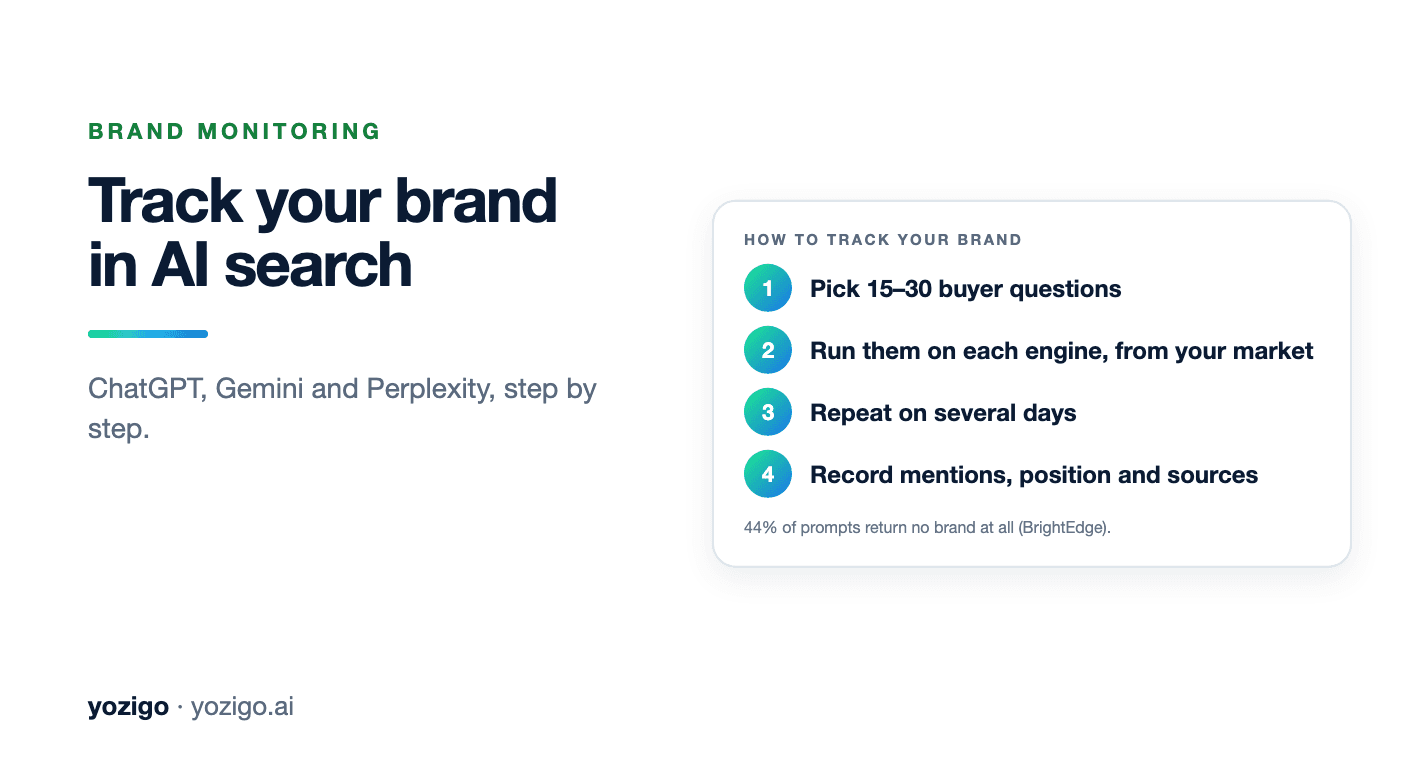
TL;DR: Track your brand in ChatGPT, Perplexity and Gemini by running the same 15–30 buyer questions on each engine, from your target market, on several days, and recording mentions, position and cited sources. BrightEdge found 44% of prompts return no brand at all, so start with unbranded category questions.
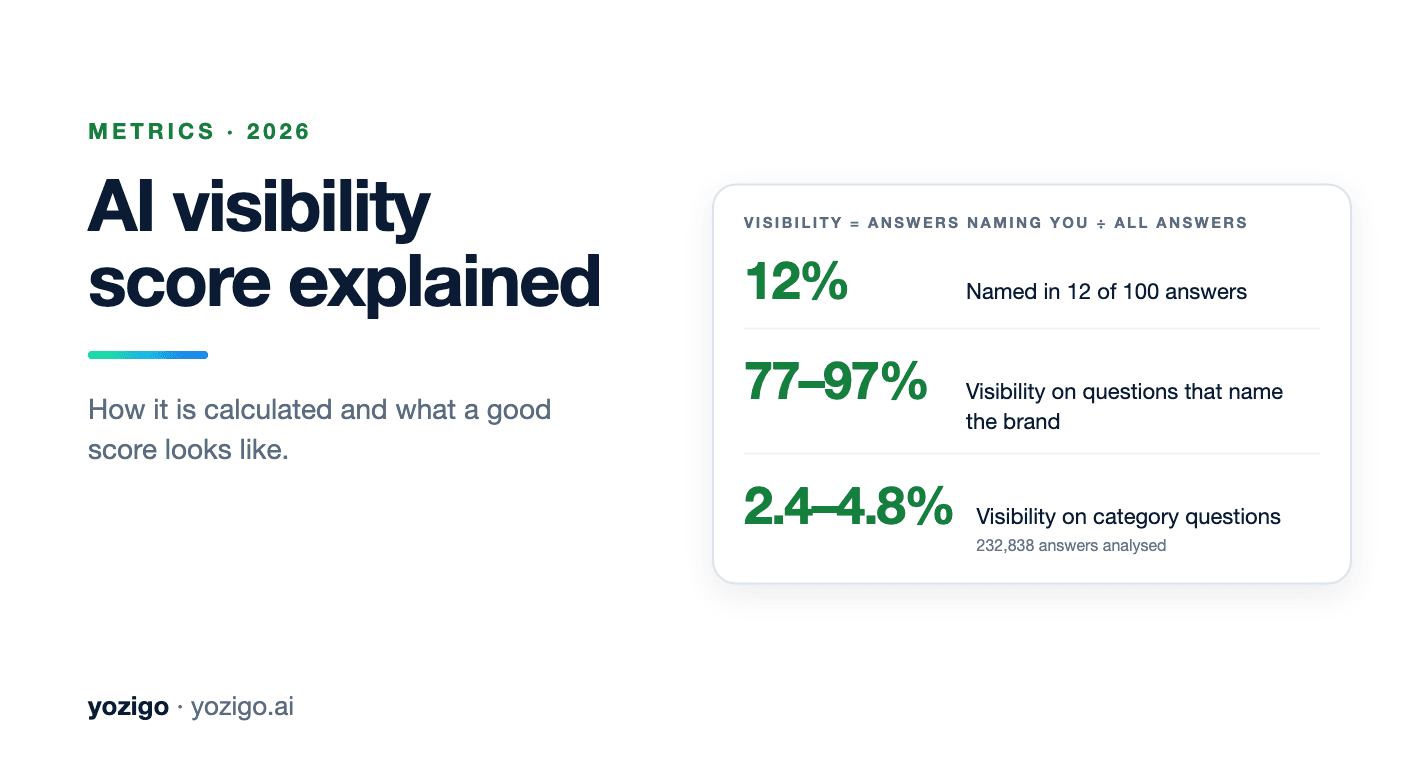
BrightEdge analysed millions of AI search responses in 2025 and found that 44% of all AI prompts return zero brand mentions — not because competitors are better, but because brands haven't optimised for AI citation (BrightEdge Research, 2025). Without a monitoring system, you can't know whether you're in that invisible 44% or not.
The measurement gap is real. Most marketing teams track Google rankings, social mentions, and press coverage. Almost none track whether their brand appears in the AI responses that 900 million weekly ChatGPT users and Perplexity’s users are reading every week. This is the largest unmonitored channel in marketing today.
The business case for monitoring is straightforward. ChatGPT referral traffic converts at 15.9%, versus 1.76% for Google organic (Seer Interactive, 2025). Every AI citation is an endorsement from a highly trusted intermediary — and that trust transfers directly to your brand. Building a monitoring system is the first step to claiming those endorsements.
This guide walks through monitoring across three core platforms: ChatGPT (dominant at 87.4% of AI referral traffic), Perplexity (fastest growing, with the highest-intent technical audience), and Google Gemini (integrated into the world's most-used search engine). Then we cover how to combine them into a unified workflow. Each engine behaves differently; our AI search trackers comparison shows how sources, answer length and brands named differ across all six, with a page per engine such as the Perplexity visibility tracker and ChatGPT visibility tracker.
How Do You Monitor Your Brand in ChatGPT?
ChatGPT's web browsing mode — available on Plus, Team, and Enterprise plans — fetches live web content to supplement its training data. When monitoring your ChatGPT brand presence, test both the browsing-enabled mode (web search on) and the default mode (training data only). The results reveal two different gaps: training data gaps and live retrieval gaps.
Manual monitoring method
Create a spreadsheet with your top 20–30 customer queries — the exact questions your buyers type into Google or ask a colleague. For each query, paste the text into ChatGPT with web browsing enabled and note: (1) Is your brand mentioned? (2) Is it cited as a source? (3) Which competitors are cited? Run this audit monthly and track changes over time.
ChatGPT citations appear as numbered footnotes (¹, ², ³) with source links. A mention without a citation means ChatGPT knows your brand exists but doesn't yet trust it enough to cite as a primary source — this is the gap GEO optimization closes. A citation means ChatGPT pulled content from your site and presented it as an authoritative answer.
Automated monitoring with Yozigo
Yozigo's AI Search Monitoring module runs your query set against ChatGPT, Perplexity, Gemini, and Google AI Overviews daily and aggregates results into a single dashboard. Instead of 30 manual queries per week, you get automated alerts when your brand's citation rate changes, competitor mentions spike, or a new query type emerges where you have zero presence.
How Do You Track Your Brand in Perplexity?
Perplexity reported 100 million search queries a week as early as October 2024 (TechCrunch, 2024), and it is popular with developers, researchers and tech professionals. Its audience is disproportionately high-intent — people using Perplexity are actively researching a topic — which makes it the highest-value audience for B2B SaaS, fintech, and enterprise software brands.
Perplexity's citation model is more transparent than ChatGPT's. Every response lists its sources in a sidebar, and you can click through to the original content. This makes auditing easier — you can see exactly which pages Perplexity is citing for your target queries, and which competitors appear in those source lists.
Manual monitoring method
Open Perplexity.ai in 'Focus: All' mode and run each of your target queries. For each response: check the source panel — is your site listed? Read the response — is your brand mentioned? Click into the sources — are your pages being cited for their key insights? Export source URLs monthly to track which of your pages are performing.
Perplexity-specific optimisation
Unlike ChatGPT, Perplexity explicitly rewards recently updated content. Pages with clear publication dates are cited more frequently. Perplexity also favours direct, factual writing over conversational prose. Consider adding a 'Quick Summary' section at the top of each page — a 150-word factual summary designed specifically for AI extraction.
How Do You Monitor Your Brand in Google Gemini?
Google Gemini's integration into Search means your Gemini visibility and your traditional SEO performance are now directly linked. Google AI Overviews — powered by Gemini — appear in about 25% of searches (Conductor, 2026) and pull content from the pages Google has indexed. But appearing in a traditional result doesn't guarantee you'll be cited in the AI Overview above it.
Google Search Console is your first tool for Gemini monitoring. The Performance report includes an 'AI Overviews' filter that shows which queries triggered an AI Overview containing your page, how many impressions that generated, and the resulting clicks. For most sites, AI Overview appearances drive significant impression volumes but lower click-through rates — because the AI answer often satisfies the query without a click. The exact filters to apply are in our Search Console and Bing AI visibility playbook.
Manual monitoring for Gemini
Search your target queries in Google Chrome and look for AI Overviews. When one appears, check: Is your brand mentioned? Is there a 'more' or 'see sources' link pointing to your page? Is a competitor cited where you're not? Document findings in your monthly monitoring spreadsheet alongside ChatGPT and Perplexity results.
Gemini-specific optimisation
Google AI Overviews heavily favour pages with FAQPage schema, HowTo schema, and clear hierarchical heading structure (H1 → H2 → H3). If you've been following standard SEO best practices for structured data, your Gemini visibility foundation is already in place — the incremental work is ensuring your content directly answers the queries that trigger AI Overviews for your target topics.
How Do You Optimise Your Website for Perplexity Citations?
Perplexity cites sources using a real-time retrieval mechanism: it searches the live web and then synthesises an answer from retrieved pages. Your Perplexity citation performance is primarily a function of two things: whether your pages appear in its web search results, and whether your content is structured so Perplexity's synthesis model can extract and quote it.
The most effective optimisation for Perplexity citations is what practitioners call Passage-Level Answering — structuring your content so every H2 section contains one self-contained, 50–80 word passage that fully answers the section's question. This mirrors Perplexity's extraction model, which pulls passages rather than full pages. A well-structured page gives Perplexity pre-assembled quotable blocks.
Perplexity also prioritises pages with high credibility signals: HTTPS, fast load times under 2.5 seconds, no intrusive popups, and no cookie consent barriers blocking content. Its crawler treats any friction between the user's query and the page content as a quality signal failure. Audit your Core Web Vitals before optimising text.
The recency factor matters more for Perplexity than any other AI search platform. Perplexity explicitly labels source dates and prefers content published or updated within the last 6–12 months. Create a quarterly content refresh calendar and prioritise updating your highest-traffic pages with current statistics, examples, and dates. A 2024 page updated in March 2026 will consistently outperform a static 2024 page in Perplexity citations.
How Do You Build One AI Search Monitoring System?
A practical AI search monitoring system for most SMBs consists of three layers: a query bank (the 30–50 most important questions your customers ask), a weekly manual testing protocol (rotating through 10 queries per week across ChatGPT, Perplexity, and Gemini), and a monthly automated report from a dedicated GEO monitoring tool.
To build your query bank
start with your Google Search Console top 50 queries. Add your top sales call questions — the literal words prospects use. Add competitor brand names plus your own. Add category queries like 'best [product category] tool for [use case]'. This gives you a 40–60 query set representing your competitive landscape in AI search. Our guide to finding the right AI prompts to track covers the sourcing method in detail.
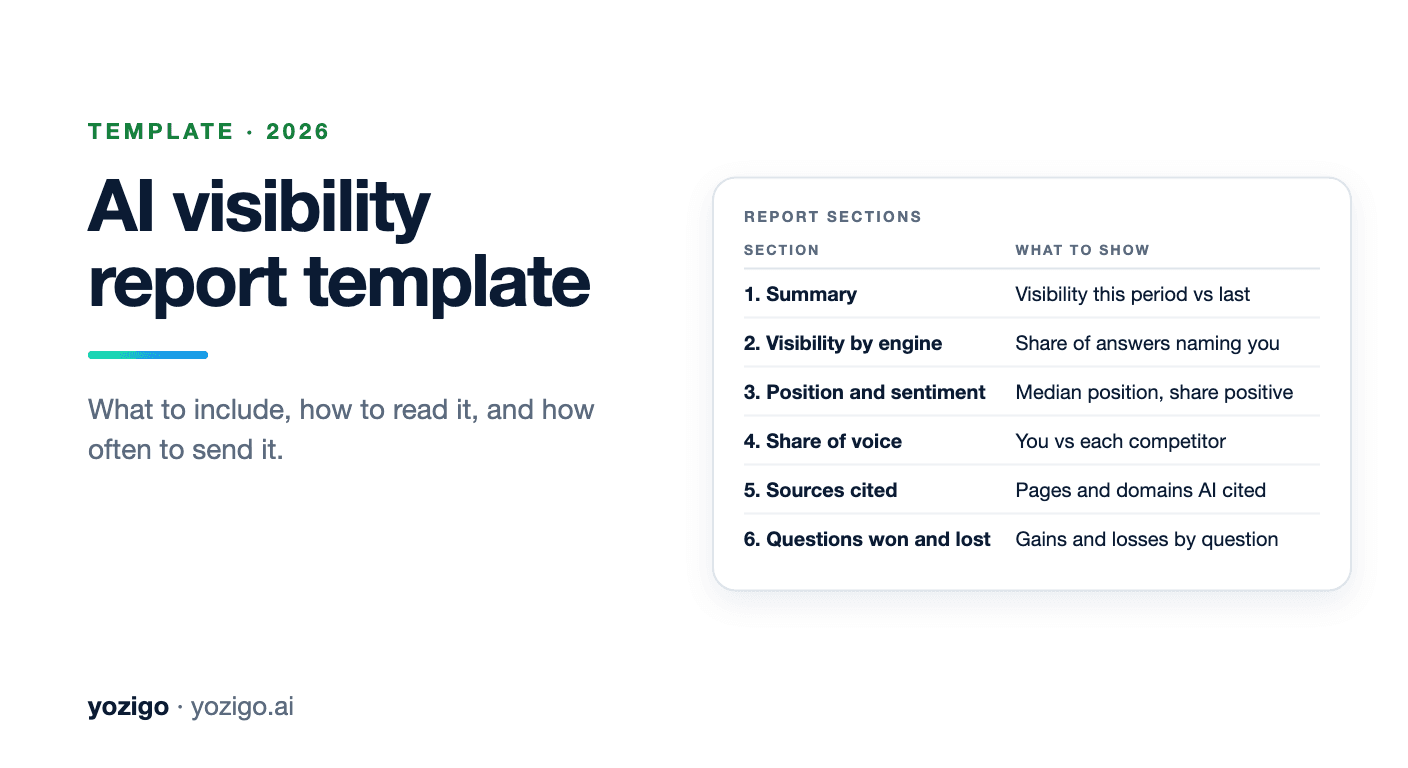
For the manual testing layer, create a shared Google Sheet with columns: Date, Platform, Query, Brand Mentioned (Y/N), Brand Cited (Y/N), Competitor Mentioned, Notes. After three months, you'll have enough data to identify patterns — which query types you dominate, which you're invisible in, and where your competitors have an AI search advantage.
For automated monitoring at scale, Yozigo's AI monitoring dashboard runs your entire query bank daily across all major AI platforms and surfaces alerts when your visibility changes. Its Citation Journey feature shows not just whether you're cited, but which specific pages are being pulled and which content sections are quoted most often — giving your content team precise editing instructions. Once you know which sections are being skipped, the eight writing mistakes that block AI citation explains why, and what to change.
To automate this, Yozigo runs your prompts daily across six AI engines and shows every page they cite; see what the platform tracks, connect Google Search Console and Bing Webmaster Tools so your prompts reflect real demand, and start with the 14-day free trial.
Frequently Asked Questions: AI Search Brand Tracking
Run a full manual audit monthly across all three platforms (ChatGPT, Perplexity, Gemini). Use an automated tool like Yozigo to get daily alerts for significant visibility changes. Weekly manual spot-checks of your 10 most competitive queries are sufficient for most SMBs between full audits.
Google Alerts monitors the traditional web and news but does not track AI-generated responses. It won't notify you when ChatGPT or Perplexity mentions your brand in a response. You need either a dedicated GEO monitoring tool or a manual checking protocol to capture AI mentions. The same blind spot applies to rank trackers — see AI visibility tools vs traditional SEO tools.
A mention without a citation means AI engines know your brand exists but don't yet trust your content as a primary source. The fix is structural: improve your content's answer-first formatting, add cited statistics, and build more referring domains from credible third-party sites. Most brands see citation rates improve within 60–90 days of targeted GEO work.
If your site develops technical issues — slow load times, broken pages, thin content — AI systems will reduce their reliance on it as a citation source. There's no formal deindex process as with Google, but sustained quality signals over time determine how frequently AI systems trust and cite your content.
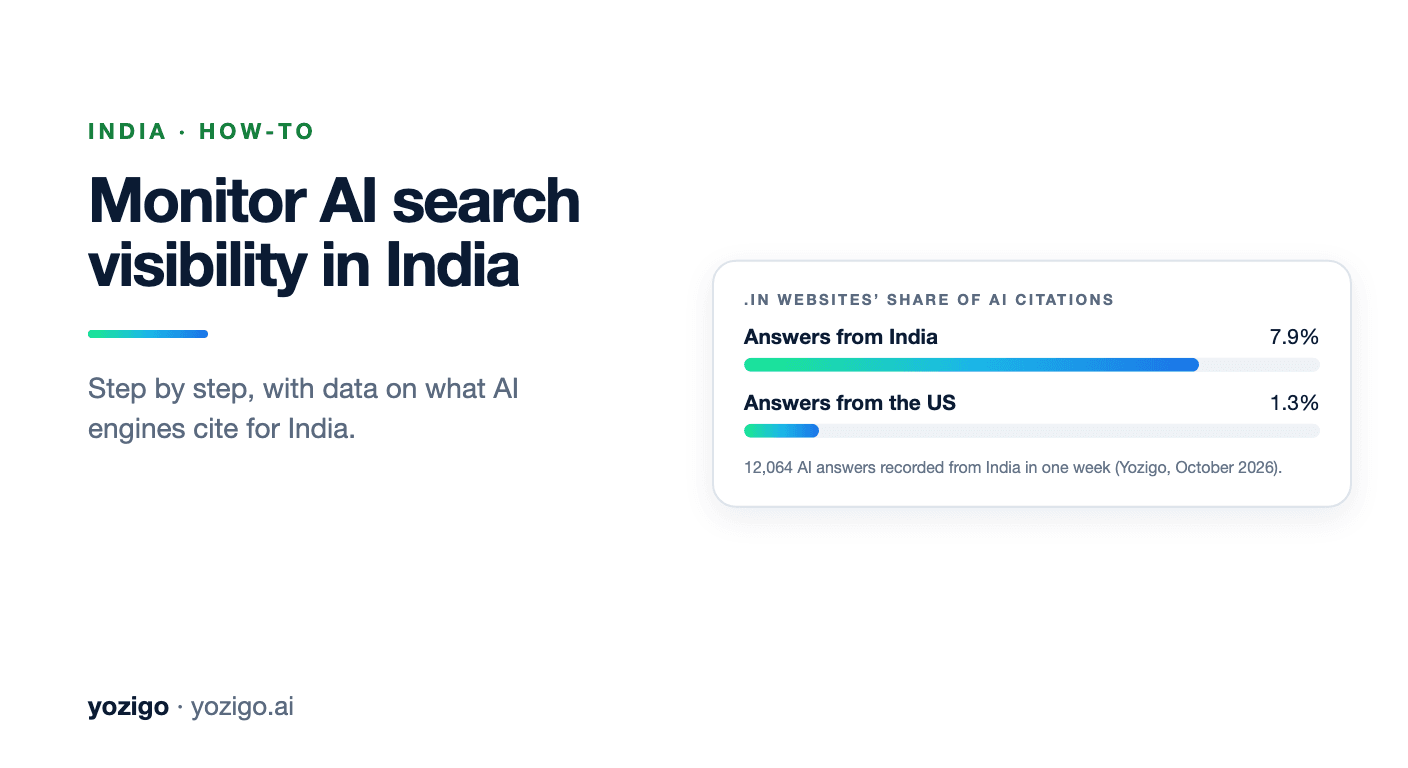
Run your query tests from IPs in each target region using a VPN, or use a GEO monitoring tool with geo-targeted query simulation. AI responses vary significantly by region — a brand dominating AI search in the US may be invisible in India for the same query, because the AI's web retrieval layer returns geographically different pages.